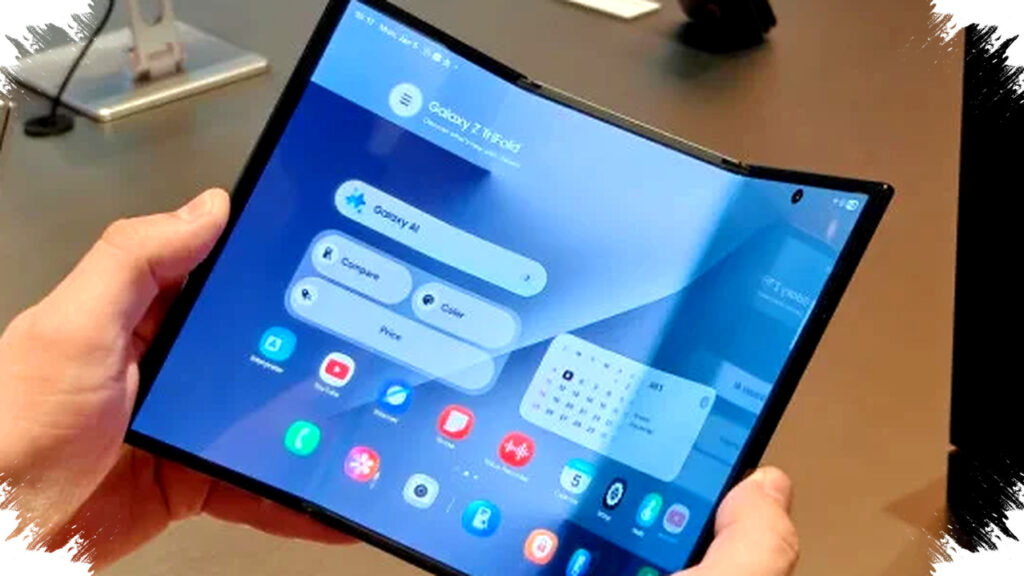
Samsung’s Galaxy Z TriFold has reportedly ceased domestic shipments in South Korea as of March 17, 2026. This move signals a critical turning point for the ambitious triple-fold smartphone, which has struggled to secure a foothold in the competitive foldable market. Industry insiders reveal that the device, priced at around $2,900, was more of a technological showcase than a long-term commercial product.
The Galaxy Z TriFold was unveiled at the end of 2025 with a revolutionary dual-hinge design. This mechanism allowed the device to transform from a regular smartphone into a full-sized tablet. Despite the innovation, Samsung decided to halt new stock distribution abruptly, prompting questions about the device’s viability and the company’s broader foldable strategy.
Production Complexities and Pricing Challenges
The main factor driving Samsung to stop shipments is the high manufacturing cost associated with the complex triple-fold design. Unlike standard foldables, the Z TriFold requires exceptionally precise hinge components, which add to production difficulties. Although the flagship was introduced at a steep price of $2,900, profit margins remained thin due to these technical challenges.
Consumers in the United States have experienced similar scarcity issues. Official channels frequently report limited stock availability, forcing buyers to resort to secondary markets such as eBay. Here, used Galaxy Z TriFold units have seen soaring prices, becoming collector’s items because of their rarity. This phenomenon underscores how supply constraints can paradoxically increase a product’s market value in the resale arena.
Market Reception: Innovation versus Practicality
Samsung’s Galaxy Z TriFold aimed to push the boundaries of mobile design by offering a larger, tablet-like display in a compact form factor. However, the device’s complexity and cost served as significant barriers for mass adoption. Market analysts believe Samsung’s strategy was never to flood the market with millions of units but rather to demonstrate technical prowess and test consumer appetite for radical foldable innovations.
The early discontinuation fuels speculation that Samsung is reevaluating its approach to foldable devices. While the Galaxy Fold and Flip series continue to enjoy broader market penetration, the TriFold appears to have been a high-risk experiment with limited commercial intent. This approach exposes the difficulties manufacturers face in balancing groundbreaking design with production scalability and consumer affordability.
Industry Impact and Future Prospects
The halt of Galaxy Z TriFold shipments is a notable case study in the evolution of foldable technology. It highlights that pioneering form factors require not only engineering feats but also alignment with market readiness and cost efficiency. Samsung’s decision to stop distributing the TriFold domestically suggests lessons learned for both the company and its competitors.
For now, Samsung has not announced any official plans regarding a successor to the Galaxy Z TriFold. The company seems to be focusing on refining existing foldables while monitoring technological advancements. The next generation of foldable devices may incorporate innovations from the TriFold’s design without repeating its logistical and financial hurdles.
Key Points on Galaxy Z TriFold’s Discontinuation
- Samsung ceased domestic shipments in South Korea starting March 17, 2026.
- The $2,900 device faced high production costs due to its triple-hinge design.
- U.S. markets suffer stock shortages, driving up resale prices significantly.
- The device functioned more as a technology showcase than a mass-market product.
- Samsung has not confirmed plans for a second-generation model.
The Galaxy Z TriFold episode illustrates the experimental nature of foldable smartphones. It reflects the tension between innovation ambitions and commercial practicality in a fast-developing segment. Enthusiasts and industry watchers will continue to observe how Samsung and others navigate these challenges to define the future of flexible mobile technology.