


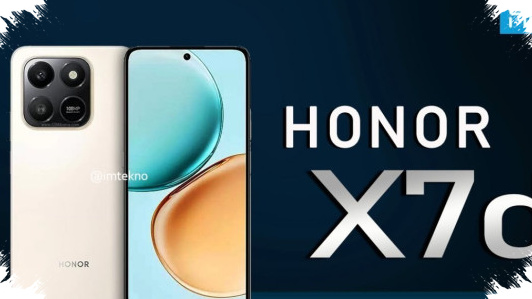
Honor has officially launched the X7D as a new entry in the affordable smartphone segment, targeting users who want durability, long battery life, and generous storage instead of raw benchmark numbers. In Indonesia, the phone sits in the roughly $185 to $245 range, positioning it as a practical option for buyers who usually worry about cracked screens, fast battery drain, and full memory.
The device arrives with a clear message: it is built to reduce everyday hassle. Honor pairs a reinforced body, a large 6,500 mAh battery, and a 108MP camera with a software layer that leans heavily on AI tools, making the X7D one of the more interesting lower-midrange launches in recent months.
A tougher body for daily use
Honor does not frame the X7D as a performance-first phone. Instead, the company focuses on physical durability, which has become a major selling point in the budget segment where many users care more about repair costs than speed.
The phone carries SGS Premium Drop Resistance certification with Five Star protection and Cushioning 2.0 architecture. It also comes with an IP65 rating, which means it has protection against dust and low-pressure water jets, while the Wet Touch feature keeps the screen usable even when a user’s hands are wet.
The design still tries to look premium despite the price class. Honor uses black and gold color options, along with a camera module that gives the phone a more expensive appearance. The frame may still rely on polycarbonate to keep costs down, but the overall build strategy clearly prioritizes resilience over luxury materials.
Display stays smooth, even with basic panel tech
The X7D uses a 6.77-inch display with a 120Hz refresh rate, which should make scrolling feel smooth during daily use. Honor also claims peak brightness can reach 880 nits, giving the screen a better chance of staying readable outdoors.
There is a trade-off here, however, because the display uses a TFT panel and HD+ resolution. That decision may sound modest in 2026, but it helps Honor keep power consumption lower and the final price more accessible.
For users who mainly browse social media, chat, stream video, and use light apps, the screen setup is still practical. The limitations will be more noticeable for people who care about color accuracy, sharpness, and deeper contrast, especially when compared with AMOLED rivals.
AI Button adds quick access to smart tools
One of the more unusual features on the Honor X7D is a dedicated AI Button. With a long press, users can jump into functions such as AI Eraser, AI Translate, and AI Subtitle, which are designed to make photo editing and communication faster.
The phone also comes with Gemini AI integration and runs Magic OS 9.0 based on Android 15. This puts the X7D in line with current software trends, especially as more brands try to make AI features feel useful on affordable devices rather than just premium flagships.
Honor also backs the phone with a large 512GB internal storage option and 8GB of RAM, which can be expanded virtually up to 16GB through RAM Turbo. That amount of storage is especially relevant for users who keep many photos, videos, and downloads on one device.
Key software and memory highlights
- Magic OS 9.0 based on Android 15
- Google Gemini AI integration
- AI Button for quick access to smart features
- 512GB internal storage
- 8GB RAM with virtual expansion up to 16GB
That storage capacity is one of the strongest selling points in this class. For many buyers, it removes one of the most common frustrations of entry-level phones, which is constantly deleting files to make room for new apps or photos.
Snapdragon 685 returns to the spotlight
Honor powers the X7D with the Snapdragon 685, a chipset that first appeared in 2022. The processor is not new, and it will not attract buyers looking for top-end gaming performance, but it is designed for stable everyday use.
Based on the reference performance data, the phone reaches around the 500,000 range in AnTuTu testing. That places it firmly in the mainstream budget category, where the emphasis is usually on efficiency rather than heavy multitasking or demanding graphics.
For games, the chipset is enough for popular titles like Mobile Legends at 60 fps and PUBG Mobile at around 40 fps. More demanding games such as Genshin Impact are a different story, since the phone is expected to run them only on the lowest settings, with occasional frame drops.
This makes the X7D a better fit for casual users than mobile gamers. It should handle everyday tasks, streaming, messaging, and light entertainment without much trouble, but it is not built to compete with performance-focused phones in the same price band.
6,500 mAh battery is the main attraction
The biggest headline feature on the Honor X7D is its 6,500 mAh battery. Honor uses a double-cell structure to fit that large capacity into a body that is still only 8.24 mm thick.
That combination matters because huge batteries often lead to bulky phones, but the X7D tries to avoid that problem. In testing referenced by the source, the device reportedly lasted 21 hours and 50 minutes in PC Mark battery testing, which is a strong result for a handset in this segment.
Honor also says the battery is built to hold up for up to five years of use. That claim will depend on charging habits and daily usage patterns, but it signals that the company is targeting buyers who want a phone that stays reliable over time.
The charging speed is less impressive, though. The device supports 35W fast charging, so filling such a large battery will still take some time. Users who value longevity will likely accept that trade-off, but it is still an important detail for anyone used to faster charging speeds.
Camera setup focuses on practical tools
Honor equips the X7D with a 108MP main camera, which should give users enough resolution for social media posts, casual photography, and everyday documentation. The setup appears to lean on a primary lens rather than a more advanced multi-camera system, so the overall imaging experience will depend heavily on software processing.
To make the camera system more useful, Honor adds AI features such as AI Open Eye, which can help fix photos where someone blinked, and AI Outpainting, which expands background areas in an image. These tools are clearly meant to improve the real-world value of the camera without raising hardware costs too much.
For the target audience, that may matter more than having multiple secondary lenses. Many budget buyers want dependable photos and simple editing shortcuts, not a complicated camera array that adds little practical value.
Positioning and market appeal
Honor appears to be aiming the X7D at users who want a stress-free phone for daily life. The formula is straightforward: durable body, long battery life, large storage, and enough performance for routine tasks.
That approach puts the X7D in a crowded segment, but it also gives the phone a clearer identity than many low-cost models that try to chase benchmark results. With its mix of shock resistance, water protection, AI tools, and a massive battery, the phone is designed to reduce the common headaches that buyers often face after a few months of use.
For shoppers comparing phones in the roughly $185 to $245 window, the Honor X7D stands out as a practical choice for people who value endurance, storage, and durability more than speed, while still getting a modern software package and a large 120Hz display for everyday use.