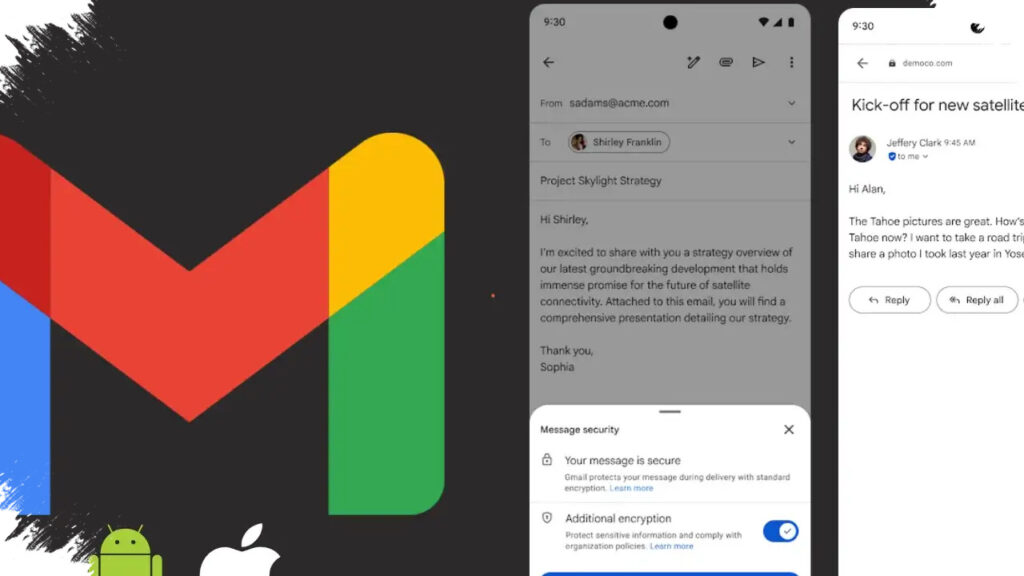
Google has expanded Gmail security on mobile by adding native end-to-end encryption support in the Gmail app for Android and iOS. The update lets eligible users write, send, and read encrypted emails directly on their phones without relying on third-party tools or switching to a browser.
This move closes a key gap between Gmail’s desktop and mobile experience. Until now, the stronger encryption option was mainly available on the web, while mobile users had fewer built-in protections for highly sensitive messages.
What changed in Gmail mobile
Google is now bringing end-to-end encryption, or E2EE, directly into the Gmail app. That means the message content stays protected from the moment it leaves the sender’s device until it reaches the intended recipient.
In practical terms, even Google cannot read the message body while it is encrypted. Only the sender and the authorized recipient can access the content, which makes the feature especially useful for confidential business communication.
The company says the feature works natively inside Gmail on Android and iOS. Users no longer need to install extra software or use a separate encrypted email app to send sensitive information.
How the encrypted email flow works
When a user composes a new email, they can tap the lock icon and choose the additional encryption option before sending. If both sender and recipient use Gmail within the supported setup, the email arrives in the inbox with the extra protection already applied.
If the recipient does not use Gmail, Google does not block the message. Instead, it sends a secure link that opens in a web browser, allowing the person to read and reply safely without creating a Gmail account.
That design matters because email communication often crosses different platforms. By keeping the process accessible, Google tries to balance stronger privacy with practical usability for business users.
Who can use it right now
The rollout is not available to everyone yet. Google currently limits access to Google Workspace Enterprise Plus customers, and even then only for organizations that also have the required Assured Controls or Assured Controls Plus add-on.
There is another layer of control on the admin side. IT administrators must enable Android and iOS access through the client-side encryption interface before users can start using it on mobile devices.
That restricted release suggests Google is aiming first at large organizations that handle regulated or highly sensitive data. For those companies, mobile encryption can reduce risk when employees work outside the office or on personal devices.
Why this matters for Gmail security
Email remains one of the most common tools for business communication, but it also remains a frequent target for interception, phishing, and data exposure. Native E2EE on mobile makes it harder for unauthorized parties to read confidential content if a message is intercepted in transit.
The timing also reflects a broader push in the tech industry toward stronger default privacy controls. Google first introduced the desktop version of Gmail encryption support in April 2025, and the mobile rollout now extends that protection to the devices people use most often.
For many companies, that is the missing piece. Workers increasingly handle documents, contracts, approvals, and internal discussions from their phones, so a desktop-only security model no longer fits how modern teams operate.
Key points for users and IT teams
- The feature is built directly into Gmail for Android and iOS.
- Users can activate it from the compose screen using the lock icon.
- Recipients outside Gmail can still access encrypted mail through a secure web link.
- Access is limited to Google Workspace Enterprise Plus customers with specific add-ons.
- IT admins must turn on mobile access before employees can use it.
How this compares with enterprise email trends
Google’s update also strengthens its position against rivals in the enterprise software market. Microsoft 365 and other business platforms already compete heavily on compliance, security, and admin controls, so Gmail’s mobile E2EE support helps narrow one of the more visible gaps.
The feature also shows how encryption is moving from a specialist tool to a mainstream expectation. Businesses now want secure messaging that works smoothly on phones, tablets, and desktops without forcing employees into complicated workflows.
For Android and iPhone users inside supported Workspace organizations, the new Gmail setup adds an important layer of protection while keeping email easy to use. As more companies adopt mobile-first work habits, the demand for secure communication tools that work natively on smartphones will likely continue to grow.