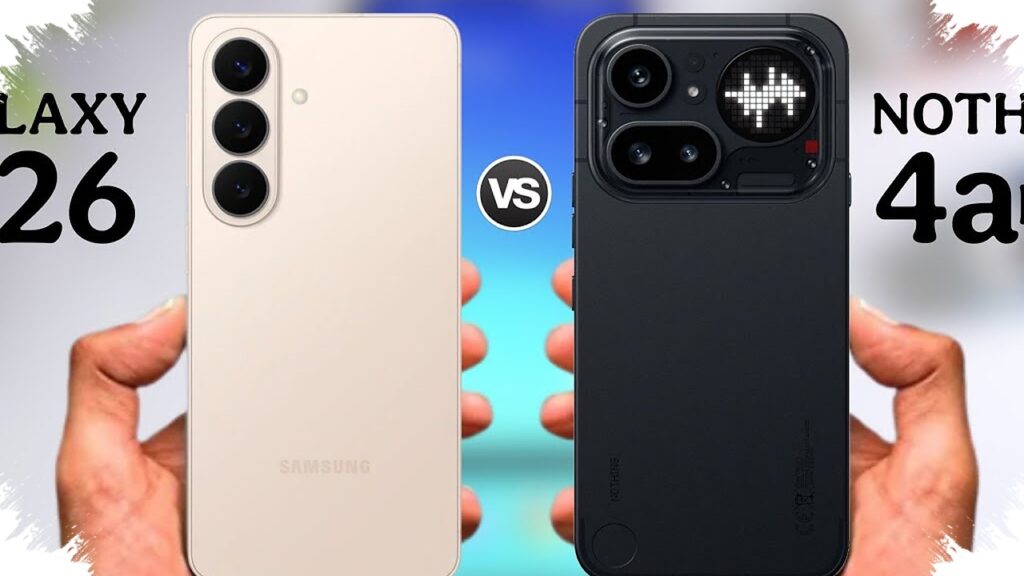
Samsung Galaxy S26 and Nothing Phone (4a) Pro sit in very different price tiers, but they still overlap in the areas that matter most to buyers. That makes this comparison less about brand loyalty and more about whether a mature flagship or an ambitious midrange phone gives better real-world value.
Samsung’s Galaxy S26 is built for users who want a premium device that feels complete from day one. Nothing’s Phone (4a) Pro, meanwhile, tries to challenge that idea with distinctive design, strong battery life, and standout features usually reserved for more expensive phones.
Two phones, two very different priorities
The Galaxy S26 leans into durability and polish. It uses Gorilla Glass Victus 2 on the front and back, paired with an Armor Aluminum 2 frame and IP68 protection, which puts it ahead in long-term resilience and water resistance.
The Nothing Phone (4a) Pro takes a more expressive route. Its unibody aluminum design and mini-LED Glyph Interface give it a unique look that stands out immediately, but its IP65 rating is not as robust as Samsung’s flagship-level sealing.
That gap matters for buyers who keep phones for years or use them in harsher conditions. A premium build often does not change daily performance, but it can change how confidently a phone survives long-term use.
Display quality versus display speed
Both phones aim to deliver a screen that feels premium for media and gaming. The Galaxy S26 uses a Dynamic AMOLED LTPO panel with HDR10+, which should produce balanced colors, strong contrast, and efficient adaptive refresh behavior.
Nothing’s Phone (4a) Pro pushes harder on motion smoothness with a larger AMOLED display and a 144Hz refresh rate. For scrolling, social feeds, and fast-paced games, that higher refresh rate can feel more fluid and responsive.
- Galaxy S26: better color consistency, premium tuning, LTPO efficiency.
- Nothing Phone (4a) Pro: larger display, 144Hz refresh rate, smoother motion.
For many users, the better display is not the one with the highest number on the spec sheet. It is the one that fits their habits, and that depends on whether they value visual refinement or sheer smoothness.
Performance is where the gap becomes obvious
Samsung equips the Galaxy S26 with a flagship-class chipset such as the Snapdragon 8 Elite Gen 5 or Exynos 2600, depending on the market. That places it firmly in the top tier for gaming, multitasking, AI processing, and sustained performance under pressure.
Nothing uses the Snapdragon 7 Gen 4 in the Phone (4a) Pro, and that choice keeps the device efficient and cost-conscious. It remains suitable for everyday tasks, but it does not match the raw speed, thermal headroom, or long-term performance stability of Samsung’s flagship chip.
This difference matters more over time than at launch. As apps become heavier and AI features expand, the Galaxy S26 should stay fast for longer, while the Nothing Phone (4a) Pro will likely feel its limits sooner.
Battery strategy reflects the price gap
Nothing seems to prioritize endurance and charging convenience. The Phone (4a) Pro uses a larger battery and supports 50W fast charging, which should appeal to users who want quick top-ups and less dependence on a charger throughout the day.
Samsung takes a more balanced approach with a smaller battery and 25W charging. It does not lead in charging speed, but it adds wireless charging and reverse wireless charging, which are valuable extras in a premium ecosystem.
That creates a clear trade-off. Nothing offers the more aggressive battery spec on paper, while Samsung offers the more flexible charging package in daily life.
Camera hardware shows Samsung’s broader ambition
The Galaxy S26 carries a more complete camera system, with a 50MP main sensor, telephoto lens with OIS, and a stable ultra-wide camera. It also supports 8K video recording and HDR, which makes it more suitable for users who care about consistent photo and video performance.
Nothing’s Phone (4a) Pro is not without highlights. Its 50MP periscope camera with 3.5x optical zoom is unusual at this price level, and that alone can make it attractive to camera shoppers who want more reach without moving into flagship pricing.
Still, Samsung appears stronger overall in camera balance. The Nothing phone may impress in zoom shots, but the Samsung device looks more dependable across the full range of shooting conditions, especially for video and ultra-wide use.
For selfie and front-camera use, the difference is more nuanced:
- Nothing Phone (4a) Pro: 32MP front camera, higher resolution for detail.
- Galaxy S26: 12MP front camera with autofocus and 4K video, better for consistency.
That makes Samsung the safer choice for creators who need stable results across selfies, calls, and front-facing video.
Price and value decide the final answer
Samsung Galaxy S26 is priced around ₹88,000, or about $900, which places it squarely in premium flagship territory. Nothing Phone (4a) Pro is expected to sell at a much lower price, making it far more accessible for buyers who want high-end features without flagship spending.
Samsung justifies the higher cost with seven years of software support, premium materials, stronger water resistance, Samsung DeX, and a more powerful chipset. Nothing counters with design originality, a larger battery, a periscope camera, and a much lower entry price.
The more rational choice depends on what “value” means to the buyer. If value means long-term confidence, performance headroom, and a richer feature set, the Galaxy S26 is the stronger case. If value means getting interesting hardware and modern features at a lower cost, the Nothing Phone (4a) Pro makes a compelling argument.
For buyers who want a phone that feels fully future-proof and ready for years of heavy use, Samsung remains the safer bet. For buyers who want something different, stylish, and surprisingly ambitious without paying flagship money, Nothing’s midrange approach may be the smarter purchase.