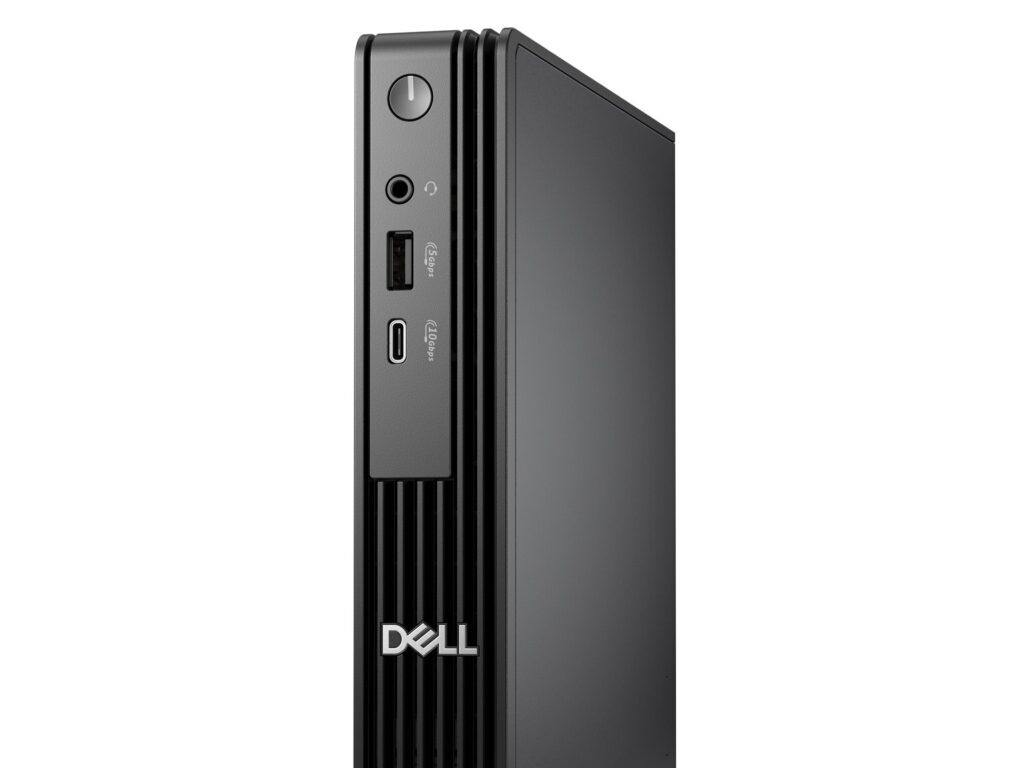
Dell has officially introduced the Pro 5 Micro, a compact mini PC aimed at professionals who need serious performance in a very small footprint. The device stands out because it uses Intel’s latest Panther Lake platform, signaling Dell’s focus on balancing speed, efficiency, and enterprise-grade manageability in a tiny desktop form factor.
Despite its size, the Pro 5 Micro is built for demanding office workflows, hybrid work setups, and business environments that need flexible deployment. With dimensions of 182 x 36 x 178 mm, a volume of about 1.2 liters, and a weight of roughly 2.42 pounds, it can fit almost anywhere without crowding a desk.
A compact design built for flexible office layouts
Dell is targeting users who want a machine that is easy to place and simple to integrate into existing workspaces. The Pro 5 Micro can be mounted under a desk, attached to a wall, or paired with an all-in-one stand alongside a monitor.
That flexibility matters in modern offices where space is limited and cable management is important. In shared work areas and hybrid setups, a small footprint can improve both appearance and practicality.
Two business-class processor options
Dell offers two processor choices for the Pro 5 Micro: the Intel Core Ultra 5 335 vPro and the Intel Core Ultra 7 366H vPro. Both are designed for multitasking, business applications, and responsive performance under heavier workloads.
The vPro platform adds an important layer for security and device management. For companies, that means easier fleet monitoring, policy enforcement, and remote support across multiple systems.
Key specifications at a glance
- Processor: Intel Core Ultra 5 335 vPro or Intel Core Ultra 7 366H vPro
- Memory: up to 64GB DDR5 at speeds up to 7200MT/s
- Storage: up to 2TB across two M.2 Gen 4 SSD slots
- Display support: up to five monitors at once
- Wireless: Wi-Fi 7
- Front ports: USB 3.2 Gen 1 Type-A, USB 3.2 Gen 2 Type-C, universal headset jack
- Rear ports: HDMI 2.1, DisplayPort 1.4a, Ethernet, USB 2.0, USB-C with 100W Power Delivery and DisplayPort Alt Mode
The combination of large RAM capacity and dual SSD support makes the system suitable for more intensive tasks. Data work, creative production, and heavy multitasking should all benefit from the stronger configurations.
Why multi-monitor support matters
One of the standout features of the Pro 5 Micro is support for up to five displays. That capability is especially useful for data analysts, developers, editors, and professionals who need to track multiple windows at the same time.
A multi-monitor setup can improve workflow efficiency because users spend less time switching between applications. In business settings, that can turn a compact PC from a simple desktop replacement into a small but capable workstation.
Connectivity aimed at modern work
Dell also equips the Pro 5 Micro with a broad set of connectivity options. The rear USB-C port supports 100W power delivery and display output, while Ethernet remains available for environments that still depend on wired stability.
Wi-Fi 7 further strengthens its position as a modern business machine. As hybrid work and cloud-based tools become more common, fast wireless connectivity has become a key productivity factor rather than just a convenience.
Pricing places it in the premium mini PC segment
Dell lists the Pro 5 Micro at several price points depending on configuration. The base model with the Intel Core Ultra 5 335 vPro starts at $1,273 without accessories, while a bundle including a keyboard, mouse, Windows 11 Pro, and Wi-Fi 7 rises to about $1,409.
The higher-end version with the Intel Core Ultra 7 366H vPro is priced at around $1,691. In the mini PC market, that puts the Pro 5 Micro firmly in premium territory, but the pricing matches its business-focused hardware and enterprise features.
Competition in the mini PC space is also intensifying, with rivals such as the Minisforum Elite M1 Lite and GMKtec NucBox K17 offering different combinations of processors and storage capacity. Dell’s advantage remains its enterprise reputation, vPro support, and the appeal of a compact system that is designed to handle demanding work without taking up valuable space.