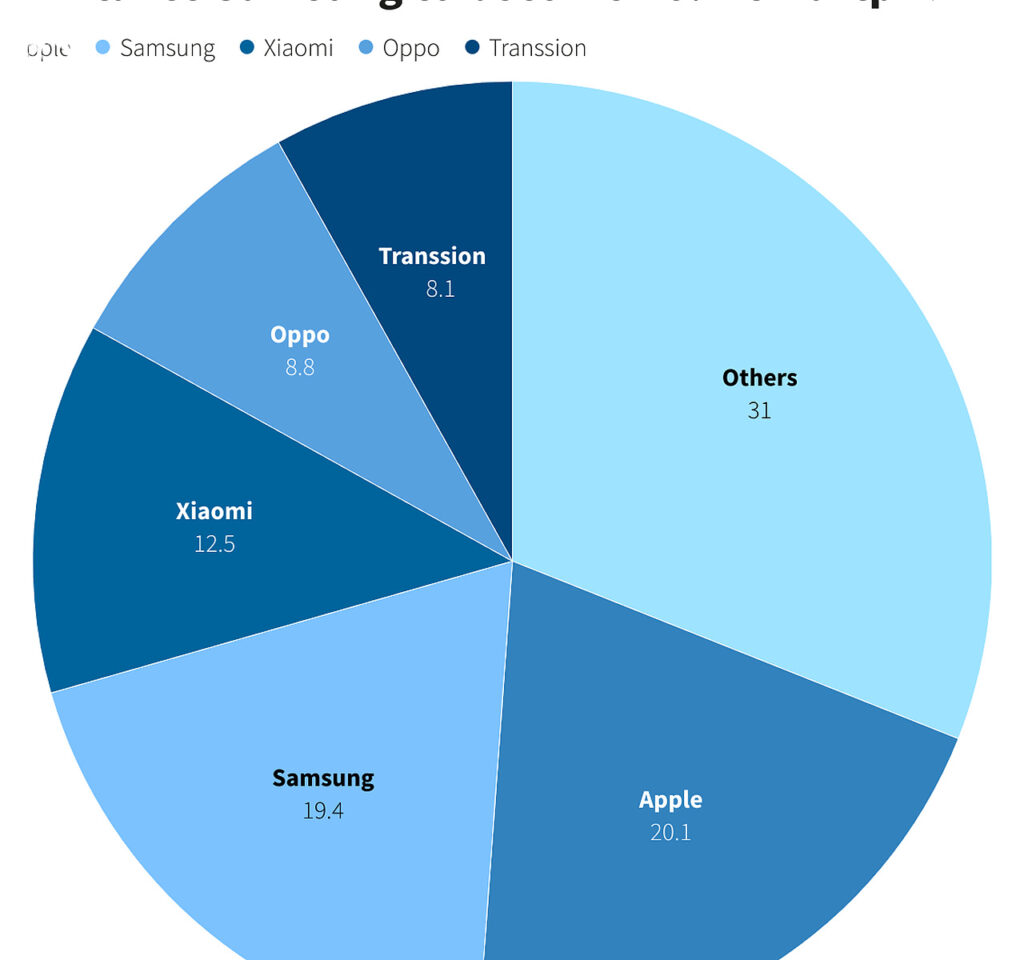
Apple has overtaken Samsung in global smartphone shipments for the first quarter of 2026, according to Counterpoint Research. The shift marks a notable change in the market leadership race, even though Samsung kept a strong 20% share and remained the second-largest smartphone maker worldwide.
The new data shows how demand for the iPhone 17 series helped Apple post 5% year-on-year growth between January and March 2026. Apple was the only major brand to post positive momentum in a quarter when most leading vendors faced softer demand, tighter supply conditions, and rising component costs.
Apple’s first-quarter push
Counterpoint’s shipment data points to strong demand in several key markets, especially China, Japan, and India. Apple also moved quickly to manage memory supply constraints, which helped it protect volume in a period when many brands were forced to adjust pricing and product plans.
The company’s premium positioning also gave it an advantage. High-end buyers tend to be less sensitive to price swings, and that made Apple more resilient than rivals with stronger exposure to mass-market and entry-level phones.
Samsung stays large, but growth slows
Samsung remained close behind with a 20% market share, but its shipments fell 6% year on year. That means Samsung kept its scale, yet it lost ground in momentum as the market rewarded brands with stronger premium demand and cleaner inventory planning.
The company has already responded by reshaping its portfolio. It has reduced some entry-level options, placed more focus on high-end models, and raised starting prices in parts of its lineup to protect margins and strengthen its premium image.
Why the market shifted in Q1 2026
Several industry-wide pressure points helped reshape the rankings. Memory chip costs rose, which forced manufacturers to rethink pricing and production volumes, while price-sensitive buyers in the entry-level segment became harder to win.
That hurt brands that rely heavily on affordable devices. At the same time, premium products held up better, which gave Apple a clear advantage and reduced the impact of broader market weakness.
Global smartphone shipments in Q1 2026
- Apple — 19% market share, +5% YoY
- Samsung — 20% market share, -6% YoY
- Xiaomi — 12% market share, -19% YoY
- OPPO — 11% market share, -4% YoY
- vivo — 8% market share, around flat versus last year
- Others — 28% market share, down overall
The ranking shows how sharply the market is separating premium leaders from brands that depend on lower-priced volumes. Xiaomi, for example, dropped to third place after a deep 19% decline, while OPPO and vivo also saw softer performance despite solid positions in India and the mid-range segment.
What happened outside the top five
Counterpoint also noted that several smaller brands performed well. HONOR grew 25% year on year, supported by aggressive marketing and continued expansion outside its home market.
Google’s Pixel shipments rose 14% year on year, helped by stronger photography features and a more mature AI-driven product strategy. Nothing also continued to carve out a niche with its distinctive design approach, which keeps it visible in a crowded market.
Why Samsung’s lead was threatened
Samsung’s position as a long-time global leader was not erased by one quarter alone, but Q1 2026 exposed the pressure facing the company. Its premium lineup still matters, but the company also faces tougher conditions in volume-driven categories where price competition is intense and consumer demand remains cautious.
The company’s next moves will matter as much as the shipment data itself. If Samsung can convert its premium strength into better growth while stabilizing lower-tier performance, it may recover some momentum in the coming quarters.
Key market drivers behind the Q1 2026 shift
| Factor | Effect on market |
|---|---|
| Strong iPhone 17 demand | Lifted Apple shipments |
| Premium buying trend | Favored high-end brands |
| Rising memory costs | Pressured pricing across the industry |
| Weak entry-level demand | Hurt mass-market vendors |
| Portfolio simplification | Helped brands protect margins |
The Q1 2026 numbers show a smartphone market that is becoming more selective. Premium demand, supply discipline, and product positioning now shape the rankings as much as raw brand size, and that shift is what allowed Apple to move ahead while Samsung lost its crown for the quarter.