


Apple’s long-rumored foldable is starting to look less abstract and more like a real product with a distinct identity. Recent leaks point to a book-style design, a nearly crease-free display, and a premium price tag that would place it at the very top of Apple’s lineup.
The device is still widely referred to as the iPhone Fold, but that may not be the name Apple ultimately chooses. Weibo leaker Instant Digital says Apple could instead go with iPhone Ultra, even writing it as “iPhone Ultra (Fold),” and that claim is said to have support from other leakers on the platform.
A premium name for a premium foldable
The Ultra branding would fit Apple’s recent habit of reserving that label for its highest-end products. That approach already exists with Apple Watch Ultra, so extending it to a foldable iPhone would follow a familiar pattern.
The name is only part of the picture, though. The stronger takeaway from the leaks is that Apple appears to be positioning the device as a luxury foldable rather than a mainstream experiment. Every reported detail points toward a product built to stand apart from regular iPhone models.
Book-style body, tablet-like feel
According to analyst Ming-Chi Kuo, Apple’s foldable will use a book-style form factor. The internal display is said to measure around 7.8 inches, while the cover screen is expected to be about 5.5 inches.
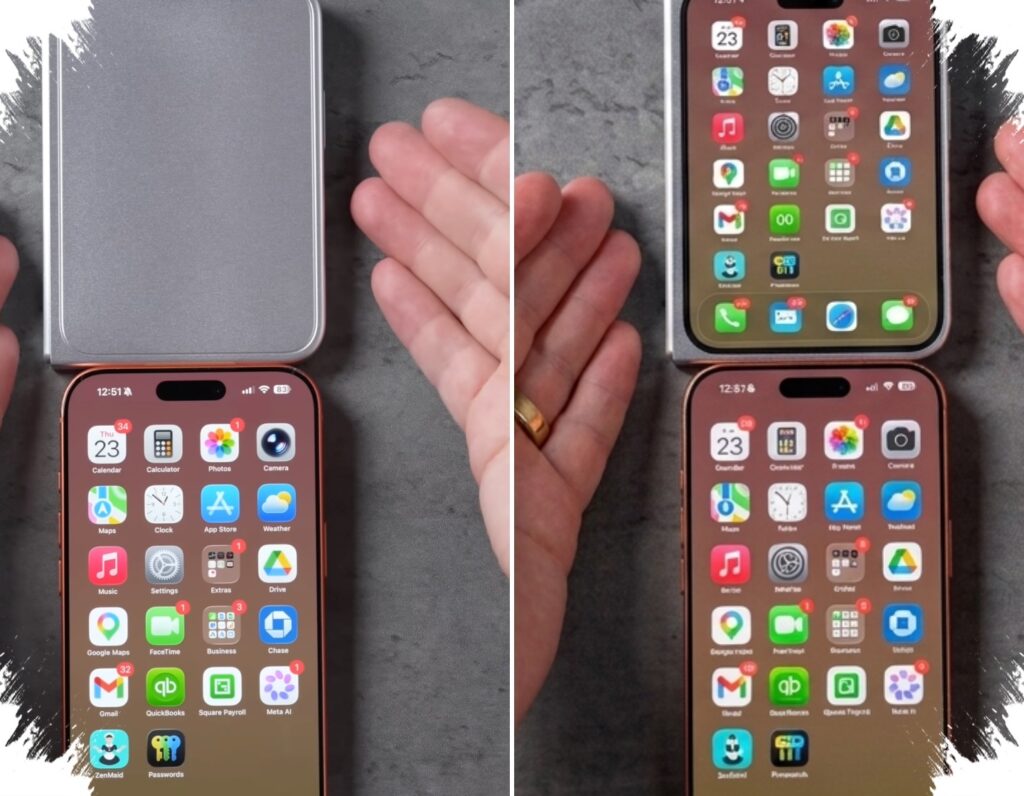
That combination suggests a device that feels compact when folded and closer to a small tablet when opened. A dummy unit photo shared by Sonny Dickson adds to that impression, showing an internal screen with a 4:3 aspect ratio that makes the unfolded device resemble an iPad mini-like layout.
The design may also include a notable change in button placement. Instant Digital claims the volume buttons will no longer sit on the left side, but instead move to the upper portion of the right edge.
Internal layout may shape the exterior
Instant Digital also says the power button with Touch ID will remain on the right side. A separate AI button is reportedly planned as well, with a possible function as a camera shutter key.
That unusual layout is said to come from the way Apple has arranged the internals. The main board is reportedly placed on the right side so the company does not need to run circuitry across the display area to support buttons on the left.
If accurate, that choice suggests Apple is working hard to keep the chassis as compact as possible. It also shows how much of the device’s design is being driven by internal efficiency, not just outward appearance.
Display technology and the push to reduce the crease
The screen itself appears to be one of Apple’s biggest priorities. A report from Korea’s The Elec says the company will use a custom CoE OLED panel from Samsung, with the Color Filter on Encapsulation process helping make the panel thinner and lighter.
That matters because the foldable iPhone is expected to have a very slim body. Apple reportedly wants a large display without adding unnecessary thickness or weight, which is a difficult balance for foldable hardware.
Front Page Tech adds another important detail: Apple is said to be aiming for a display with a nearly invisible crease. The same report says the company is using a special metal plate to spread pressure when the screen bends, while the hinge may rely on liquid metal to improve durability and help reduce the fold mark.
Cameras, silicon, and battery ambitions
Kuo says the device will carry two rear cameras and one front camera that can be used whether the phone is folded or open. Instant Digital adds that the rear camera module is arranged horizontally, with two lenses, a microphone on the right, and a flash, all set against a black module that contrasts with the rest of the body.
That setup makes the device sound visually different from many other foldables. The design has even been compared to iPhone Air, although this foldable is expected to include two rear sensors rather than one.
Performance leaks point to an Apple A20 chip and an Apple C2 modem, according to Weibo leaker Mobile Phone Chip Expert. The same source says the chip is expected to use TSMC’s 2nm process, and that Pro models plus the foldable may use an “Ultra” version under the codename Borneo Ultra.
Battery space also appears to be a major focus. Instant Digital says the redesigned internal layout could allow for a larger battery than any previous iPhone, calling it a potential record-holder in Apple’s lineup.
High price, late-stage production signals
That level of hardware is expected to come at a steep cost. Kuo estimates the price at $2,000–$2,500, while Bloomberg’s Mark Gurman has linked the figure to the use of premium materials and components.
Gurman also believes the device is still on track for a September 2026 launch alongside the iPhone 18 series, assuming no major production problems appear. Fixed Focus Digital has likewise said the production line is in its final stages, keeping that release window in play for now.