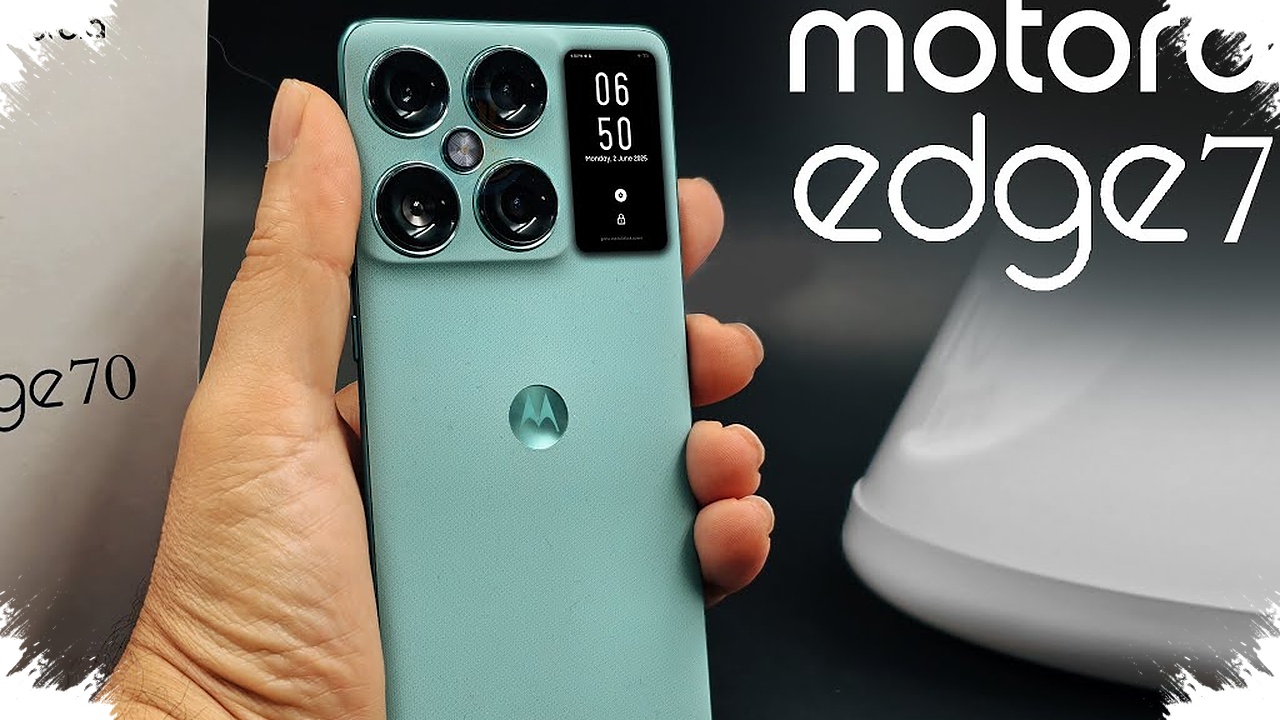
Motorola’s Edge 70 family is no longer just a collection of similar-looking phones. By April 2026, the lineup has split into four global versions, and each one now serves a different priority, from design and battery life to cameras and raw performance.
That clearer positioning also makes the series easier to understand in markets where the Edge 70 Fusion has already arrived, including Indonesia in April 2026. Rather than pushing one model to do everything, Motorola appears to be giving each Edge 70 variant its own core strength.
Different strengths, same family identity
All four models still share a premium base. They use high-refresh-rate displays, an in-display fingerprint sensor, stereo speakers, and IP68, IP69, and MIL-STD 810H certification.
Motorola also keeps the overall design language consistent, so the phones still look like part of the same family. The real separation happens in the details that matter most to buyers.
The most design-focused model
Among the four, the standard Edge 70 is the one that stands out first for its build. It was introduced in late October 2025 and is the only model in the group with a metal frame, which gives it the strongest premium impression from a materials standpoint.
Motorola also gives it a camera setup that looks balanced on paper, with three 50 MP cameras covering the main, ultrawide, and selfie roles. Even so, it has the smallest battery in the family, although it is the only Edge 70 variant with wireless charging.
Battery takes the lead in Fusion
Edge 70 Fusion, which debuted in early March 2026, takes a different route. Motorola uses two chipset options for this model, Snapdragon 7s Gen 3 and Snapdragon 7s Gen 4, depending on the market.
Its battery story is even more varied. Some regions get a 5200 mAh pack, while others get 7000 mAh, making the Fusion the model with the largest battery capacity in the Edge 70 series so far.
Fusion+ shifts the focus to imaging
Edge 70 Fusion+ arrived in mid-March 2026 and brings the clearest camera upgrade in the lineup. It pairs a 50 MP selfie camera with a 50 MP main camera using a Sony LYTIA 710 sensor.
On the back, Motorola adds a 50 MP ultrawide camera and a 10 MP telephoto camera with 3X optical zoom. That makes the Fusion+ the only model in the series with three rear cameras.
Pro is the performance and charging option
The Edge 70 Pro came near the end of April 2026 and takes the performance role. It uses the MediaTek Dimensity 8500 Extreme, while the other three models in the family rely on Snapdragon chips.
It also carries a 6500 mAh battery and supports 90 W charging, which is the fastest charging speed among all Edge 70 models released so far. For users who care more about speed than anything else, that makes the Pro the most aggressive package in the lineup.
What separates them in practice
The differences are not limited to processors and batteries. The standard Edge 70 uses a 6.7-inch P-OLED panel, while the other three models use 6.78-inch or 6.8-inch AMOLED displays with brightness reaching up to 5200 nits.
That means Motorola is splitting the family by usage priorities rather than by appearance alone. The Edge 70 pushes materials and wireless charging, the Fusion emphasizes battery choice, the Fusion+ leans on camera hardware, and the Pro targets performance and charging speed.
| Model | Chipset | Battery | Charging | Main rear camera setup |
|---|---|---|---|---|
| Edge 70 | Snapdragon 7 Gen 4 | 4800 mAh | 68W, 15W wireless | 50 MP + 50 MP ultrawide |
| Edge 70 Fusion | Snapdragon 7s Gen 3 / 7s Gen 4 | 5200 mAh / 7000 mAh | 68W | 50 MP + 13 MP ultrawide |
| Edge 70 Fusion+ | Snapdragon 7s Gen 4 | 5200 mAh | 68W | 50 MP + 50 MP ultrawide + 10 MP telephoto |
| Edge 70 Pro | Dimensity 8500 Extreme | 6500 mAh | 90W | 50 MP + 50 MP ultrawide |
Color choices also help define each model
Motorola extends that separation through color options as well. The Edge 70 comes in Gadget Gray, Lily Pad, Bronze Green, and Cloud Dancer, while the Edge 70 Pro is offered in Lily White, Titan, and Tea.
The Fusion and Fusion+ also use green, blue, and silvery tones, although the exact combinations are not identical. With those distinctions in place, the Edge 70 series now reads less like one phone with four names and more like a lineup built for different buyers.
Source: www.idntimes.com-

-

-
-