


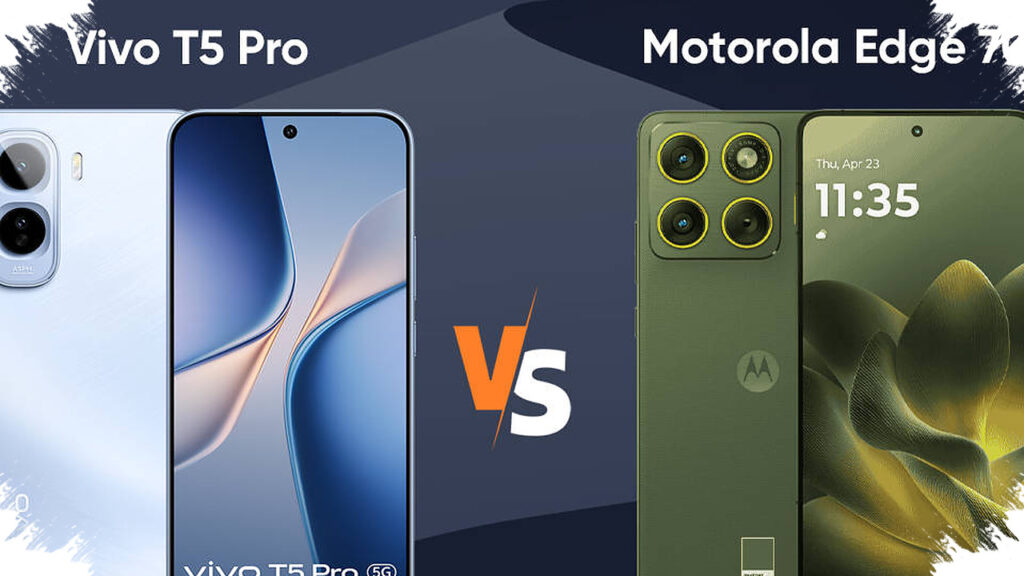
The comparison between Vivo T5 Pro and Motorola Edge 60 Pro is not just about which phone has the bigger battery. It is about which one delivers the more practical package for everyday buyers, and Motorola makes a stronger case on several fronts.
Both devices sit in the premium mid-range space and share a familiar set of headline features: large batteries, 90W fast charging, and IP68 plus IP69 protection. Even so, the two phones are aimed at different kinds of users, with Vivo pushing endurance and screen size, while Motorola focuses on balance and overall value.
Pricing immediately changes the conversation
Motorola Edge 60 Pro starts at 28,999 Indian rupees for the 8GB+256GB variant. Vivo T5 Pro begins at 29,999 Indian rupees, but that price only gets the 8GB+128GB model.
That gap matters because Motorola offers twice the base storage for less money. Its higher trims also stay competitive, with 12GB+256GB priced at 32,999 Indian rupees and 16GB+512GB at 35,999 Indian rupees.
Vivo’s higher configurations are more expensive by comparison. The 8GB+256GB version is priced at 33,999 Indian rupees, while the 12GB+256GB model goes up to 39,999 Indian rupees.
Design choices point to two different priorities
Vivo T5 Pro is built around a large 6.83-inch AMOLED display with a 2800 x 1260 resolution and a refresh rate of up to 144Hz. It also claims a peak brightness of 5000 nits, which reinforces its focus on a big, bold viewing experience.
Motorola Edge 60 Pro takes a different route with a 6.7-inch quad-curved pOLED display, a 2712 x 1220 resolution, and a refresh rate of up to 120Hz. The panel is smaller, but the curved front-and-back design and leather or nylon-inspired finishes give it a more premium appearance.
Weight also separates the two phones clearly. Motorola weighs 186 grams, while Vivo comes in at 213 grams, making the Motorola model easier to handle during longer daily use.
Performance and memory favor Motorola’s broader package
Vivo T5 Pro runs on the Snapdragon 7s Gen 4 built on a 4nm process. It is paired with up to 12GB of LPDDR4X RAM and an 18,000 mm² cooling area designed to help with gaming and sustained workloads.
Motorola Edge 60 Pro uses the MediaTek Dimensity 8350 Extreme, also built on 4nm. Its stronger memory setup includes up to 16GB of LPDDR5X RAM, which gives it more headroom for multitasking and faster app responsiveness.
Storage is another area where Motorola looks stronger on paper. Vivo offers 128GB and 256GB options with UFS 3.1, while Motorola goes up to 512GB with UFS 4.0, which is the faster storage standard of the two.
The biggest gap is in the camera setup
Vivo T5 Pro uses a 50MP Sony IMX882 main camera with OIS, a 2MP bokeh camera, and a 32MP front camera. That setup covers basic everyday photography, but it is still limited in versatility.
Motorola Edge 60 Pro offers a much more complete system. It has a 50MP Sony LYTIA 700C main camera, a 50MP ultrawide/macro camera, a 10MP telephoto camera with 3x optical zoom, and a 50MP front camera.
That extra range gives Motorola more flexibility for landscapes, portraits, and zoom shots. For users who care about camera variety rather than only a single main sensor, the difference is hard to ignore.
Battery size vs charging flexibility
Vivo T5 Pro clearly wins on raw battery capacity with a massive 9020mAh silicon anode battery. It also supports 90W fast charging, which matches the charging speed offered by Motorola.
Motorola Edge 60 Pro uses a smaller 6000mAh battery, but it adds 15W wireless charging and 5W reverse wired charging. Those extras make it more flexible in day-to-day use, even if it cannot match Vivo’s sheer capacity.
The contrast is straightforward. Vivo is built for maximum endurance, while Motorola balances battery life with more charging options and broader convenience.
A more complete choice for most buyers
Vivo T5 Pro is the better fit for users who want the biggest battery, a larger display, and a high refresh rate screen. Motorola Edge 60 Pro is easier to recommend for most people because it starts lower in price, offers more storage at the base level, uses faster memory and storage, weighs less, and includes a richer camera system.
That combination makes Motorola feel like the more sensible purchase in this matchup, even though Vivo still stands out for buyers who place battery capacity above everything else.
Source: tech.sportskeeda.com