


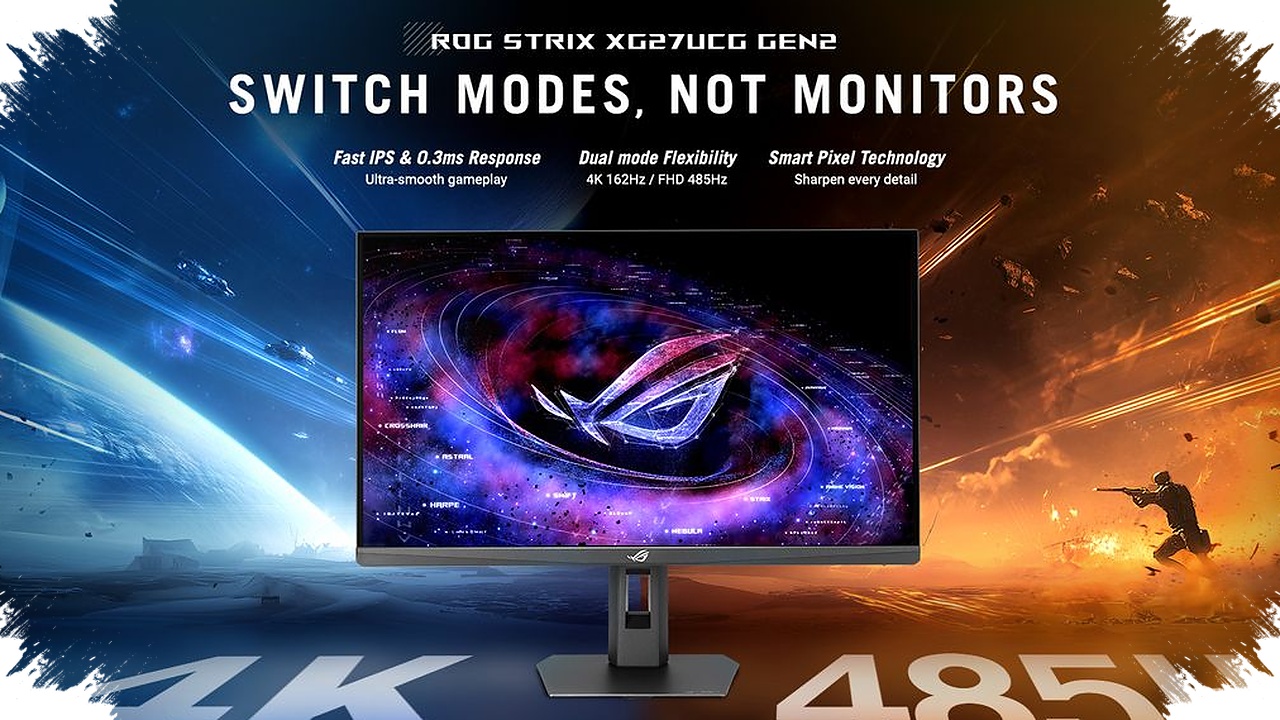
For players who switch between cinematic single-player titles and fast-paced competitive matches, one display often has to compromise. ASUS is trying to remove that trade-off with the ROG Strix XG27UCG, a 27-inch gaming monitor built around Dual Mode.
That flexibility is the headline feature. In one setting, the monitor runs at 4K 3840 x 2160 with a 160Hz refresh rate, while another setting shifts it to FHD 1920 x 1080 with 320Hz for esports-focused play.
Two display personalities in one panel
The appeal of the ROG Strix XG27UCG is not only that it offers two modes, but that it lets users move between them quickly. ASUS designed the monitor for players who do not want to keep two different screens on the desk for different game genres.
When the priority is image quality, the 4K mode is the stronger option. It is aimed at gamers who want richer detail, broader game worlds, and a more cinematic presentation while playing AAA titles or story-driven games.
When the focus shifts to competitive play, the FHD 320Hz mode takes over. That configuration is intended for games such as Valorant and CS2, where smoother motion and fast response matter more than ultra-detailed image output.
Fast IPS as the foundation
ASUS built the switching experience on a Fast IPS panel that has been optimized for this dual-purpose use. The idea is to preserve high performance while keeping image consistency stable across both modes.
That approach makes the monitor relevant for very different play styles without forcing users to change hardware. It also gives the display a wider practical range than a conventional gaming monitor that only excels in one direction.
Smart Pixel keeps the image readable
The monitor also includes Smart Pixel, a feature aimed at preserving image clarity when users move to a lower resolution. In practical use, it helps maintain sharpness and reduce blur so the picture does not feel overly soft in FHD mode.
ASUS says the technology also adjusts contrast and saturation in real time. That should make objects easier to spot, including enemies hiding in darker parts of the screen, which matters in fast matches where visibility can affect the outcome.
Built for long sessions and mixed use
The design follows the familiar ROG identity, with a futuristic look, thin bezels, and subtle lighting. It is meant to look premium whether the monitor sits on a gaming desk or in a more general work setup.
Ergonomics are part of the package too. The stand supports height, tilt, swivel, and pivot adjustments, giving users more control over viewing position during long gaming sessions or daily desktop use.
Connectivity that fits modern setups
For connections, ASUS equips the monitor with DisplayPort 1.4, HDMI 2.1, and USB Type-C with power delivery support. That makes it suitable for high-end PC gaming setups as well as current consoles such as PS5 and Xbox Series X.
The monitor is not positioned only for players at the competitive end of the spectrum. ASUS also frames it as a fit for content creators and users who want a single display that can handle both high visual quality and high-speed gaming.
With Dual Mode and Smart Pixel at the center of its design, the ROG Strix XG27UCG is clearly aimed at one of gaming’s most common dilemmas. It tries to give players detailed 4K visuals when they want immersion, then switch to 320Hz speed when the match demands it.