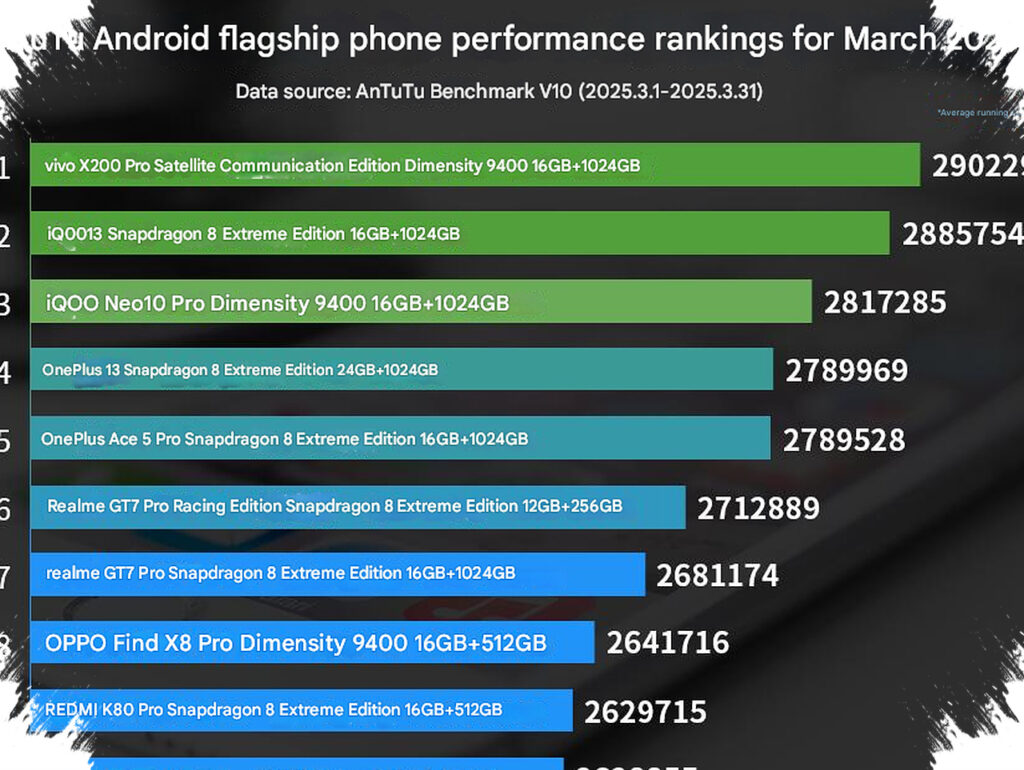
AnTuTu’s monthly rankings are often treated as a simple speed chart, but the platform does not place a phone near the top just because it once hit a record score. Instead, the list is built to reflect more stable performance, using data that is meant to resemble what users are more likely to experience in daily use.
That distinction matters because benchmark numbers can look impressive without telling the full story. AnTuTu tries to limit the impact of extreme results, so the final ranking is shaped by consistency, not by a single standout test.
Average scores, not peak numbers
The core method is straightforward: AnTuTu uses the arithmetic average of all valid scores collected during one month. That approach reduces the influence of outlier results that might otherwise push a device higher than its usual performance would justify.
In practice, the ranking is designed to be less sensitive to one unusually high run. It gives more weight to the broader set of results gathered over time, which makes the final position more representative of ordinary usage.
A phone also needs enough valid data
A device cannot enter the monthly list just because it has strong hardware or a handful of benchmark runs. AnTuTu requires at least 1,000 valid data points in a month before a model can qualify for the ranking.
This rule helps keep the sample size large and lowers the chance that the list is distorted by very small pools of data. It also makes it harder for unusually optimized tests to sway the results too much.
The listed version is usually the strongest one
When a model appears in the ranking, the displayed entry is generally the variant with the highest average valid score. That means one phone model may show up with a specific RAM and storage configuration if that version performs best in the collected data.
For example, if a 16/512 GB version scores higher on average than a 12/256 GB version, the 16/512 GB variant is the one that appears. The ranking is not comparing every version head to head; it is showing the best-performing configuration for that model.
Test conditions still matter a lot
Benchmark results are not fixed because many outside factors can change them. Device temperature, battery level, operating system version, and background apps can all affect the outcome in a meaningful way.
A phone that is already hot may lower CPU and GPU clocks, while some chipsets also reduce performance when battery falls below 20%. Even the same device can therefore produce results that differ by 5–10% between tests.
Different AnTuTu versions should not be mixed
Another common mistake is comparing scores across major versions, such as v10 and v11. Each major release uses a different scoring scheme, so the numbers are not directly interchangeable.
The weights for CPU, GPU, RAM, and UX can change, along with graphics algorithms and responsiveness testing methods. A higher-looking score from a different version does not automatically mean the device is much faster.
A ranking with regional limits
AnTuTu’s official ranking data is dominated by the Chinese market and is limited to a single calendar month. That means the published list reflects a specific collection window, not performance across all time.
Because of that, the ranking is better read as a regional indicator than as a universal standard. Devices that are more popular in other regions may not be represented as well, and usage patterns or climate conditions can also differ.
Taken together, the average-score method, the minimum data requirement, and the version limits show that AnTuTu is aiming for a more realistic picture of performance. The result is less about chasing the highest possible number and more about showing how a phone performs under conditions that are closer to everyday use.