


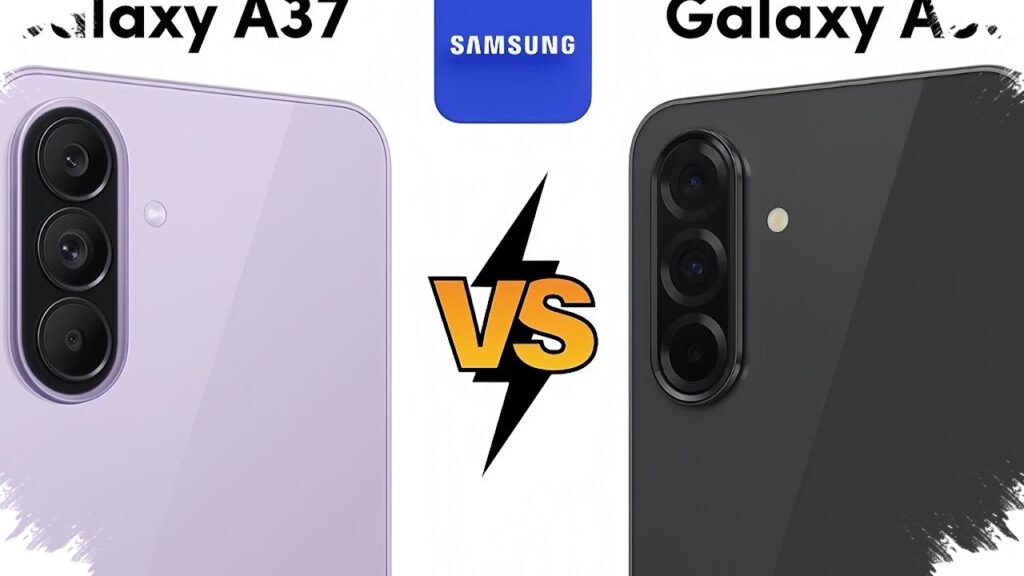
Samsung’s Galaxy A37 5G does not try to win attention with a dramatic redesign. Instead, it targets the areas that matter most in day-to-day use, which is why the higher price becomes easier to understand for some buyers.
That positioning also makes the comparison with the Galaxy A36 5G more interesting. On the surface, the two phones look almost identical, but Samsung has shifted the upgrades into performance, software, and storage.
What stays the same
Samsung keeps the display formula largely unchanged on both models. The Galaxy A37 and Galaxy A36 each use a 6.7-inch Super AMOLED panel with Full HD Plus resolution of 1,080 x 2,340 pixels.
Both phones also carry a 120 Hz refresh rate and the same brightness level. For everyday use, that means scrolling, video playback, and gaming should feel equally smooth on either device.
Battery life is another area where Samsung did not change the basic package. Both phones come with a 5,000 mAh battery and 45-watt fast charging.
Where the Galaxy A37 pulls ahead
The clearest update sits inside the device. The Galaxy A37 uses the Exynos 1480 built on a 4 nm process, while the Galaxy A36 relies on the Snapdragon 6 Gen 3, also on 4 nm.
Both chipsets still sit in a close midrange class, but the Exynos 1480 is described as the stronger option for multitasking and longer-term use. That makes the A37 more appealing for buyers who expect the phone to stay responsive over time.
Storage is also upgraded. The Galaxy A37 uses UFS 3.1, while the Galaxy A36 remains on UFS 2.2.
In practical terms, that change can affect how quickly apps open, how fast files move, and how well the phone handles frequent switching between tasks. It is the kind of improvement that may not sound dramatic on paper but can influence the daily experience.
Software is a bigger gap than it first appears
Samsung also ships the Galaxy A37 with newer software out of the box. It runs Android 16 with One UI 8.5, while the Galaxy A36 comes with Android 15 and One UI 7.
That difference matters in the midrange segment because software support often carries as much weight as raw hardware. A newer system gives the A37 access to fresher features, more current security, and the potential for a longer update runway.
Cameras look similar, but not identical
On paper, the camera setup appears unchanged. Both phones use a 50 MP main camera with OIS, an 8 MP ultrawide camera, a 5 MP macro camera, and a 12 MP front camera.
The main camera sensor, however, is larger on the Galaxy A37. Samsung gives it a 1/1.56-inch sensor, compared with 1/1.96-inch on the Galaxy A36.
That larger sensor should help the A37 gather more light, which may translate into brighter and more detailed low-light shots. The rest of the camera package remains closely matched.
Price becomes the real decision point
The Galaxy A37 starts at Rp 6.6 million for the 8/128 GB variant. The Galaxy A36 was previously sold starting at Rp 5.2 million.
That gap makes the A37 a more selective purchase, especially for buyers focused on value alone. Still, the combination of a newer chipset, newer software, faster storage, and a larger main sensor gives the higher price a clear logic.
For existing Galaxy A36 users, the jump does not look mandatory. For new buyers who want a midrange phone with fresher software and a more future-ready feel, the Galaxy A37 offers the stronger case even though it costs more.