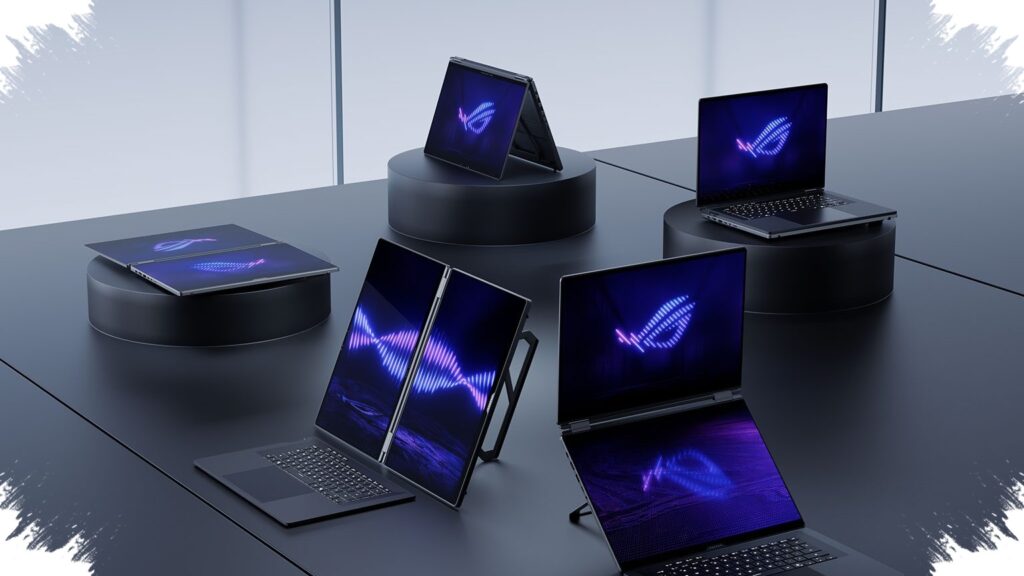
ASUS is pushing its 2026 laptop lineup toward a new benchmark: not just speed, but AI readiness. Across seven models, the common thread is clear performance on paper, with multiple devices carrying at least 50 TOPS of NPU power to handle demanding AI-driven workflows, gaming, and multitasking.
That shift matters because laptop buyers are no longer looking only at raw processor clocks. They are also weighing how well a machine can support productivity tools, creative workloads, and heavier graphics tasks without giving up mobility or security.
A lineup built around different types of users
The most unusual model in the group is the ASUS Zenbook DUO 2026 (UX8407). It stands out with two 14-inch ASUS Lumina Pro OLED touchscreens, both offering 3K resolution and a 144Hz refresh rate, which makes the laptop especially suited for users who keep several apps open at once.
Its hardware matches that ambition with up to an Intel Core Ultra X9 388H processor and a 50 TOPS NPU. ASUS also pairs it with up to 32GB LPDDR5X memory, a 2TB PCIe 4.0 SSD, and a 99Wh battery, while supporting laptop, dual-screen, desktop, and sharing modes.
For users who want a thinner profile, the Zenbook S 16 OLED (UM5606) takes a different route. It measures just 1.19 cm thick and weighs 1.50 kg, yet still brings an AMD Ryzen AI 9 HX 370, 32GB LPDDR5X RAM, and a 1TB NVMe SSD.
Its 16-inch 3K OLED display runs at 120Hz and supports touch and stylus input. That combination keeps it relevant for professionals who work with visuals, presentations, or design tasks, but still want a device that is easy to carry.
Creative work gets workstation-class muscle
ASUS ProArt P16 (H7606) is aimed directly at creators who need heavier graphics performance. It uses the AMD Ryzen AI 9 HX 370 with a 50 TOPS NPU and adds an NVIDIA GeForce RTX 5080 GPU for demanding workloads such as rendering and graphic design.
The configuration can go up to 64GB LPDDR5X memory and dual SSD storage with as much as 2TB. Its 16-inch 4K OLED 120Hz display is PANTONE validated, which is important for workflows that depend on color accuracy.
ASUS also includes the ROG Flow Z13-KJP (2026) for users who want a compact 2-in-1 format without giving up serious capability. The device is powered by an AMD Ryzen AI MAX+ 395, a 50 TOPS NPU, AMD Radeon 8060S graphics, and up to 128GB LPDDR5X memory.
Its 13.4-inch OLED touch display offers 2.5K resolution and a 180Hz refresh rate, while the 1.72 kg weight keeps it relatively portable for a machine in this class. That makes it suitable for both intensive work and entertainment.
Gaming options range from premium to practical
At the top end of ASUS gaming hardware sits the ROG Strix SCAR 18 (G835). It combines an Intel Core Ultra 9 275HX, NVIDIA GeForce RTX 5090 graphics with 175W TGP, up to 64GB DDR5 RAM, and 4TB SSD storage in RAID 0 mode.
The display is an 18-inch Mini LED panel with 2.5K resolution and a 240Hz refresh rate. That setup is clearly aimed at AAA gaming, fast load times, and an immersive visual experience.
For players who want a more balanced portable option, the ASUS TUF Gaming A14 (2026) FA401EA offers a more restrained but still capable package. It comes with up to an AMD Ryzen AI MAX+ 392, a 50 TOPS NPU, AMD Radeon 8060S graphics, 32GB LPDDR5X memory, and a 1TB SSD.
Its 14-inch 2.5K display runs at 165Hz, and the laptop weighs 1.48 kg. ASUS also gives it MIL-STD-810H certification, which adds appeal for users who move between locations and need a tougher chassis.
Business-focused features are not left behind
The most clearly corporate-oriented model in the group is the ASUS ExpertBook P5 (P5405). It uses an Intel Core Ultra 7 258V processor with Intel Arc 140V graphics and includes AI ExpertMeet to improve the online meeting experience.
Up to 32GB LPDDR5X memory and a 1TB SSD are offered for modern office workloads. The 14-inch WQXGA display runs at 144Hz, while TPM 2.0 and fingerprint authentication add important data security layers for business use.
Taken together, the seven laptops show how ASUS is separating its 2026 lineup by role rather than by speed alone. High NPU capacity, large memory options, fast SSDs, and specialized displays now define the pitch, whether the target is creative work, portable productivity, gaming, or enterprise security.