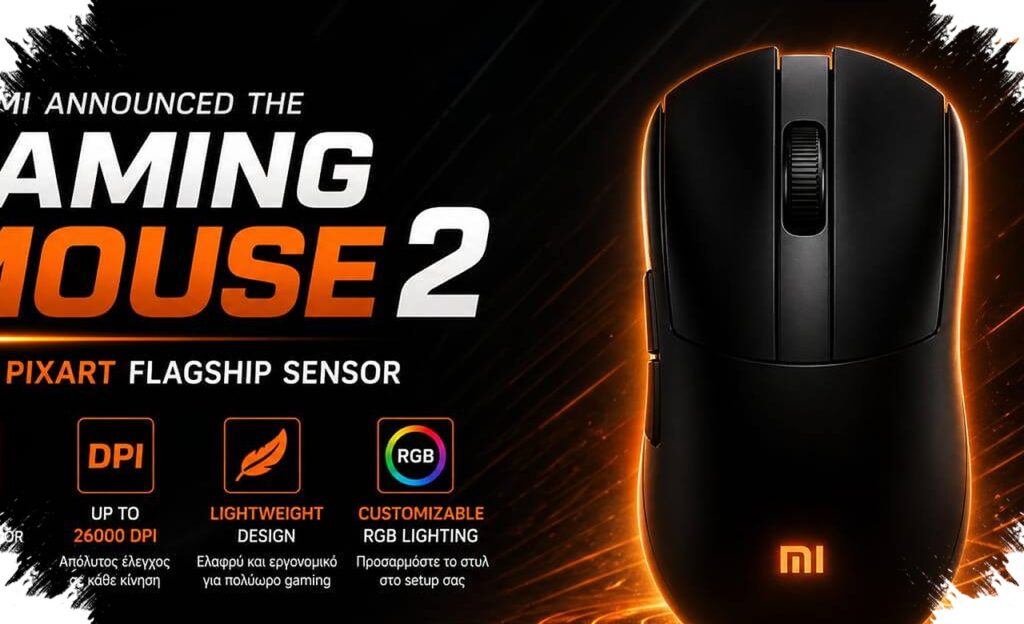
Xiaomi’s new Gaming Mouse 2 is built around one clear idea: speed should not depend on a cable. The mouse supports an 8000Hz polling rate in both wired mode and 2.4GHz wireless mode, making it one of the more aggressive wireless-focused gaming peripherals in Xiaomi’s lineup.
That high-end positioning is backed by a lightweight 58-gram body and a sensor package aimed squarely at competitive play. Xiaomi is not presenting this as a casual mouse, but as a tool for players who care about fast response, tight control, and consistent tracking.
Wireless performance is the main attraction
The 8000Hz polling rate is the headline feature here, because it allows the mouse to send data at a very high frequency and reduce input latency. Xiaomi also says this level of performance is available over both cable and 2.4GHz wireless, so players do not have to give up responsiveness when cutting the cord.
To support that speed, Xiaomi uses a dual-core Telink TL3228 controller. The company also says the mouse sends dual data packets through two channels every 125 microseconds, which is part of its stability-focused approach at high polling rates.
Built for competitive tracking
Under the shell, Xiaomi uses a custom PixArt PAW3955XM sensor. The sensor supports up to 40,000 DPI, 750 IPS tracking speed, and 60G acceleration, while an esports-specific mode pushes static scan rate beyond 20,000 FPS.
The mouse also supports one-step DPI adjustment, giving users finer control over sensitivity changes. Xiaomi says the device is factory calibrated with a DPI error rate below 1 percent, which suggests the company is emphasizing consistency as much as raw performance.
Lightweight, but not stripped down
At 58 grams, the Gaming Mouse 2 follows the current trend toward ultra-light gaming mice. Xiaomi pairs that weight with an ergonomic shell designed using grip data from competitive players, and the shape is intended to suit claw grip, fingertip grip, and palm grip.
Inside, Xiaomi uses a lightweight umbrella skeleton frame to reduce weight without weakening the structure. The internal layout is also said to keep front-to-back weight distribution at 1:1, a detail that can matter when making quick aiming movements.
More tuning options than a simple speed upgrade
Xiaomi includes Motion Sync, five levels of lift-off distance adjustment, 1-degree angle snapping, and glass tracking support on surfaces thicker than 4 mm. Those additions show that the mouse is not focused only on headline specs, but also on how the sensor behaves in different use cases.
The left and right buttons use TTC optical switches, while the scroll wheel uses a TTC gold wheel encoder rated for up to 2 million cycles. Users can adjust DPI, polling rate, and sensor tuning through a web-based tool or local software, then save the settings to onboard memory so the profile stays available when the mouse is moved to another PC.
Battery, connectivity, and price
Gaming Mouse 2 supports three connection methods: a braided USB-C cable, 2.4GHz wireless, and Bluetooth 6.1. Xiaomi equips it with a 530mAh battery and claims up to 160 hours of use in 2.4GHz mode, although that figure is based on polling being reduced to 1000Hz.
For China, Xiaomi has set the retail price at 399 yuan, with an introductory price of 349 yuan. Crowdfunding is scheduled to begin on May 11 through Youpin.
Source: www.gizmochina.com