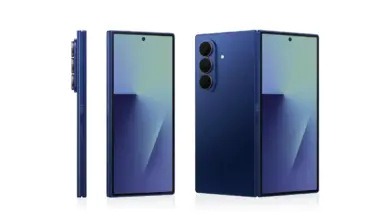

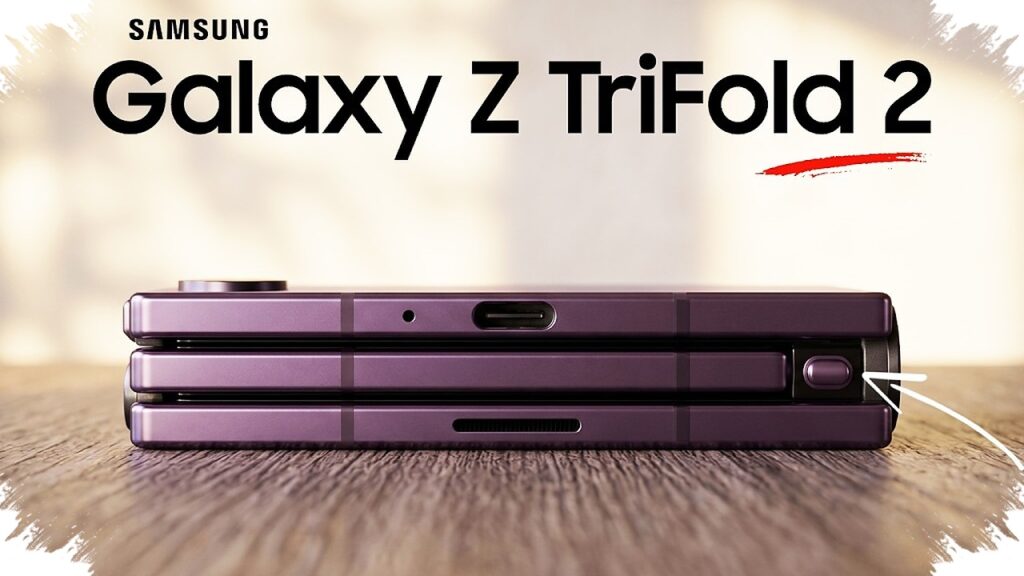
Samsung may be working on a more ambitious answer to one of the hardest problems in tri-fold phones: where to put the S Pen. A newly surfaced patent suggests the company is testing a built-in stylus slot placed directly inside the hinge area of its next-generation foldable.
The concept stands out because it takes a very different route from the Galaxy S Ultra line, which stores the stylus inside the main body. In this design, the S Pen sits vertically along part of the hinge structure, making the storage system part of the folding mechanism itself.
A hinge-based storage system
Illustrations shared by tipster @xleaks7 show a dedicated compartment inside the folding hinge assembly. The slot is described as more than a simple storage space, since it also supports magnetic retention, charging while the stylus is docked, and a detection system that confirms the pen is inserted correctly.
That approach addresses a familiar limitation for tri-fold devices, where internal space is already under heavy pressure. A phone with multiple hinges, flexible display layers, batteries, and cooling hardware has very little room to spare, especially if the body is still expected to stay thin.
Why the S Pen matters on a foldable
For a foldable built with productivity in mind, stylus support carries real value. A tri-fold screen is better suited to multitasking, note-taking, sketching, and document work than a standard slab-style phone.
That is why the absence of a built-in pen slot on the first tri-fold model was not surprising, but it still left a clear gap in the device’s feature set. If Samsung brings this patent idea to life, it could close that gap without sacrificing the device’s core folding design.
The patent imagery shows the S Pen sliding into a channel formed around the hinge area. This keeps the stylus integrated with the foldable structure rather than taking up space inside the main chassis like it would on a conventional phone.
Possible trade-offs for the display
The same design that makes the slot efficient also raises durability concerns. In the patent images, the flexible inner display appears to form part of the storage path on three sides, which creates a potential wear issue over time.
Repeatedly inserting and removing the S Pen could bring it into contact with the foldable screen layer. That makes the durability of the display a central question, unless Samsung changes the stylus design to reduce friction with the surface.
One possible answer would be a softer outer material on the S Pen. That would help limit the impact of contact with the foldable panel, although the patent itself does not confirm that Samsung has committed to such a change.
Thin design, difficult balance
Thickness is another challenge. Samsung is reportedly trying to make the Galaxy Z TriFold 2 thinner and lighter than its predecessor, while a built-in S Pen system would add another layer of design complexity.
That leaves Samsung with three competing goals at once: keep the phone slim, protect the flexible display, and reserve safe internal space for the stylus. In a tri-fold device, those demands are not easy to combine.
For now, the idea remains a patent and not a confirmed product feature. Companies often file experimental concepts that never make it to retail, so there is no guarantee that this hinge-mounted stylus system will appear on a commercial device.
Even so, the direction is telling. Samsung’s exploration of an S Pen storage solution for a tri-fold suggests that stylus support is being treated as a meaningful part of the category’s future, not just an optional extra. If the concept reaches production, it could become one of the most distinctive elements of the next tri-fold generation.