


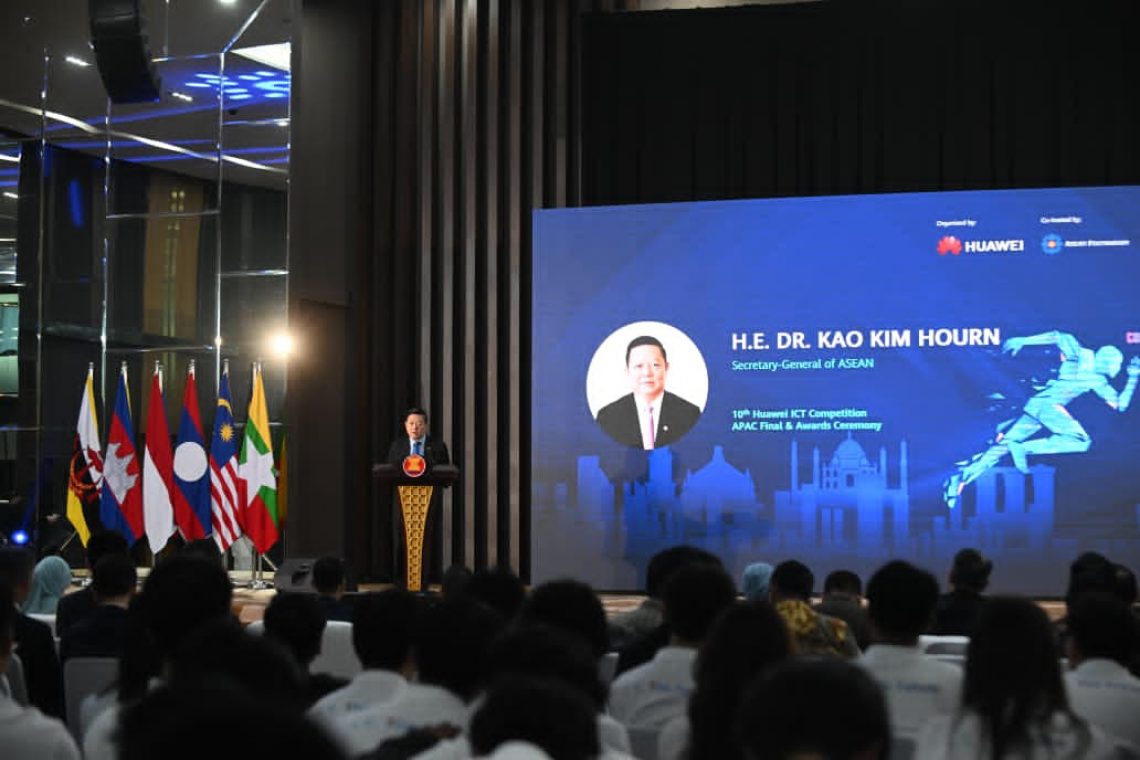
The most closely watched prize in Asia-Pacific digital education has now moved to Shenzhen. Sixteen top teams from across the region will represent Asia Pacific in the global Huawei ICT Competition after a high-stakes final round in Jakarta.
The road to that stage was highly competitive. More than 8,600 students from 14 countries and territories in Asia Pacific entered the annual contest, and more than 160 students from 13 countries and territories advanced to the APAC final at the ASEAN Secretariat in Jakarta.
Competition tracks shaped the race
The final featured two major formats: the Practice Competition and the Innovation Competition. The practice side was divided into Cloud Track, Network Track, and Computing Track, while the innovation side evaluated technology ideas with clear practical value.
The National University of Singapore team won the Grand Prize in the Innovation Competition. Their solution was recognized for both strong commercial potential and major social impact.
In the Practice Competition, the Vietnam Posts and Telecommunications Institute of Technology stood out in the Computing Track and the Cloud Track. Bulacan State University took the Grand Prize in the Network Track.
Winners came from across the region
The list of top performers also included students from Indonesia, Malaysia, Thailand, Brunei Darussalam, Japan, Laos, Timor-Leste, Hong Kong SAR, and Macao SAR. Those teams placed first through third across different categories, showing how widely talent is spread across the region.
The result reflects more than a single contest outcome. It also highlights the growing scale of ICT competition in Asia Pacific, where technical training and innovation are becoming central to how students prepare for future work.
ASEAN leaders point to digital talent as a strategic need
The Jakarta final also drew senior regional figures, including Kao Kim Hourn, representatives of the Indonesian government, and organizations working in telecommunications and digital development. Their presence underlined how seriously the region is treating digital skills development.
Kao said youth talent is key to ASEAN’s digital transformation. He described digital talent as the “main pulse” behind the ASEAN Digital Masterplan 2030, linking the competition directly to the region’s broader digital agenda.
That message came at a time when artificial intelligence and rapid technology change are reshaping skill needs across industries. The competition therefore served not only as a student showcase, but also as a signal of what governments and institutions now expect from the future workforce.
Huawei expands its AI and skills push
Huawei used the event to introduce a new initiative focused on AI talent development in Asia Pacific. Peter Pan said the company wants to create greater impact through collaboration and sustained innovation.
At the same event, Huawei launched a white paper titled ICT Job Roles and Skills in the Intelligent World. The document was developed with IDC, OpenAtom Foundation, and the Global Intelligent Internet of Things Consortium, and it examines future ICT job trends, changing skill requirements, and development pathways for an AI-driven era.
The launch was also attended by Boni Pudjianto and formally introduced by Sun Hu. Huawei, the ASEAN Foundation, and the International Telecommunication Union also presented a symbolic collaboration that reinforced their commitment to strengthening digital capacity among young people in Asia Pacific.
Training networks continue to grow
Huawei’s ICT Academy program has expanded quickly over the past nine years. It now reaches more than 500 institutions in 18 countries and territories in Asia Pacific, up from only two educational institutions at the start.
More than 160,000 students have taken part in Huawei ICT Academy training so far, and around 60,000 are still actively enrolled. That scale shows how strong the demand has become for ICT learning and digital capability building across the region.
With the APAC final now complete, attention shifts to Shenzhen, where the 16 best teams will compete globally in June. For students, educators, and policymakers alike, the Jakarta event reinforced one message clearly: the race to build digital talent is now a regional priority.