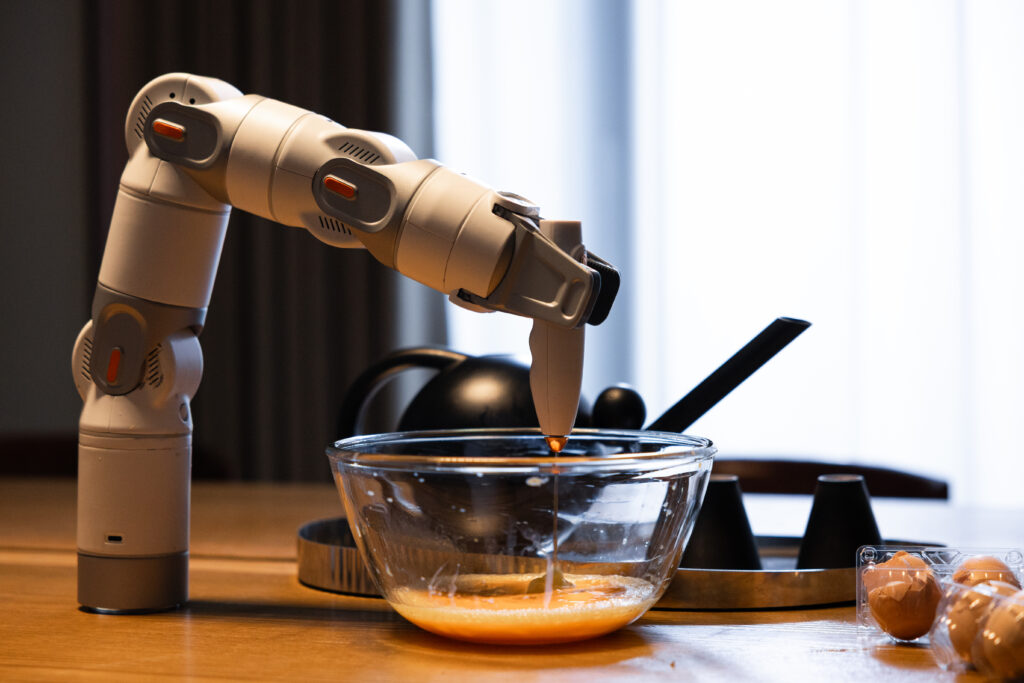
Kynooe is trying to make robot arms feel less like specialist equipment and more like something that belongs in a home. Through its Kickstarter campaign, the company is introducing a modular AI robot arm built for creative work, everyday automation, and consumer use rather than laboratory or industrial settings.
That positioning matters because consumer robotics often looks intimidating from the start. Kynooe is centering the product around app-based control, AI interaction, and a no-code approach so it can feel closer to mainstream consumer tech than to a technical machine.
A modular platform for more than one job
Unlike many robot arms that are designed around a single fixed function, Kynooe uses a fully modular design. The system supports interchangeable tools, accessories, and attachments, which gives the same arm room to adapt to different tasks.
The platform is described as compatible with precision instruments, custom modules, and 3D-printed extensions. Kynooe summarizes that idea with the line “One arm. Infinite applications,” pointing to a device that can shift roles depending on how it is configured.
That flexibility also changes how the product is being positioned. Instead of being framed as an industrial machine with a narrow purpose, the arm is aimed at smart automation, content creation, creative workflows, and household use.
Designed to lower the learning curve
One of Kynooe’s main selling points is that users do not need to code to control it. The company says the robot can be operated and customized through a visual interface in a companion app that is meant to feel intuitive, much like using a smartphone.
The system also includes AI-assisted interaction to make it easier for first-time users to get started. That approach is important in consumer robotics, where setup complexity often becomes a barrier before the device is even useful.
Kynooe appears to be trying to reverse that pattern by making ease of use part of the product identity. The goal is not just to add smart features, but to make the entire experience feel approachable from the beginning.
AI features built for natural interaction
The user experience is also built around more natural forms of control. Users can issue commands in natural language, which reduces reliance on manual control or traditional programming methods.
The most visible built-in AI feature is on-device face tracking. Kynooe says this is intended for content creators and smart filming, helping a camera follow a face automatically so recording feels smoother and more hands-free.
The company also says it is taking an on-device approach to AI. More AI features are planned for the future, with the aim of improving the experience while maintaining privacy.
Made for everyday environments
Kynooe is not presenting the arm as a device for a single narrow niche. The company is aiming it at household assistance, entertainment, smart recording, creative projects, and interaction with family and friends.
That use case depends heavily on the modules and accessories attached to the arm. In practice, users can shape the device around their own workflow and creative needs rather than adjusting their needs to fit the machine.
The ecosystem around the product is also being opened up. Kynooe is preparing an open-source SDK on GitHub, which will give developers and advanced users room to work on AI integration and low-level robot connection control.
Alongside that, the company is building Kynooe Robot Hub as a place to share robot behaviors and workflows. Through that platform, users are expected to be able to train, customize, publish, and share behaviors with a wider community.
Production is moving forward
Kynooe says the structural design, hardware validation, and small-scale trial production have already been completed. The project is now moving into certification, production validation testing, and preparation for mass manufacturing before shipments planned for 2026.
The roadmap also includes tooling optimization, manufacturing preparation, and compliance testing. Those steps matter because hardware crowdfunding projects are often judged by how ready they are for production, not just by how ambitious the concept looks.
The Kickstarter campaign is scheduled to open on 20 May. Kynooe is preparing launch-day discounts, limited-edition rewards, and several pledge options, including bundles for creators and modular accessory packages.
For distribution, the first wave of shipping is expected to begin around September 2026. A second batch and follow-up fulfillment are planned for October 2026 as Kynooe works to establish a new place for home robotics in the consumer market.