


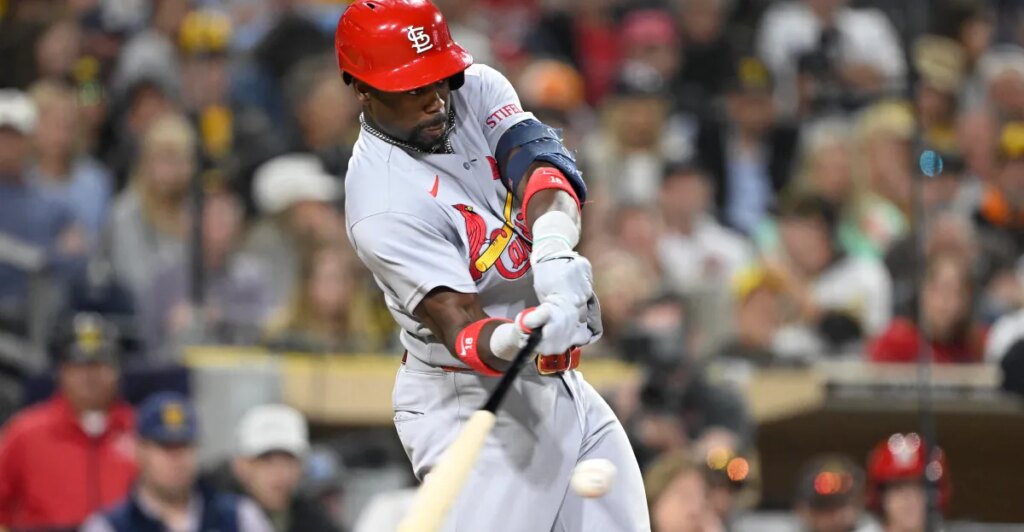
Jordan Walker is giving the St. Louis Cardinals something they have lacked in recent seasons: a legitimate emerging star who changes the shape of the lineup. At 24 years old, he has moved beyond the early-stage questions that followed him and now looks like a player whose production is starting to match the talent that made him one of the organization’s most watched young hitters.
The biggest shift is not just that Walker is hitting better, but that the improvement is showing up across his game. His offense, baserunning, and defense have all moved in a positive direction, and that matters for a team trying to build a more complete roster around younger pieces.
A profile that looks more stable
The reference point for judging Walker’s season starts with plate appearances, and the article notes that the Cardinals and evaluators have now passed the 200-PA mark, a level that offers a clearer view of what is sustainable. That matters because Walker’s numbers are no longer living off a tiny sample, and the trend has continued to improve as the season has unfolded.
The offensive profile also stands out because it resembles a proven major league hitter. The article points to Statcast overviews that show Walker’s current shape looking strikingly similar to Paul Goldschmidt’s 2022 season, including comparable spray patterns and overall production traits.
That type of comp is meaningful because Goldschmidt’s 2022 season produced 6.8 fWAR, and Walker plays right field, a position with a lighter defensive adjustment than Goldschmidt’s role that year. The article also suggests Walker’s defense grades better from the Statcast sheet, which leaves room for even more overall value if his current level holds.
Why the improvement looks real
The article raises the central question directly: is this real, and is it sustainable? The answer is not absolute, but the evidence is moving in Walker’s favor as he shows gains in several areas at once.
His walk rate has climbed from a career mark of about 7.5% before this year to more than 10% in 2026. His chase rate has also increased to 36%, up from a career norm of 30.1%, which would normally raise concern.
Other contact indicators help explain why the overall result still looks positive. His waste swing rate is at a career low of 7.7%, while his chase contact rate has risen from 30% to 36%. That suggests better plate coverage, stronger pitch recognition, and improved ability to do damage even when he expands the zone.
The article also notes that Walker’s SquareUpSwing%, BlastSwing%, and IdealAttackAngle% are all at career highs. Those indicators support the idea that he is seeing the ball better and committing with more conviction when he decides to swing.
The lineup impact is already visible
Walker’s growth matters because it changes the batting order as much as it changes his own stat line. The article notes that Masyn Winn opened the season as the cleanup hitter, which underscored how thin the lineup could be at times.
A productive Walker changes that equation. It improves the top four spots in the order and gives the Cardinals a stronger group in front of the middle and lower lineup spots. With Walker in form, the combination of JJ Wetherholt, Iván Herrera, Alec Burleson, and Walker creates a tougher top portion for opposing pitchers to navigate.
That matters especially for a club that has needed more “star” players. The article’s broader roster framework defines a “Starz” player as one in the top 20th percentile of WAR, and it argues that competitive teams usually need more of them than St. Louis has recently carried.
How Walker changes the Cardinals’ star count
The article says the Cardinals previously had five “Starz” in 2025: Winn, Donovan, Contreras, Gray, and Liberatore. It also says that was not enough, and that the team needed roughly four more star-level players to reach a stronger competitive baseline.
After offseason changes and trades, the picture has shifted again. The Cardinals still have three current Starz on the field, with Walker, Herrera, and Wetherholt in that group, while Burleson and Winn sit just outside it.
Walker is the player who most clearly changes the outlook. His 2.1 fWAR places him among the top 100 fWAR accumulators in 2026 and, according to the article, ranks ninth overall, alongside some of the game’s elite names. That level of production is enough to reshape how the roster is viewed.
More than bat-to-ball value
Walker’s impact is not limited to slugging or on-base production. The article says his baserunning value is strong, which becomes more important as he reaches base more often. That adds a layer of value that traditional batting lines do not fully capture.
His fielding run value is described as middle-of-the-pack, but that still represents progress because the article contrasts it with where he was two years ago, when his defense ranked worst. For a Cardinals team that depends heavily on run prevention, simply avoiding damage in the field is part of the overall value he now brings.
That combination is what gives Walker added importance. He adds with his bat, helps on the bases, and no longer drags the team down defensively in the way he once did.
What his rise means for the rebuild
The Cardinals’ longer-term picture changes if Walker becomes a true top-tier performer. The article says that if he reaches a 6-7 WAR season, the effect on the roster would be much larger than a simple replacement-level comparison, because he is improving from a negative baseline of -1.2 fWAR last year.
That makes his current jump even more significant. A 7-WAR season would not just be good in isolation; it would represent an enormous gain for a team trying to accelerate a rebuild without waiting too long for the rest of the system to catch up.
The contract-control timeline also matters. The article notes that Walker has three years of control left after 2026, which creates a shorter window than the one tied to younger controlled players such as Wetherholt. That reality could push the front office to move faster if the team wants to build around Walker while he is still under control.
For now, the Cardinals appear to have found the kind of player who can change the tone of a lineup and raise the ceiling of the roster. Walker’s season has moved from promising to consequential, and the next question is no longer whether he belongs, but how far his emergence can carry St. Louis.
Read more at: www.vivaelbirdos.com