Oleksandra Oliynykova’s breakthrough at Roland Garros brought a first Grand Slam main-draw win, but her strongest message came after the match. The Ukrainian player beat Russian qualifier Elena Pridankina 6-1, 6-2 and then used her press conference to keep focus on the war in Ukraine, the destroyed tennis facilities she grew up on, and what she sees as the silence of some figures in the sport.
Her victory sent her into the second round at a major for the first time and secured at least €130,000 in prize money at Roland Garros. But for Oliynykova, the result also carried a personal weight, because her father, Denis, who is on leave from the Ukrainian Army, was in Paris to watch it happen.
A win shared with her father
Oliynykova said the moment meant more because her father was there in person. She took the Ukrainian flag after the match and ran toward him, later explaining, “It was very important for me that my father saw my first Grand Slam win in real life.”
She described the scene as one she can only experience once, calling it a special memory for both of them. Her father had also been with her the previous week in Strasbourg, making the Paris moment even more meaningful in the middle of a difficult season for Ukrainian sport.
The war remains central to her public voice
Oliynykova has already spoken publicly this season about training in Ukraine while bombs continue to fall, and about tensions with WTA officials over her criticism of players she believes support Russia’s invasion. In Paris, she returned to that theme quickly and firmly.
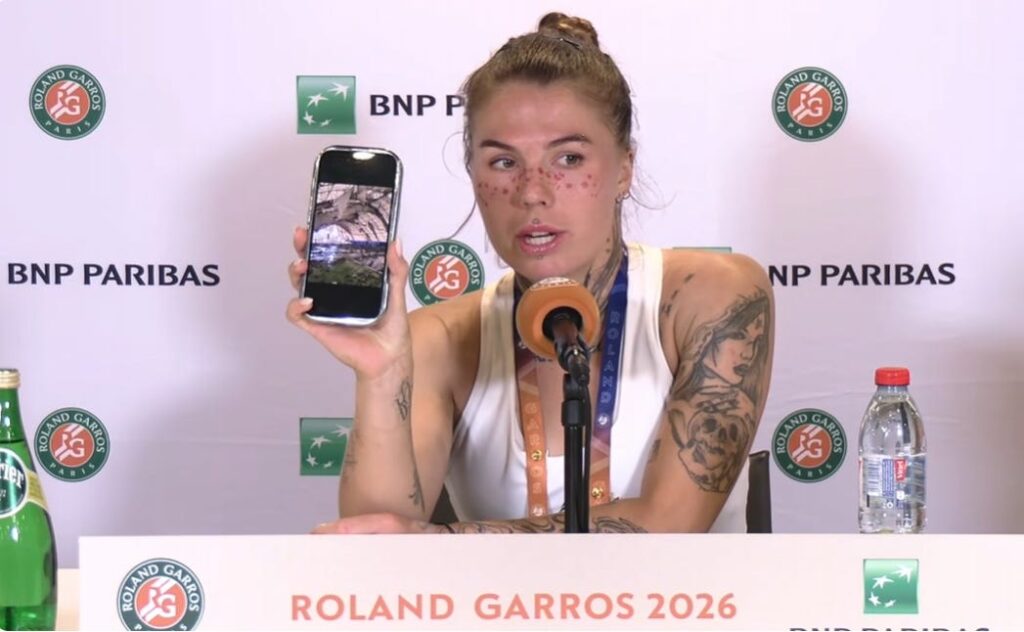
She said that facing a Russian opponent does not change her professional approach on court, but she stressed that the broader context cannot be ignored. She also showed reporters a photo on her phone of a tennis center in Ukraine that she said had been hit by Russian bombs.
A childhood court in Kyiv destroyed
Later, Oliynykova identified the damaged facility as Lyodovyi in Kyiv, where she trained as a child. She said the court held a large part of her personal history and that seeing it destroyed caused deep pain.
According to the tennis club’s Instagram, the site was bombed two days before her press conference, on Sunday, May 24. Oliynykova said many Ukrainian athletes have gone to war to defend the country, while others have been killed as civilians in their homes.
She argued that silence from some players amounts to support for the Kremlin. “They are staying silent, and by [doing] this, they are supporting the regime,” she said, adding that some players are “actively participating in propaganda.”
Her criticism extends beyond the court
Oliynykova also linked the issue to what she sees as the normalizing of aggression against Ukraine. She said influential athletes have a platform and should use it responsibly rather than benefit from tournaments while ignoring the war.
For her, the problem is not only what happens during matches. She said the bigger issue is what players choose to represent away from the court, especially when public exposure and prize money can strengthen the influence of those she accuses of backing the Russian state.
She said the lack of reaction on tour is “very triggering” and called on sports organizations to do more. In her view, tennis cannot keep behaving as if the destruction in Ukraine is separate from the sport’s public stage.
The debate over flags adds another layer
Her comments came as the broader issue of national flags for Russian and Belarusian players is being discussed in other sports. The IOC has recommended reinstating Belarusians with full status, but the International Tennis Federation said its position has not changed and that suspensions of the Belarus and Russian Tennis Federations remain in place.
Oliynykova responded with unusually sharp language, calling the Russian flag “a symbol of terror” and comparing its use in the current context to displaying a swastika. She said the idea of normalizing that symbol is “absolutely immoral” and deeply traumatizing for Ukrainians.
Support from inside the tour has helped
Despite her criticism, Oliynykova said some international players have shown support, even in small ways. She said those gestures matter, especially in a setting where she often feels isolated by the wider silence around the war.
She also said she does not believe Russian players are privately detached from the conflict if they remain publicly silent. In her view, their lack of protest already shows where they stand.
What comes next in Paris
Oliynykova now moves into the second round against Australian Kimberly Birrell, who upset fifth seed Jessica Pegula late Tuesday night. Her run has already given her both a landmark victory and a larger platform, and she has made clear that she intends to use it.
She said her motivation is not publicity or money, even though Roland Garros has given her both visibility and a significant prize. “I want to help my country,” she said, adding that she plans to donate a large part of her earnings after the tournament to the army.
For Oliynykova, tennis remains important, but only as part of a larger mission. She said she would rather speak the facts, even if it leads to fines or punishment, because she believes that staying silent would mean accepting a reality she cannot endorse.