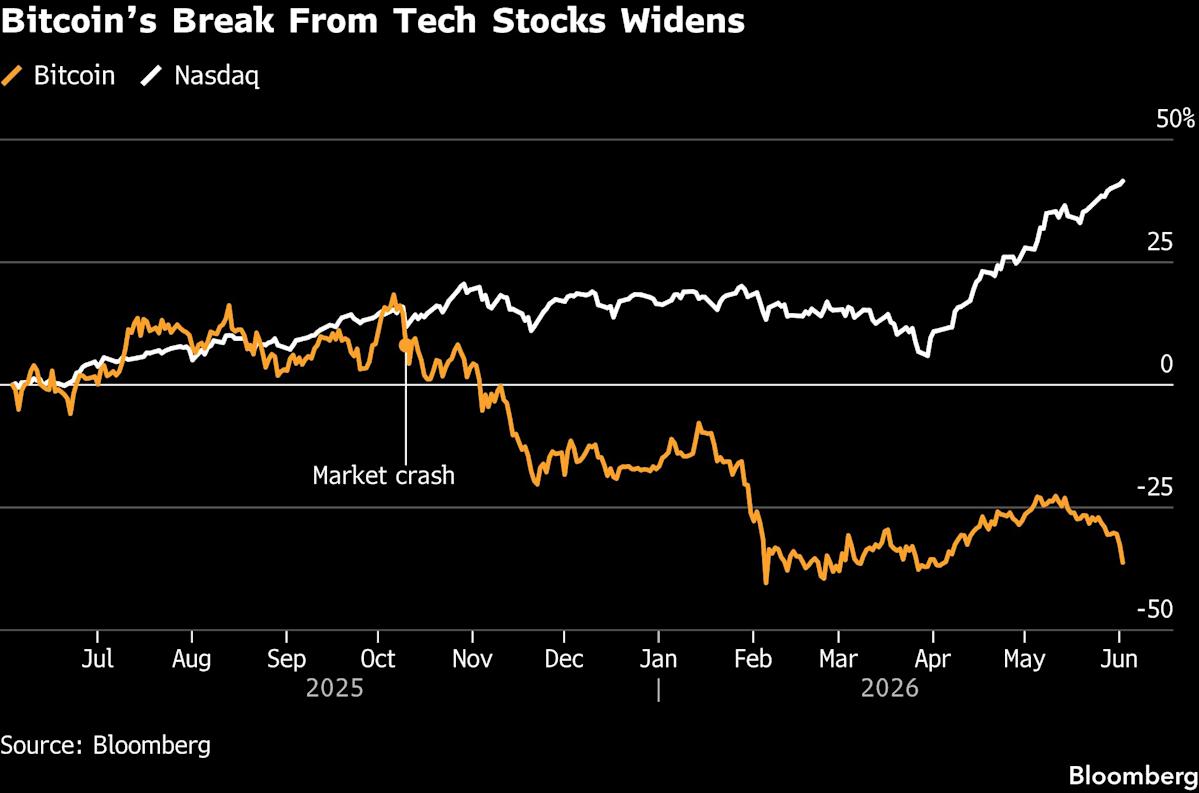
Bitcoin’s latest slide has deepened its split from technology stocks after Strategy Inc.’s small sale of the cryptocurrency shook market confidence. The token fell as much as 4% to $64,692 in late New York trading, its lowest level since Feb. 28, after a drop that has wiped out more than $160 billion in market value this week.
The move came even as the Nasdaq 100 Index hit a fresh record, highlighting how far Bitcoin has drifted from the tech rally that once helped lift it. Traders are now weighing weaker crypto sentiment, heavy fund outflows, and a shift in capital toward artificial intelligence shares.
Why Strategy’s sale mattered more than its size


Strategy sold about $2.5 million of Bitcoin, equal to 32 tokens from a holding of 843,706 coins valued at about $56 billion. The sale was tiny relative to the company’s position, but it challenged a key part of Chairman Michael Saylor’s long-promoted “never sell” message.
Rajiv Sawhney, head of international portfolio management at Wave Digital Assets, said the trade was “financially trivial” but still important because it changed what the market thought Strategy stood for. For many investors, the problem was not the amount sold, but the signal it sent after Bitcoin had already been under pressure.
Bitcoin loses ground while tech keeps climbing
Bitcoin’s weakness now stands in sharp contrast to equities, especially large technology names. The Nasdaq 100 has risen 41% over the past 12 months, while Bitcoin has fallen 38% and sits 48% below its peak from last year.
That divergence reflects a broader shift in investor positioning. Bitcoin was once treated by many traders as a leveraged proxy for tech, but that link has weakened since the market crash in October last year.
Capital is moving toward AI-linked stocks
Some investors are redirecting money away from digital assets and into AI-related equities. Carney Mak, a partner at FXHB Asset Management, said some portfolios have been rebalanced because AI currently offers a more attractive risk-reward profile than crypto.
That shift has been reinforced by real capital moves. Nasdaq-listed K Wave Media said last month it would drop plans to deploy roughly $500 million into Bitcoin and instead focus most of that money on AI data centers, GPU infrastructure, and related acquisitions.
Bitdeer has also sold its entire Bitcoin treasury to fund expansion into AI and high-performance computing businesses. Those decisions add to the impression that some companies now see more opportunity in AI than in holding Bitcoin.
ETF outflows and derivatives add pressure
The pressure is also showing up in market flows. Investors have pulled nearly $4 billion from US-listed Bitcoin exchange-traded funds over the past 12 sessions, marking a record streak of consecutive outflows, according to Bloomberg-compiled data.
At the same time, about $1 billion in bullish crypto positions in perpetual futures has been wiped out over the past 24 hours, based on Coinglass data. Those moves suggest that the selloff is not only about one corporate transaction, but also about a broader retreat from risk.
The market is watching Strategy and its imitators
For a market built around the idea that major holders would keep buying, Strategy’s sale carried outsized symbolic weight. The concern is that the disclosure may have altered the psychology supporting one of Bitcoin’s most important narratives.
Glassnode data show that buyer behavior has changed since May. During the rally early last month, accumulation was led by wallets holding 1,000 to 10,000 Bitcoin, a group often tied to larger institutions, but in June those buyers have become less active while smaller wallets and the largest whales have shown more willingness to buy into weakness.
That leaves the market more dependent on liquidity and macro conditions, while the near-term catalyst for crypto remains limited. Some crypto-related IPO plans have also been delayed, even as AI companies continue to attract investor demand and momentum.
Pressure may spread beyond Strategy shares
Strategy’s own stock has fallen 18% this week and more than 70% from its peak, raising concerns that the damage could spread into products tied to the company. Leveraged and income funds linked to Strategy shares, including MSTU, MSTY and MSTX, may face sharper swings if investors question the company’s accumulation strategy.
Pratik Kala, a portfolio manager at Apollo Crypto, said those products can amplify daily moves in Strategy’s stock, so even a modest loss of confidence can trigger larger declines and portfolio rebalancing. He described the dynamic as “a vicious feedback loop,” with losses in MSTR feeding weakness in the funds built around it and further pressuring sentiment across the broader trade.
The result is a market where Bitcoin is no longer moving in step with tech stocks, and where even a small sale from one of its best-known corporate holders has become a major test of confidence.
Read more at: finance.yahoo.com