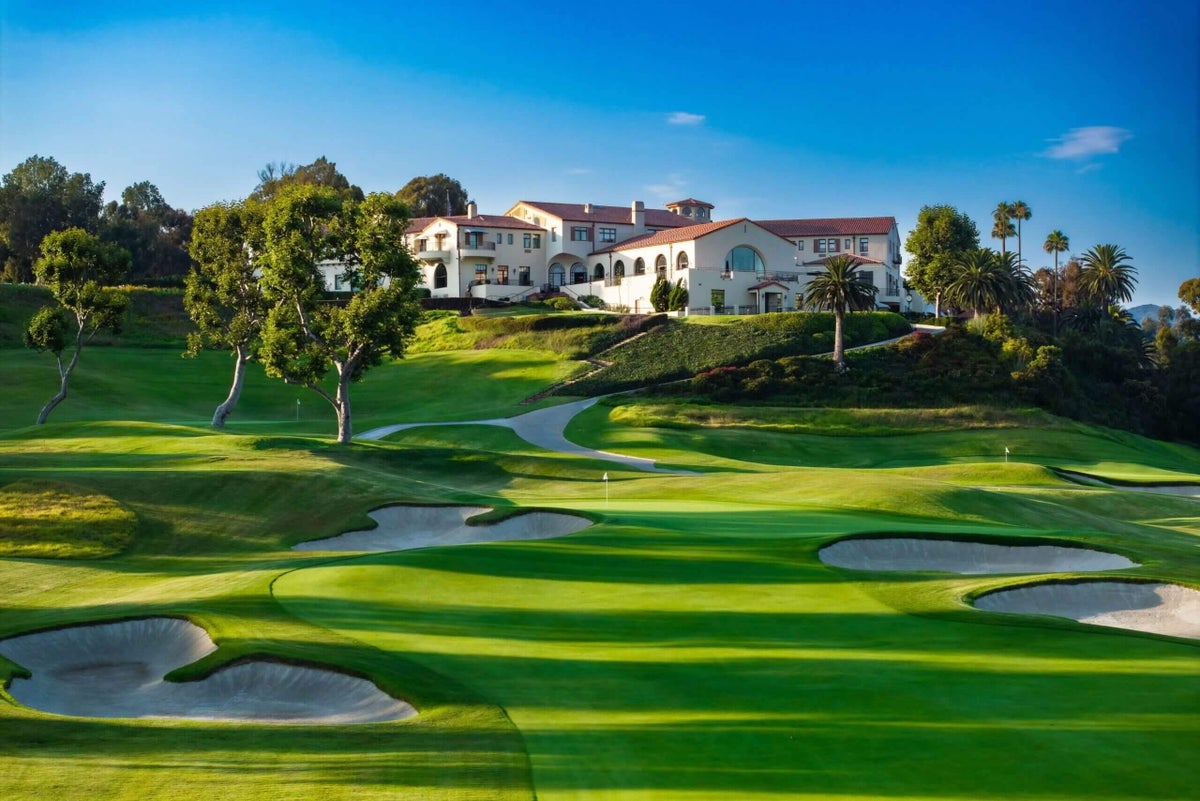
Los Angeles is about to stage a rare two-week showcase for women’s golf, with Riviera hosting the U.S. Women’s Open and Bel-Air following with the Curtis Cup. Together, the two venues put classic architecture, high-level competition, and the city’s skyline on the same stage.
The run of events gives women’s golf a visible prime-time spotlight in one of the sport’s most recognizable settings. It also places two George C. Thomas designs under pressure in very different ways, showing how course setup can change the meaning of a familiar layout.
Riviera brings a major-championship test
The U.S. Women’s Open will turn Riviera into a different kind of examination than the one seen during the PGA Tour’s Genesis Invitational. The USGA has spent four years studying the course and working on a setup plan designed to reveal more of Thomas’ original ideas, rather than simply mirror the men’s championship configuration.
“We have this unique opportunity to set up golf courses at a lot of classic, fantastic, iconic venues that the best female players in the world just don’t get to play on a week-to-week basis,” said Shannon Rouillard, the USGA’s senior director of championships. “We take that seriously.”
That approach matters at Riviera because the course’s famous bunkering and minimalist design can lose some of their bite when players can overpower certain holes. The USGA wants the women’s championship to ask different questions, especially on holes that can play dramatically differently from the men’s event.
The par-3 fourth is one of the clearest examples. Ben Hogan once called it the “greatest par-3 in America,” but the PGA Tour setup has lengthened it to more than 270 yards and added a new tee box that changes the hole’s character.
How Riviera will look different
The USGA did not want the back tee box to define the Women’s Open version of the fourth hole. Instead, Riviera adjusted to a setup that better fits the championship and preserves the intent of Thomas’ redan-style green, which features a steep embankment and fortified shape.
That hole is only one part of a course that will reward discipline over power. The eighth, 10th and 11th holes are also expected to play in noticeably different ways from the men’s event, adding more variety to four rounds of major championship golf.
Riviera has long been known as one of the best courses in the United States, but it becomes even more demanding when the setup highlights precision and strategy. The course may be familiar, yet the Women’s Open will make it feel newly exposed.
The timing also adds weight to the event’s television appeal, with NBC set to air weekend coverage in primetime. That kind of slot often helps lift ratings, which gives the championship a broader national platform.
Bel-Air shifts the focus to the amateur game
The Curtis Cup at Bel-Air offers a different kind of showcase, but it sits in the same larger Los Angeles moment. If Riviera is built to test the world’s best professionals over four demanding days, Bel-Air is about variety, movement and the energy of team match play.
Rachel Sadowski, the USGA championship director in charge of the event, described that flexibility as a major advantage. “I’ve got a par 3 that’s 112 yards, and I’ve got a par 3 that’s over 200, and a few in between,” she said. “That’s really important when you’ve got four-ball format, foursomes format, singles format, and just making it so it’s different every single time they play it.”
Bel-Air keeps much of Thomas’ architecture on display, but the course plays shorter and uses its natural elevation in a more dramatic way. That creates shots that feel almost theatrical, from tee balls hit near the clubhouse patio to approaches that cross the suspension bridge above the 18th green.
The par-3 10th stands out as one of the more stressful holes on the property, especially in a match that carries national pride. The course also gives the USGA enough room to change hole locations and alter playing angles from day to day.
A strong U.S. team and a familiar rivalry
The United States enters the Curtis Cup with a strong group of amateurs, led by Kiara Romero, Farah O’Keefe and Asterisk Talley. Romero is ranked No. 1, O’Keefe is No. 4 and Talley is No. 7, giving the home side a clear talent base.
Great Britain and Ireland still bring real momentum into the match after winning the 2024 Curtis Cup at Sunningdale Golf Club in England. That result gives the visitors confidence, even if the setting in Los Angeles tilts the spotlight toward the Americans.
The Curtis Cup will also serve as another reminder that women’s golf is producing depth at both the professional and amateur levels. The U.S. Women’s Open presents the present tense of that story, while the Curtis Cup shows where it is headed next.
From Riviera’s demanding major-championship setup to Bel-Air’s changing angles and match-play variety, Los Angeles is giving women’s golf a stage that feels both historic and current. The venues carry their own identities, but together they frame a rare stretch in which the sport’s best players can be seen in one of the game’s most iconic cities.
Read more at: www.nytimes.com-

-

-

-