


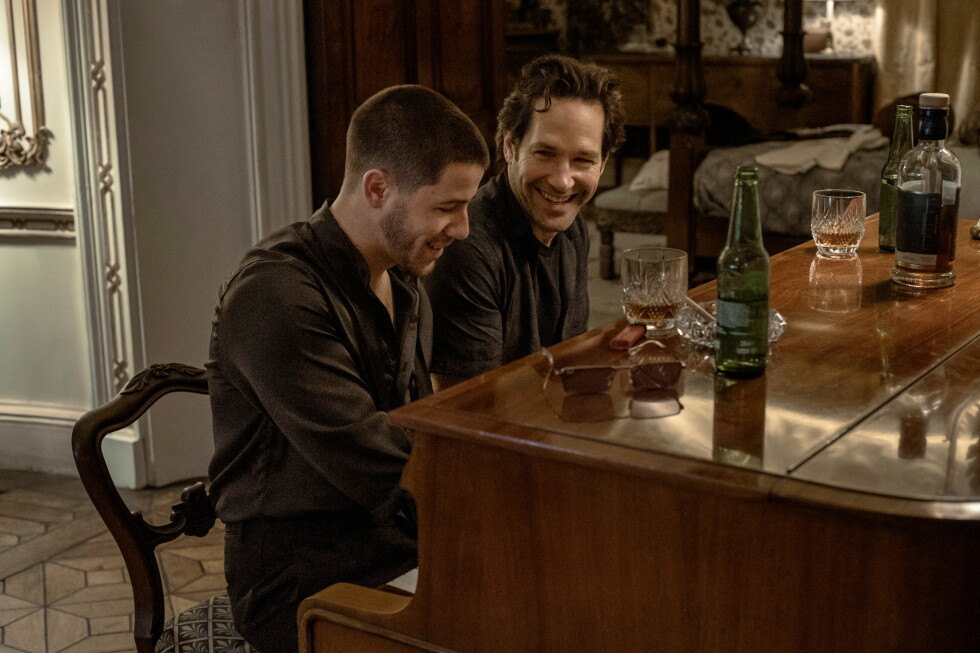
“Power Ballad” gives Paul Rudd and Nick Jonas a smart, soulful stage to play on, and both actors land in the right register. The film uses music not just as decoration, but as the force that pulls two very different performers into the same creative space.
John Carney returns to a familiar theme here: songs can change lives, expose ego, and reveal who gets heard in the music business. That idea runs through the film as a wedding band singer and a pop star cross paths, turning what begins like a fable into a story about ambition, authorship, and the price of recognition.
A wedding band world with little glamour
The movie opens in a setting that rarely gets much respect in pop culture: the wedding circuit. In the film, the Bride and the Groove survive by playing the crowd-pleasers, and one member sums up the job with a blunt line — they are “human jukeboxes.”
Paul Rudd plays Rick, an American musician who once had bigger rock-band dreams before settling into family life in Dublin. He still holds onto the hope that his songwriting matters, even if his nightly audience is usually more interested in “September” and “Celebration” than anything original.
That tension gives the film its early spark. Rick is not a washed-up dreamer in a tragic sense, but a capable musician who has simply found himself trapped between practical life and unrealized ambition.
The unexpected meeting that changes the tone
The story shifts when Danny, played by Nick Jonas, steps in at a castle wedding and performs Stevie Wonder’s “I Wish.” The moment works because the film does not treat Danny as a cartoonish celebrity or Rick as an automatic underdog.
Rick initially dismisses Danny’s kind of fame-driven pop music as “manufactured content for young, excitable teens,” but the performance quickly complicates that assumption. Danny proves he can sing, and more importantly, he proves he understands music as craft rather than image alone.
From there, the film’s most engaging passages emerge. Rick and Danny connect, jam together, and trade unfinished ideas, with Carney leaning into what he does best: showing creative energy as something almost spiritual when two musicians click.
Why the collaboration feels authentic
Carney has built much of his filmmaking around the redemptive side of music, from “Once” to “Sing Street” and “Flora and Son.” “Power Ballad” fits that tradition, but it also adds a sharper edge by focusing on invention, ownership, and the blurry line between inspiration and appropriation.
One of Rick’s songs, “How to Write a Song (Without You),” becomes the emotional and structural center of that conflict. The film treats the act of making music as something alive and collaborative, which makes the later dispute over who deserves credit feel more painful.
That second half moves the story away from the easy fantasy of a perfect duet. Instead, Rick ends up fighting to prove that the song he helped shape belongs to him too, and that struggle gives the film a more uneasy rhythm than its opening stretch.
Paul Rudd and Nick Jonas both find strong character beats
Rudd fits Rick especially well because the role lets him mix warmth, frustration, and quiet vanity without losing sympathy. His performance works less because of musical talent than because he plays the character as a charming, slightly ridiculous man who still believes he has one more great song in him.
Jonas also benefits from a part that avoids simple villainy. Danny may take the song and turn it into a hit, but the film gives him pressure from the music industry and a label executive who wants “Danny 2.0” without much confidence that he can deliver it.
That makes Danny more complicated than a typical thief figure. He adds a bridge, shapes the song, and uses his vocal power to elevate it, which keeps the conflict grounded in the messy reality of commercial music rather than pure moral outrage.
Where the film loses momentum
The movie’s biggest strength is also what makes its second half harder to sustain. The first part builds on chemistry, discovery, and the thrill of artistic possibility, while the later stretch moves into grievance and proof.
Without a recorded demo, Rick struggles to convince anyone that the song was his creation. Even his family and bandmates do not fully buy his version of events, which leaves him isolated inside a fight that should be obvious but is not.
Still, the film keeps returning to a larger question about authenticity. In a music culture where questions of authorship and image now overlap constantly, the story feels timely without needing to force the point.
A familiar Carney belief, with some friction
Carney’s work often insists that sincerity matters, and “Power Ballad” continues that argument even as it shows how hard it is to keep faith in it. The film suggests that the world may be less kind to heartfelt art now than it once was, but it still refuses to give up on the idea that a genuine song can cut through noise.
That belief gives the movie its emotional center, even when the plot becomes more uneven. Rudd and Jonas carry the material with enough conviction to make the central conflict feel rooted in real artistic stakes, not just a clever premise.
Rated R for “language throughout and some drug use,” the Lionsgate release runs 108 minutes and arrives as another earnest Carney drama about the stubborn power of music. “Power Ballad” may begin like a fairy tale, but it stays interesting because it understands that the fight over a song can be as dramatic as the song itself.