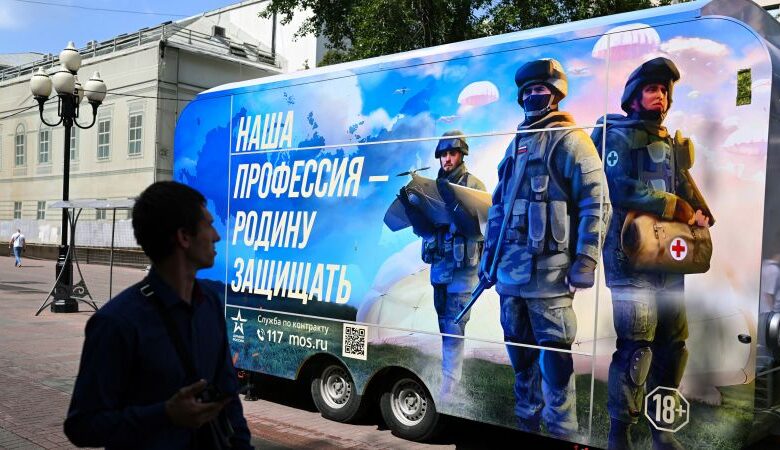
Russia is still trying to buy soldiers with huge cash bonuses, debt relief, and promises of fast-tracked citizenship. But the problem for the Kremlin is getting harder to hide: recruitment is slowing while the war keeps draining men, money, and industrial capacity.
That squeeze matters because Moscow has long relied on an attritional strategy, using its larger population and defense sector to outlast Ukraine. Now, according to www.cnn.com and Russian economy expert Janis Kluge, that advantage appears to be weakening just as the war is entering its fifth year.
Recruitment Incentives Are Getting Bigger
Men in Russia are being shown ads offering eye-watering sums to sign up, including an $80,000 bonus and, in some cases, $140,000 in debt relief. The military has also used roadside billboards and social media to promote service as a path to heroism or citizenship.
Yet those offers are not delivering the same results they once did. Kluge said military recruitment was down 20% in the first quarter of this year compared with 2025, and he added that there are signs the trend is still weakening.
| Recruitment incentive | What the article says |
|---|---|
| $80,000 bonus | Marketed to potential recruits as a major signing incentive |
| $140,000 debt relief | Offered to men who sign up and may otherwise face default penalties |
| Fast-tracked citizenship | Used as another recruiting promise |
Labor Shortages Are Hitting More Than The Front Line
Nigel Gould-Davies of the International Institute for Strategic Studies said this is the first war in Russia’s history in which the state is paying citizens to fight instead of forcing them. He warned that the approach is creating strain across both the military and the wider economy.
Russia has already sent tens of thousands of former prisoners to the front, relied on three waves of North Korean soldiers, and brought in some immigrants to help fill the ranks. But Gould-Davies said the incentive system may no longer be working effectively, and that Russia may now be losing more troops than it can recruit.
The shortage is also showing up in civilian life. Russia’s defense factories are reportedly running around the clock, leaving little room to increase output, while the same labor pool is needed to keep the broader economy functioning.
Putin Faces Harder Choices Ahead
The manpower problem could force President Vladimir Putin into steps he has tried hard to avoid. Analysts say that could mean another unpopular mobilization, or tighter restrictions on who can leave the country, especially men of conscription age.
That would carry political risks because the first partial mobilization triggered a wave of emigration and deep public unease. If Russia cannot keep replacing losses through cash and special incentives, the Kremlin may have fewer ways to sustain its war effort without upsetting more of its own population.
The labor crunch is also feeding inflation, since shortages are pushing wages higher at a time when nearly 500,000 Russian soldiers are believed by some Western intelligence reports to have died in the war and hundreds of thousands more have left to avoid being drafted. Gould-Davies said labor is a scarcer input than physical capital or finance, and far harder to replace quickly.
He added that the state can build a factory or raise money with effort, but it cannot dictate the birth rate. That leaves Russia looking for more workers abroad, including from India, North Korea, and several African countries, even as the war continues to consume the men it needs most.