


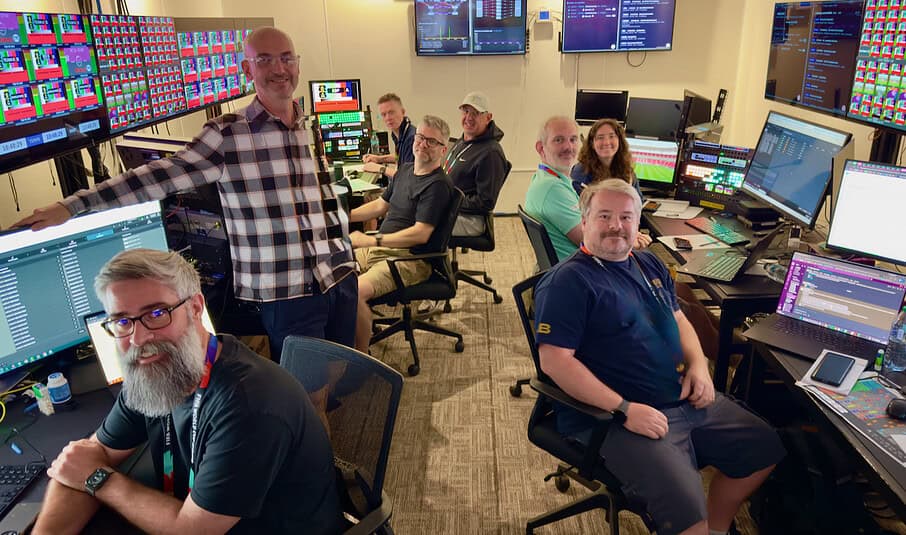
Fox Sports may have moved much of its World Cup production to Los Angeles, but its IBC team is still central to getting the tournament on air. The smaller footprint in the IBC remains critical for receiving venue signals, managing network paths, and feeding Fox’s production centers in Pico.
According to www.sportsvideo.org, coordinating technical manager Mike Davies and a team of about 50 are still responsible for the connections that bring in signals from all 16 match venues. Their job is to keep the flow moving between the IBC, Pico, Tempe, and Fox’s disaster recovery setup in New York.
Why the IBC still matters
Davies said HBS controls which providers can deliver IT services between the venues and the IBC, which makes Fox’s presence there essential. The IBC team handles Riedel comms, Sony camera shading, engineering, audio, and IT networking before passing the feeds onward to Pico, where the shows are assembled.
The setup also reflects how remote production has changed. HDR 1080p is now the native format in Pico, so Fox no longer needs LUT conversions, and the World Cup’s 59.94 frame rate removes the need for frame rate converters.
Encoding, redundancy, and transport
For encoding, Fox has moved to Appear X20, with 60 JPEG-XS paths using two 100 Gbps diverse circuits to Pico, two 100 Gbps to Tempe, and two 100 Gbps links between those facilities. Davies said the network can automatically reroute traffic via Tempe if a path between Fox and Pico is lost.
Fox is also using 26 Appear HEVC paths to Pico for content that can tolerate more latency and needs less bandwidth. Those feeds include press conferences, fan reaction shots, and match-action replays produced by HBS.
The resilience plan extends to SMPTE 2022-7 on the red and blue circuits, so packet loss is not visible to viewers. Davies noted that a 2022-6 decoder would expose the reroute as a half frame of black.
BRISK kits push more signals from the field
Fox also has six BRISK systems in the field, each an 8-to-12 camera setup deployed the day before a match at a venue. BRISK stands for Broadcast Remote IP Studio Kit, and the concept was developed by Fox Sports VP, Field Operations and Engineering Kevin Callahan and Doug McGee, with design by Diversified and in-house build work in Las Vegas by Lucas Pierce and Aaron Stevens.
The BRISK systems use EVS Cerebrum control, a redundant 2110 architecture, Arista IP backbone, Neuron video I/O, Calrec and Direct Out audio gear, and Sony HDC5500 cameras from Game Creek. Pico can receive up to 48 signals from the BRISK kits, while the production team can cut between venue shots, other stages, and reporter cameras at pitch side using LiveU bonded cellular encoders with CyanView Rio telemetry.
Dallas as the network hub
The signal workflow begins the day before a match, when venue circuits are lit and made available to rights holders. Those signals enter Fox Sports Jewel Event System 1, which is physically located in Dallas and serves as the network hub for incoming venue feeds, shading, and primary engineering, while Jewel Event System 2 is in New York.
FSJE1 includes TAG multiviewers, EVS Cerebrum integration and control, Calrec cores, and Arista 7508 switches handling uncompressed SMPTE ST 2110 traffic on both sides of the plant. Fox’s network engineering team, including Marc Fleury, Armin Vahaian, and Bryan Kolodziej, has also made JPEG XS traffic multicast-capable across the WAN.
That allows the same stream from a BRISK kit to be decoded in Pico, in the IBC for shading, and in FSJE2 in New York without decode-and-reencode steps. Signals also leave Dallas in formats suited to their destinations, including transmission-ready packages for Tempe and production versions with bespoke audio assignments for Pico.
Audio and monitoring round out the workflow
On the audio side, the IBC operation receives MADI streams and embedded audio, including commentary feeds and enhanced HBS packages. Two Calrec Impulse cores, one main and one redundant, handle audio processing and stream assembly with Direct Out Prodigy MX, while the aim is to keep delivery simple for downstream operators.
Fox has also added Grafana for real-time monitoring of traffic across the connected sites, including the 45 gigabits of red-path traffic to Pico, the links to Tempe, and the disaster recovery gallery in New York. If a fiber cut happens, the WAN traffic rules can reroute content via Tempe and across the inter-site 100Gb circuits without affecting the JPEG XS paths seen by viewers.
Fox’s IBC operation has 136 outbound paths, 48 inbound paths, four satellite paths, plus the BRISK feeds and LiveU redundancy. Even with a heavy reliance on 2110 and IP transport, Davies said the team still keeps some patch cords ready for emergency video moves when a failover path is needed.