


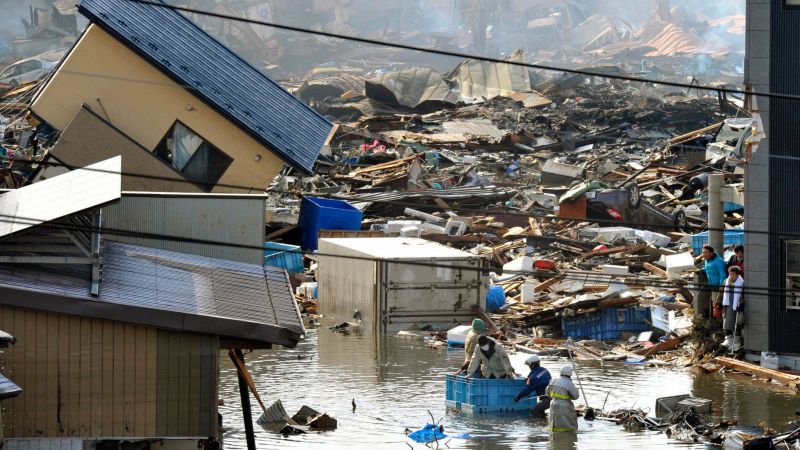
Japan’s devastating 2011 earthquake did more than unleash a tsunami and a nuclear crisis. New research suggests it also triggered a separate seismic event that shifted nearly the entire country eastward.
The movement was tiny, only 5 to 6 millimeters, but it appears to have been permanent. University of Chicago geophysicist Sunyoung Park and her colleagues say the signal was real, not a data glitch, and that it points to an “extraordinary” seismic phenomenon that had not been documented before.
A shift that spread across Japan
What makes the event unusual is its scale. Park said “the whole of Japan was moving nearly uniformly at the same time,” affecting mainland Japan from Hokkaido to Kyushu across roughly 1,800 miles.
The timing also stood out. The movement did not line up with the initial earthquake itself, and it happened before any significant aftershocks. According to the study, the displacement was tied to waves that traveled deep into Earth and then came back up to the crust.
After years of analyzing GPS and seismic data, Park’s team concluded that waves from the quake reached Earth’s core, bounced back, and displaced four major tectonic plates. Seismologists had known that some energy can travel down through the planet and reflect off the liquid-metal outer core, but they believed it would lose too much energy to matter at the surface.
Why scientists say this matters
Goran Ekstrom of Columbia University, who was not involved in the study, said the 2011 quake already moved the two plates sliding past each other under Japan by about 10 meters. That rapid motion generated the shaking and tsunami and also shifted Honshu east by about 20 centimeters.
The newly identified displacement was smaller, but it covered a much broader area than typical earthquake movement. Park said that broad footprint makes it the widest such event ever recorded and gives it an energy release similar to a magnitude 7.5 earthquake.
Park and her colleagues considered other explanations, including an undersea landslide, but argued those would have produced effects that were much more localized. Amanda Thomas of the University of California, Davis, said that if the interpretation is correct, the findings are “very significant.”
What the finding could mean for future risk
The March 2011 earthquake struck 231 miles northeast of Tokyo and killed an estimated 20,000 people. Park said policymakers should be aware of this previously unknown source of seismic hazard.
Unlike aftershocks, the round-trip journey to Earth’s core and back takes about 15 minutes, which means a similar event could in theory be anticipated. But because the energy is spread over such a wide region, Park said it would likely be felt less strongly and cause less damage than a typical magnitude 7.5 earthquake.
Japan’s dense network of seismic and satellite monitoring stations helped make the observation possible. Vedran Lekić of the University of Maryland said such a phenomenon could still occur elsewhere in poorly instrumented regions without being definitively documented.
Park said the powerful shaking from the main quake may have helped the core-bouncing wave reach the surface and reactivate the fault near the main rupture, while also triggering movement at more distant plate boundaries. She added that the finding offers another piece of the puzzle for understanding how faults continue to behave long after the first rupture ends.