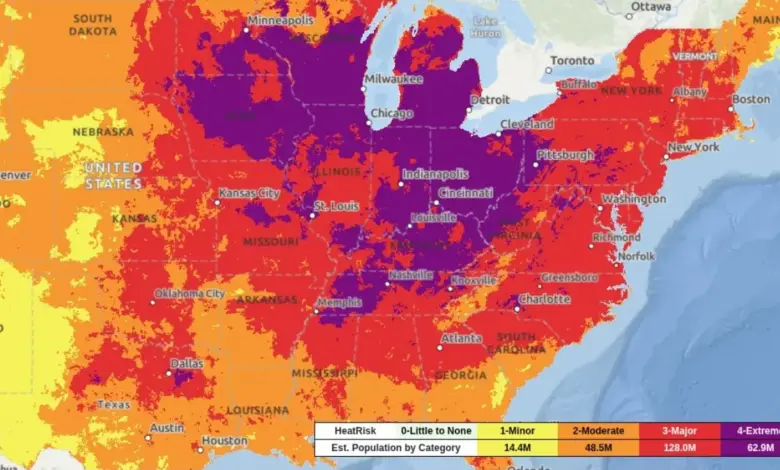
A broad and prolonged heat wave is set to push dangerous conditions across the central United States through next week and into the July 4 weekend. National Weather Service offices have already issued Heat Advisories and Extreme Heat Watches for parts of Kansas, Missouri, Illinois, Iowa, Nebraska, and South Dakota.
Many locations are expected to see heat index values above 100°F, while some areas could peak between 105°F and 110°F. The biggest concern is not only the afternoon heat, but also warm overnight temperatures that may prevent much-needed cooling.
Kansas and the St. Louis Region Face the Highest Heat Risk
In Kansas, Heat Advisories are in effect from 1:00 p.m. CDT Sunday, June 28, until 9:00 p.m. CDT Wednesday, July 1, across central, east-central, south-central, and southeast parts of the state. The forecast heat index in those areas is 100°F to 105°F.
An Extreme Heat Watch also covers north-central, northeast, and east-central Kansas from Sunday afternoon through Tuesday evening, June 30, where heat index values could reach 108°F. Eastern Kansas near the Missouri border is also included in a broader watch extending into adjacent parts of Missouri.
Illinois and Missouri are dealing with some of the most intense conditions in the warning area. Heat Advisories cover large stretches of both states from Sunday afternoon through Thursday night, with daily heat index values above 100°F expected, according to warnings issued by NWS offices and reported by watchers.news.
The St. Louis metropolitan area stands out in particular, with an Extreme Heat Watch in place from Sunday afternoon, June 28, through Thursday evening, July 2. That watch includes Madison, Monroe, and St. Clair counties in Illinois, plus Jefferson, St. Charles, St. Louis County, and St. Louis City in Missouri, where heat index values of 105°F to 110°F are possible.
Iowa, Nebraska, and South Dakota Also Under Long-Lasting Advisories
In Iowa, Heat Advisories begin at 1:00 p.m. CDT Sunday, June 28, in northwest, west-central, and southwest sections of the state. Depending on location, they remain in effect until 9:00 p.m. CDT Monday, June 29, or 9:00 p.m. CDT Tuesday, June 30, with heat index values generally ranging from 103°F to 105°F.
Much of Iowa is also under an Extreme Heat Watch from Sunday afternoon through Tuesday evening, June 30. Southwest Iowa is included in a separate watch tied to the Omaha metropolitan area, where heat index values may approach 108°F.
Nebraska’s advisories begin at 1:00 p.m. CDT Sunday, June 28, and stretch across much of the state. Eastern and southeastern Nebraska remain under advisory until 9:00 p.m. CDT Tuesday, June 30, while Cedar and Knox counties in northeast Nebraska have a shorter advisory ending at 9:00 p.m. CDT Sunday.
In southeast South Dakota, most advisories run from 1:00 p.m. CDT Sunday until 9:00 p.m. CDT Monday, while Bon Homme, Hanson, Hutchinson, and McCook counties are under a one-day advisory ending at 9:00 p.m. CDT Sunday. Forecast heat index values in these areas are expected to reach 103°F to 105°F.
Officials Warn of Heat Stress as Overnight Relief Stays Limited
Douglas and Sarpy counties in Nebraska, along with nearby counties in southwest Iowa, are also under an Extreme Heat Watch from Sunday afternoon through Tuesday evening, June 30. In those locations, heat index values may again reach 108°F.
The National Weather Service warns that prolonged exposure can sharply raise the risk of heat-related illness, especially during the afternoon and early evening when apparent temperatures are highest. Several forecast areas are also expected to stay unusually warm overnight, adding to cumulative heat stress over multiple days.
Residents in affected areas are being urged to drink plenty of water, limit strenuous outdoor activity during the hottest part of the day, seek air-conditioned spaces when possible, and keep monitoring official forecasts for updates. The current round of advisories and watches highlights how quickly dangerous heat can spread across multiple states at once.
References noted in the alerts include an Extreme Heat Watch and a Heat Advisory issued by NWS on June 27, 2026.