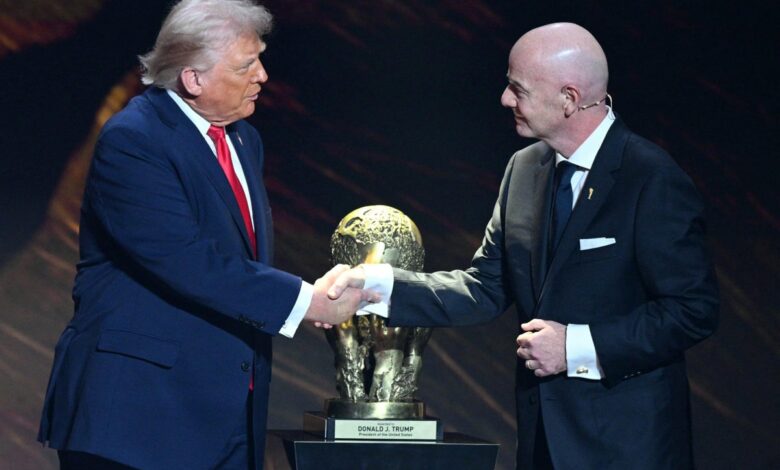
Fifty members of the European Parliament have urged FIFA to confront an ethics complaint over Gianni Infantino’s decision to award Donald Trump the inaugural FIFA Peace Prize. The move adds new political pressure to a case that already questions whether FIFA’s president crossed the line on neutrality.
The complaint was filed in December with FIFA’s Ethics Committee by FairSquare, a non-profit advocacy group focused on labour migration rights, political repression and sport. It alleges repeated breaches of FIFA’s duty of political neutrality and asks for an investigation into how Trump was chosen for the prize.
What the complaint says
| Issue | What FairSquare alleges | Related moment |
|---|---|---|
| Trump Nobel post | Infantino publicly backed Trump for the Nobel Peace Prize | Instagram post on October 9 |
| Miami remarks | Infantino took a political position and urged support for Trump’s agenda | America Business Forum on November 5 |
| Peace Prize ceremony | Infantino endorsed Trump’s foreign policy and ongoing conflicts | World Cup draw in Washington, D.C. |
| Pre-inauguration video | Infantino echoed MAGA-style language and signaled support | Instagram video on January 20, 2025 |
FairSquare says Infantino’s comments and appearances amount to “four clear breaches” of FIFA’s neutrality rules. It argues that FIFA’s statutes require the organization to remain neutral in matters of politics and religion, and that the Code of Ethics requires political neutrality in dealings with government institutions.
One of the most direct claims centers on Infantino’s October 9 Instagram post, in which he wrote that Trump “definitely deserves the Nobel Peace Prize for his decisive actions.” FairSquare says that was a clear personal endorsement of Trump in a politically sensitive context.
Another flashpoint came on November 5 at the America Business Forum in Miami, where Infantino described Trump as “a really close friend” and defended the U.S. president’s election and agenda. He said Trump should be supported because he was elected and was doing what he said he would do.
FairSquare also points to the December presentation of the FIFA Peace Prize during the World Cup draw in Washington, D.C. Infantino told Trump, “This is what we want from a leader … you definitely deserve the first FIFA Peace Prize for your action for what you have obtained in your way but you obtained it in an incredible way and you can always count, Mr President, on my support.”
Why European lawmakers stepped in
The MEPs who signed the letter say FIFA must address the complaint and show that it still stands for “fairness, equality, and respect for human dignity.” The letter was sent to Infantino and members of the FIFA Council, with copies also sent to FIFA General Secretary Mattias Grafstrom and FIFA’s investigatory chamber.
Signatories come from Ireland, Germany, Spain, France, Belgium, Italy, Luxembourg, Denmark, Slovakia and the Netherlands. Irish MEP Barry Andrews, Dutch MEP Lara Wolters and Danish MEP Niels Fuglsang were among the main organizers.
The Norwegian Football Association has already backed the complaint, with president Lise Klaveness saying Infantino made the prize decision without consulting the FIFA Council. She also said the question of neutrality should be assessed by FIFA’s ethics body.
According to FIFA, its Independent Ethics Committee is responsible for investigating possible infringements of the Code of Ethics. The committee has investigatory and adjudicatory chambers, and sanctioning powers can include a warning, reprimand, fine, compliance training or a ban from football-related activity.
The complaint also asks FIFA to investigate the process that created the FIFA Peace Prize itself. FairSquare says the award to a sitting political leader is, on its own, a breach of neutrality, and argues that the decision should have gone through the FIFA Council under Article 34 of FIFA’s statutes.
FIFA and the White House have been approached for comment, while the Ethics Committee now faces renewed scrutiny over whether it will act on a case that has moved far beyond football.
<<