

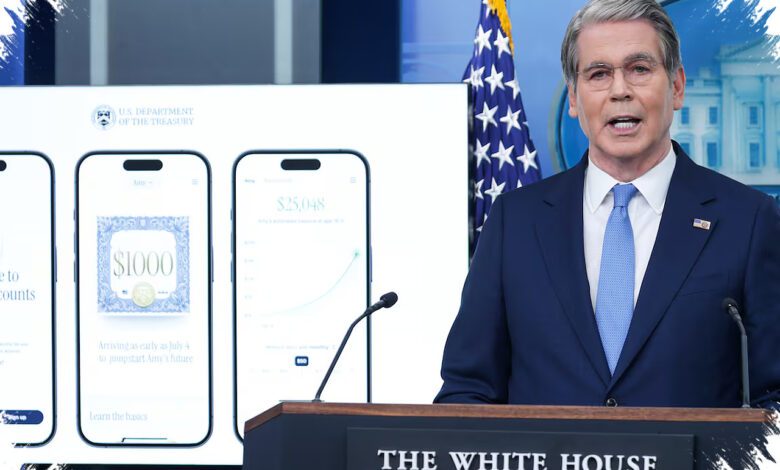
Millions of children now have access to a new investment account seeded with $1,000 from the government, but the real story is how the program may reshape family saving habits over time. The Trump Accounts also arrive with a built-in tension: broad eligibility on one side, and concerns about branding, access, and long-term usefulness on the other.
There are no income requirements or limits that prevent families from enrolling their children. Along with the initial $1,000 government contribution, families can add up to $5,000 a year, and the money must stay in low-cost index funds.
Enrollment Is Already Hitting Millions
By mid-June, Treasury data showed more than 6 million children had been registered for a Trump Account, including 1.4 million who qualify for the program. Millions more eligible children have not yet been signed up.
Many families enrolled during tax season, either by filing Form 4547 or through TrumpAccounts.gov. Treasury Secretary Scott Bessent has described Form 4547 as “the most aptly named tax document of all time.”
| Trump Accounts At A Glance | Details | Source | Notes |
|---|---|---|---|
| Government seed money | $1,000 | Treasury program details | Available for eligible children |
| Annual family contribution limit | Up to $5,000 | Treasury program details | Families can add money each year |
| Investment rule | Low-fee index funds only | Treasury program details | Restricted investment menu |
| Reported registrations | More than 6 million children | Treasury data | As of mid-June |
A Big Experiment With Political Branding
The program was authorized last year as part of the One Big Beautiful Bill Act, the Republican tax-and-spend law, but the idea behind government-backed child wealth accounts has been discussed for decades. Elaine Maag of the Urban-Brookings Tax Policy Center called Trump Accounts the largest-scale experiment of their kind in the country.
She also said BNY and Robinhood, the companies managing the accounts, stand to gain large numbers of new customers. Ray Boshara, who has advised both parties on similar legislation for years, said the concept has bipartisan roots and is again drawing support across party lines.
Republicans named the program after Trump, continuing a pattern from his first term in which his name became attached to government initiatives that sent money directly to citizens. His signature appeared on pandemic stimulus checks, and he promoted later proposals for rebate checks and IRS refunds as well.
That branding has not helped everyone feel enthusiastic. Boshara said he has “heard anecdotally that some families are not signing up for Trump Accounts because of the name.”
What Families And Advisors See In The Program
Some parents are looking past the name and focusing on the financial opportunity. Boston-based financial coach Kimberly Zimmerman Rand said she would advise clients not to “let the name dissuade you from the opportunity.”
Kevin Smee, a Democrat from Leominster, said he is considering opening an account for his two-month-old daughter even though he believes “Trump is probably one of the worst presidents we’ve ever had.” He said, “I felt like I owed my daughter that much. If this is actually something beneficial, swallow your pride a bit and sign up for it.”
The long-term structure matters just as much as the initial deposit. When a child turns 18, the account automatically becomes an individual retirement account, and most withdrawals before age 59½ are penalized unless they fit exceptions such as a first-time home purchase, medical expenses, or higher education.
Rand said that setup raises practical questions for young adults who may need cash for rent, a car, or other short-term costs. She argued that access at 18 could tempt some account holders to treat the balance like spending money rather than a retirement asset.
Wealth Gap Questions And Outside Support
Critics say the accounts may not help equally unless families have room to contribute beyond the government’s initial deposit. Michael Lind, co-founder of New America, said the restrictions reflect an ulterior purpose: laying the groundwork for a phase-out of Social Security benefits.
Bessent has also described Trump Accounts as “a backdoor way for privatizing Social Security” at a Breitbart News event last year, and said accounts growing into the hundreds of thousands of dollars could reduce the government’s Social Security burden.
Elaine Maag said the lack of asset limits means the program could widen the wealth gap if higher-income families participate at much higher rates. Treasury data showed 86 percent of children signed up come from families earning less than $200,000 a year, though Maag noted that still overrepresents wealthier households because nearly 95 percent of households with children under 18 earn below that level.
Rand said the government is offering the accounts without the financial education that many low-wealth families would need to get the most out of them. She said, “An account plus education can really do a lot.”
Some nonprofits, including Boston-based Commonwealth, are offering free support to low- and moderate-income families. Boshara said the most important change would be getting low-income families into the stock market, and he pointed to automatic enrollment, extra government deposits for low-wealth families, and an extension beyond 2028 as possible improvements.
The White House Council of Economic Advisers said a Trump Account maxed out at $5,000 a year could grow to more than $300,000 by the time a child turns 18, assuming moderate returns. With only the initial $1,000 and no additional contributions, the council projected a balance of little more than $5,000.
Several major companies, including Bank of America, Uber, and Chipotle, have pledged to match employee contributions. Michael Dell and his wife, Susan, are donating $6.25 billion to the accounts of children born between 2016 and 2024 in ZIP codes with median household income of $150,000 or less, while Ray Dalio has committed $250 to every account for similarly eligible children in his home state.
Boshara said the broader appeal is that the accounts can function as a shared investment in children’s futures. “What looks like an individual [investment] account, really is a community asset,” he said.