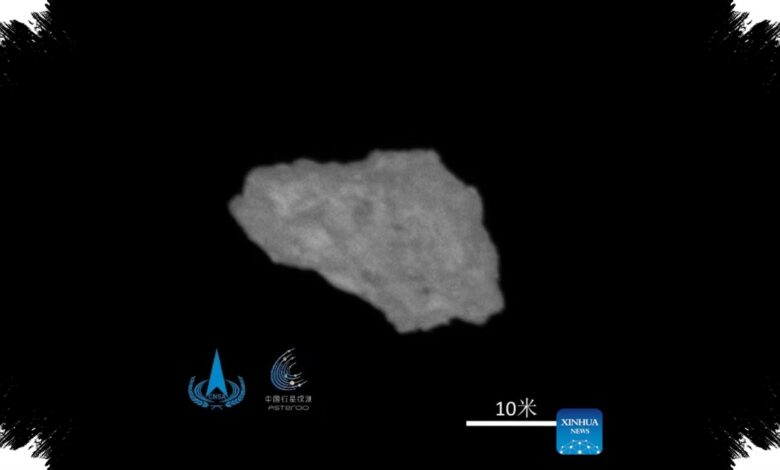
China’s Tianwen-2 probe has sent back the first image of Kamo’oalewa, the tiny asteroid better known as Earth’s elusive quasi-moon. The picture marks an early milestone in a mission that could eventually bring a sample of the object back to Earth.
The spacecraft launched in 2025 and traveled about 620 million miles, or 1 billion kilometers, to reach a point roughly 12 miles, or 20 km, from the object formally known as asteroid 2016HO3. It will now spend nearly a year studying the asteroid with 11 scientific instruments before trying to collect material from its surface.
What the new image shows
According to China’s Xinhua news outlet, the photo was taken on July 2 and shows Kamo’oalewa as a small, irregular rock measuring about 50 to 65 feet, or 16 to 20 meters, across. The image adds detail to a body that has remained difficult to study from Earth despite its unusual path around the Sun.
Some scientists think the asteroid may not have formed in the main asteroid belt at all. One idea is that a massive impact knocked a chunk of the Moon into space between 1 million and 10 million years ago, creating the object now seen as a quasi-moon.
Why Kamo’oalewa stands out
Quasi-moons, also called quasi-satellites, are small bodies that orbit the Sun in a way that keeps them close to Earth. Earth has at least seven known quasi-satellites, and its gravity can briefly capture others before they are sent back into solar orbit.
Those paths are less stable than the orbit of a true moon, which is why Kamo’oalewa has drawn so much attention from scientists. A 2024 study in Nature Astronomy suggested that the object could be material ejected from the Moon by the impact that formed Giordano Bruno crater.
A successful sample return could help test that idea directly. If Tianwen-2 manages to bring material home, the asteroid’s makeup may offer clues about whether it really came from the Moon.
China’s growing deep-space ambitions
Tianwen-2 launched on May 28, 2025, aboard a Long March 3B rocket from Xichang spaceport in southwestern China. China’s space agency later released the first image beamed home by the spacecraft when it was about 1.8 million miles, or 3 million km, from Earth.
The mission is China’s first attempt to sample an asteroid, but it is not the country’s first interplanetary project. Tianwen-1 sent an orbiter and rover to Mars in 2020, and more Tianwen missions are already planned.
China aims to launch Tianwen-3, a Mars sample-return mission, in 2028, followed by Tianwen-4 two years later to study Jupiter and Uranus. For now, though, the focus stays on Kamo’oalewa, a small object with an orbit and origin that could still reshape what scientists know about near-Earth space.
| Mission | Target | Key Detail | Status |
|---|---|---|---|
| Tianwen-2 | Kamo’oalewa / asteroid 2016HO3 | 11 scientific instruments, possible sample return | Studying the asteroid |
| Tianwen-1 | Mars | Orbiter and rover reached Mars in 2020 | Completed |
| Tianwen-3 | Mars | Planned Mars sample-return mission | Planned for 2028 |
| Tianwen-4 | Jupiter and Uranus | Mission to study both planets | Planned for 2030 |
The next phase of Tianwen-2 will be the most important one: a long period of close study followed by a possible attempt to gather a sample from the asteroid’s surface. If that succeeds, Kamo’oalewa may become one of the most informative near-Earth rocks ever visited by a spacecraft.