


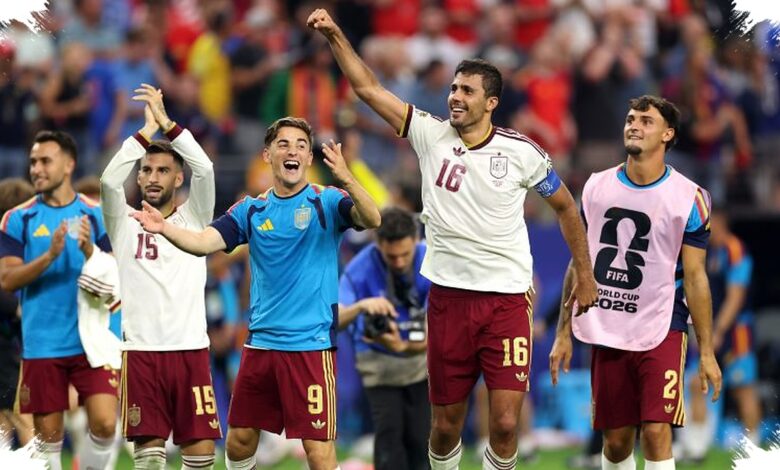
Spain’s World Cup run is starting to look like a familiar script: control the ball, stay calm under pressure and find a way through by the narrowest of margins. After a 2-0 semifinal win over France, the resemblance to the country’s 2010 title march is hard to ignore.
The comparison is not just about results. Spain have blended the old strengths of their identity with a more direct threat on the wings, and that mix has put them one step from another championship in a tournament that had already tested them early.
A Familiar Path Back to the Final
Against France, Spain again looked composed in the moments that mattered. The midfield dictated the game, the defense held firm and the team moved into the final with the kind of authority that has defined its best World Cup nights.
That formula has brought back memories of 2010, when Spain recovered from a shocking opening loss to Switzerland before steadily grinding through the tournament. CNN Sports noted the similarity, from the early setback to the semifinal control, even if this version of Spain has added a different attacking edge.
| Spain Then | Spain Now |
|---|---|
| Won through possession and midfield control | Still built around midfield control, but with more wing-driven threat |
| Recovered after losing the opener to Switzerland | Rebounded after an early loss to Cape Verde |
| Reached the knockout rounds with narrow wins | Has advanced with tight, controlled victories |
From Tiki-Taka To Something More Direct
This Spain side is an evolution of the tiki-taka team that dominated from 2008 to 2012. The difference is that the current version has leaned less on repetitive possession for its own sake and more on dynamic play from the flanks.
That shift helped power the Euro 2024 triumph, where Lamine Yamal and Nico Williams gave Spain the kind of width and unpredictability that old opponents often struggled to handle. Heading into this World Cup, though, both wingers were not fully fit, forcing Luis de la Fuente to adapt.
Spain struggled in the opening match against Cape Verde while trying to keep the same Euro 2024 style without both of its wide threats. De la Fuente has since been credited with returning the team to its roots while adding his own touch, which one line in the piece describes as “Tiki-taka con un poquitín de magia por las bandas.”
Rodri And The Midfield Still Set The Tone
The midfield remains the core of Spain’s identity, and against France it was decisive again. Fabián Ruiz and Dani Olmo were outstanding, but Rodri stood out as the team’s main organizer and connector.
Rodri’s return to full form gives Spain a stabilizing presence in the center of the pitch. The Manchester City midfielder controlled tempo, linked the lines and even used a touch of gamesmanship late on as France faded.
The defense also delivered another strong display. Aymeric Laporte, Pau Cubarsí, Pedro Porro, Marc Cucurella and Unai Simón all played important roles, even if Simón’s handling briefly raised the tension for Spain supporters.
The Wingers Could Decide The Final
Yamal was uneven at times, but he still produced the move that drew the penalty which put Spain ahead for good. Williams then came off the bench in the 83rd minute and showed enough to suggest he could have a bigger role in the final.
If Yamal reaches top form at MetLife, Spain will believe it has a strong chance of winning a second world title. The team now carries the look of a side that knows how to control big games, yet also has the pace and directness to hurt opponents in a different way than the classic 2010 side.
That is what makes this run feel less like a coincidence and more like a possible repeat of history. The only question left is whether Spain can turn the resemblance into another title on Sunday in East Rutherford.