


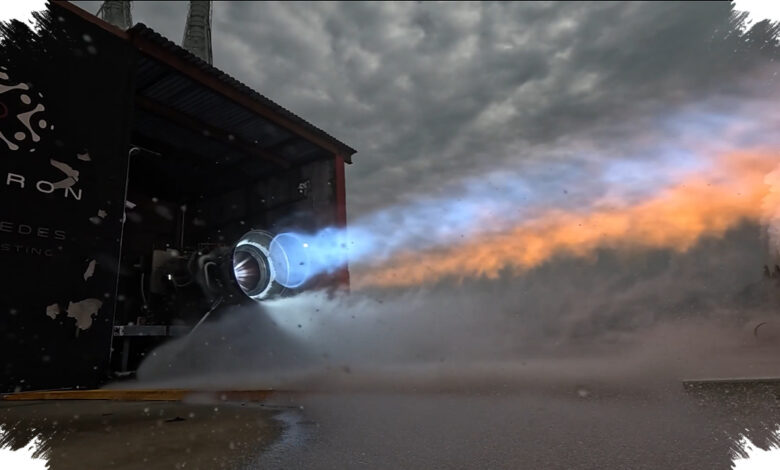
Rocket Lab has completed a full-duration firing of the vacuum version of its Archimedes engine, a major milestone for the company’s reusable Neutron rocket. The test ran for just under 5.5 minutes at NASA’s Stennis Space Center in Mississippi.
The successful burn moves a key piece of Neutron’s upper stage closer to integration with the launch vehicle. Rocket Lab described the test in a social media post as “critical preparation for Neutron’s first flight.”
A Different Upper-Stage Engine
Neutron’s second stage will use one vacuum-optimized Archimedes engine, known as AVac, to provide the final push for payloads heading to orbit. Its extended nozzle is designed for the vacuum conditions of space and stands about 2.5 meters taller than the engines used on the first stage.
For the ground test, Rocket Lab fitted the AVac engine with a shorter sea-level skirt rather than its full vacuum nozzle. The company said the change helps avoid flow separation and instability that can occur when a full-length vacuum nozzle operates at ground-level pressure.
| Engine | Role | Key Details |
|---|---|---|
| Archimedes | Neutron first stage | Eight engines provide nearly 1.5 million pounds of liftoff thrust combined. |
| AVac Archimedes | Neutron second stage | Vacuum-optimized nozzle is about 2.5 meters taller and produces 1.2 times the thrust of a first-stage engine in vacuum. |
Neutron’s Reusable Design
Neutron is designed with a recoverable first stage that can return to land either at its launch site or on droneship vehicles at sea. That approach places it in a similar broad category to SpaceX’s Falcon 9, whose first stage is also intended for reuse.
Each first-stage Archimedes engine has output comparable to a Merlin 1D engine used on Falcon 9’s first stage, according to www.space.com. Neutron’s eight-engine arrangement is intended to deliver nearly 1.5 million pounds of thrust at liftoff.
The rocket also uses an unusual payload-fairing system that remains attached to the vehicle instead of being discarded in space. Its fairing halves open like a clamshell, a mechanism Rocket Lab calls the “Hungry Hippo.”
Once those fairing halves open, Neutron’s second stage emerges and continues the mission with the AVac engine. This arrangement differs from conventional rockets, which typically jettison their protective payload fairings after leaving the densest part of the atmosphere.
Schedule Pressure Remains
Rocket Lab had previously targeted late 2025 for Neutron’s debut, then moved the goal to the first half of 2026 as development continued. The program also faced a setback in January, when the main stage tank ruptured during a pressure test at the company’s Wallops, Virginia, launch facility.
Despite those delays, Rocket Lab founder and CEO Peter Beck has said the Neutron team is focused on reaching orbit when the vehicle is ready rather than meeting an arbitrary launch date. The completed AVac firing adds an important engine milestone as the company works toward that first mission.