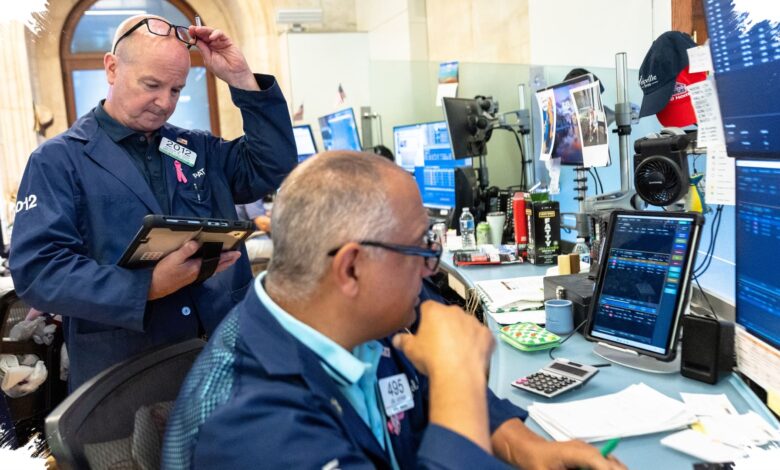
U.S. stock futures were mixed early Monday as a rise in oil prices and escalating Middle East tensions added fresh pressure to an already fragile market mood. Investors were also preparing for a consequential week of reports from several of the market’s largest technology companies.
Stock Market Futures pointed to a narrowly higher start for the S&P 500 and Nasdaq-100, while futures tied to the Dow Jones Industrial Average were nearly unchanged. The cautious tone followed weekly losses for all three major U.S. averages, with chip stocks driving much of the recent weakness.
| Market Indicator | Early Monday Move | Recent Context |
|---|---|---|
| S&P 500 futures | Up 0.2% | S&P 500 fell 1.6% last week |
| Nasdaq-100 futures | Up 0.5% | Nasdaq Composite sank 2.9% last week |
| Dow futures | Down 14 points | Dow lost 0.9% last week |
Oil Prices Add to Geopolitical Anxiety
Oil Prices climbed after tensions between the U.S. and Iran intensified over the weekend. West Texas Intermediate futures rose 3% to above $85 per barrel, while Brent crude gained 3% to more than $91 a barrel.
The U.S. military began a ninth consecutive night of strikes against Iran on Sunday, extending a campaign targeting Tehran’s capacity to attack commercial shipping in the Strait of Hormuz. The escalation put additional strain on a fragile truce between the two countries.
U.S. Central Command said a third service member had been killed during the recent fighting. It also said American forces found unidentified remains near the site of an Iranian attack in Jordan on July 17 that killed two people, and that efforts to identify the remains were underway.
Semiconductor Weakness Remains a Key Risk
Semiconductor shares were a major drag on the market last week, with the VanEck Semiconductor ETF losing nearly 9% for its third weekly decline in four weeks. The sell-off came as pressure on chip stocks weighed heavily on broader investor sentiment.
Jonathan Krinsky, chief market technician at BTIG, said the sector could rebound in the short term but may not yet have reached the kind of washout that signals a durable bottom. Speaking on CNBC’s “Closing Bell: Overtime” Friday, he said, “It’s probably premature to look for a bottom there.”
Krinsky pointed to heavy upside trading volumes in names including Micron only two weeks earlier as a reason for caution. His view suggests that even a near-term bounce may not settle concerns about the depth of the semiconductor pullback.
Big Tech Earnings Take Center Stage
Big Tech Earnings will provide the next major test for investor confidence as Alphabet and Tesla are scheduled to report after the bell on Wednesday. Intel is due to release results on Thursday after its shares dropped 13% last week amid the drawdown in chip prices.
Outside the U.S., Asia-Pacific trading was mixed as investors monitored the same geopolitical developments. South Korea’s Kospi fell 0.74% at the open and the Kosdaq declined 1.66%, while Australia’s S&P/ASX 200 rose 0.34%; Japanese markets were closed for a holiday.