


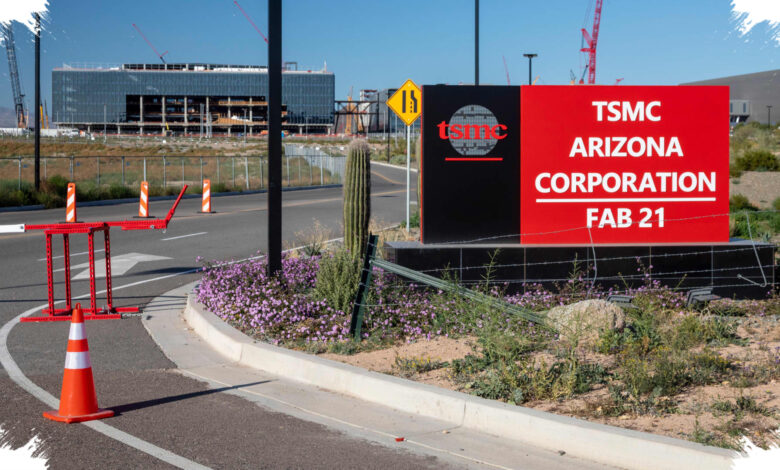
TSMC is accelerating its Arizona manufacturing expansion with an additional $100 billion commitment, lifting its total U.S. investment pipeline in the state to $265 billion. The push reflects what the company describes as a structural, multiyear surge in demand for AI-related chips.
Chief Financial Officer Wendell Huang said the expansion is being driven by strong customer demand in the U.S. market and government support. In comments reported by www.cnbc.com, Huang said TSMC intends to capture as much of the opportunity as it can while the AI megatrend remains intact.
Arizona Expansion at a Glance
The new funding is aimed at expanding both the front-end wafer fabrication footprint and back-end advanced packaging capacity in Arizona. TSMC has also raised its full-year capital expenditure outlook to between $60 billion and $64 billion.
| Area | Latest Detail |
|---|---|
| Additional Arizona commitment | $100 billion |
| Total Arizona investment pipeline | $265 billion |
| Full-year capital expenditure outlook | $60 billion to $64 billion |
| Operating Arizona technology | 4-nanometer process in phase one |
Capacity Is Shifting Toward More Advanced Chips
TSMC is optimizing its leading-edge production capacity to serve customers seeking more powerful and efficient processors. Huang said the company is rapidly converting 5-nanometer capacity to the more advanced 3-nanometer node.
The nanometer measurement refers to the size of individual transistors on a chip, with smaller transistors allowing more components to be packed into a semiconductor. TSMC’s 2-nanometer technology became a revenue contributor in the second quarter and is expected to become its newest revenue driver heading into the third quarter.
The company’s first Arizona phase, which uses 4-nanometer technology, is already operating. Huang said that capacity is set to become “bigger and bigger in the next few quarters.”
Higher Costs Are Part of the U.S. Buildout
Building fabs in the U.S. costs four to five times more than building them in Taiwan, according to Huang. He said the initial dilution from overseas operations will widen as those activities scale, but the investment should also support the development of the U.S. semiconductor ecosystem.
Huang framed the company’s approach as a balance between expansion and profitability. “We’re seeing this strong-structure, multi-year demand, and we do not plan to leave any food on the table for anybody else,” he said.
TSMC’s shares rose 1.23% ahead of its earnings release before reversing on Friday to close down 7.29%. The stock remained up about 48% year to date, though Huang said the company cannot control financial markets and must focus on its business fundamentals.
China Exposure and Future Growth Areas
TSMC continues to comply with export controls while serving customers in China, which account for about 8% of its total revenue. Huang also said the company sees limited impact from rising component prices because of its strategic focus on the high-end market.
Beyond AI processors, TSMC is looking at physical AI and specialty technologies as future growth areas. Its joint venture with Sony for image sensors is part of a longer-term effort to support customer growth in those technologies.