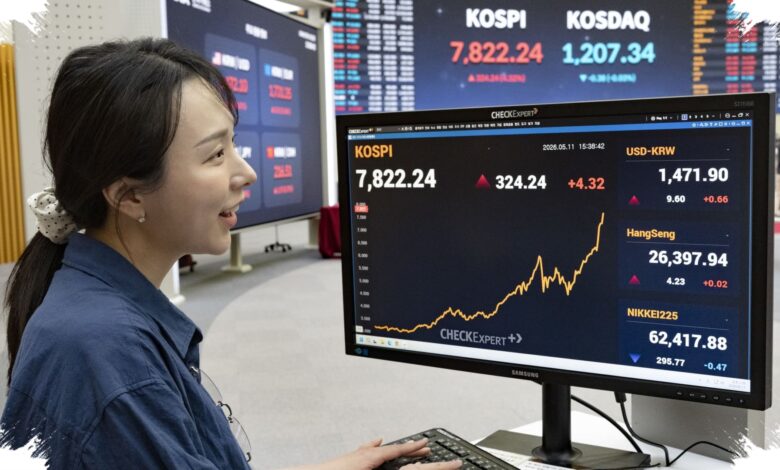
South Korean retail investors who chased the country’s AI-fueled chip rally through leveraged funds are facing severe losses after a sharp market reversal. The fallout has been especially painful in products tied to Samsung Electronics and SK Hynix.
The KODEX SK Hynix Single Stock Leverage ETF, designed to deliver twice SK Hynix’s daily share-price move, has fallen about 70% from its June record high. It is also down roughly 50% from its debut, according to LSEG data cited by www.cnbc.com.
Retail Investors Absorbed the Losses
Jung In Yun, founder of Fibonacci Asset Management, said the investors suffering the losses are “overwhelmingly domestic retail investors.” Online trading forums reflected the distress after SK Hynix recorded a one-day plunge last week.
One investor wrote, “I want to go back to before I started investing in stocks. Give me my money back.” Another posted, “You’re determined to kill me.”
Since single-stock leveraged ETFs launched on May 27, South Korean retail investors have made net purchases of 14 trillion won ($9.4 billion). Foreign investors purchased roughly 2 trillion won over the same period, according to KB Financial Group.
| Measure | Figure | Source |
|---|---|---|
| Net purchases by domestic retail investors | 14 trillion won ($9.4 billion) | KB Financial Group |
| Net purchases by foreign investors | Roughly 2 trillion won | KB Financial Group |
| KODEX SK Hynix ETF decline from June high | About 70% | LSEG |
| KODEX SK Hynix ETF decline from debut | Roughly 50% | LSEG |
Leverage Became a Bigger Part of the Market
Assets in the 25 largest Korea-focused Leveraged ETFs rose to about 30% of the relevant fund market by June. That share was about 15% at the start of 2026, according to Oxford Economics data.
Oxford Economics downgraded South Korean equities to neutral at the end of June. The firm warned that leveraged positioning had expanded and securities firms could become more reluctant to extend credit to retail investors.
The Bank of Korea said last month that leveraged stock investment by retail traders had climbed to a record high. It attributed the increase mainly to margin borrowing and increasingly concentrated semiconductor positions.
The central bank said the build-up was unlikely to become a systemic threat to the financial system. However, it warned that leverage can amplify volatility during a correction, particularly when fear of missing out pushes investors to buy with borrowed money.
New Restrictions Raise the Entry Barrier
South Korean regulators unveiled tougher rules for single-stock leveraged ETFs on Thursday after sharp swings in Samsung Electronics and SK Hynix. Investors will need to post at least 30 million won in cash to trade the products.
The new threshold is far above the previous effective minimum of 3 million won. The measures seek to curb speculative retail trading in highly volatile single-stock funds.
Peter Kim, head of global investment strategy at KB Financial Group, said the losses show how these products have become vehicles for speculation rather than long-term investing. He said there were no signs of a massive retail bailout of the market, though persistent volatility could contribute to a prolonged slump.
Thomas J. Hayes, chairman and managing member of Great Hill Capital, described semiconductors and memory stocks as the most crowded global trade among institutional and retail investors. He said the crowded positioning could unwind as aggressively as it had built during the rally.