

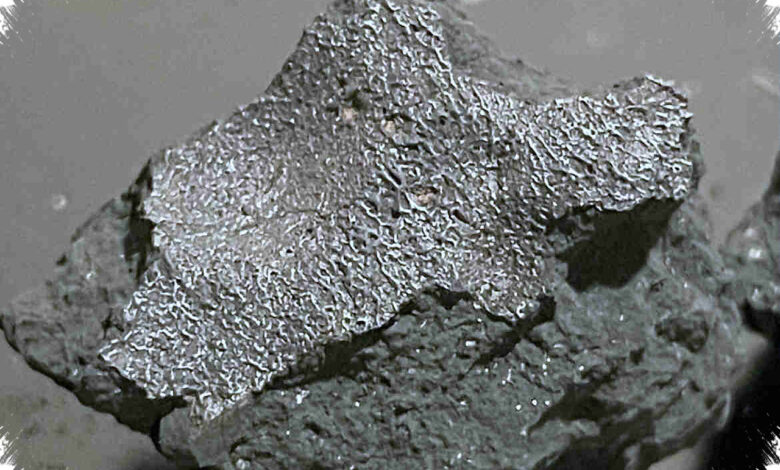
A meteorite that landed in Hillsborough, New Jersey, has revealed an unusually complex mix of briny chemistry and organic compounds. Scientists say its contents may offer a closer look at chemical processes that helped build Earth’s prebiotic inventory.
The space rock contains soluble organic molecules, including amino acids and carboxylic acids, that could have been delivered to the early Earth by carbon-rich asteroids. Its chemistry also indicates that water altered the meteorite more extensively than most comparable samples.
Brines May Have Shaped Complex Molecules
Salt-rich fluids can keep phosphate dissolved, allowing it to remain available for chemical reactions. Brines can also catalyze reactions between organic materials and minerals, potentially creating molecules important to life.
According to findings shared by www.seti.org, the Hillsborough sample contains a broad range of soluble organic compounds. Researchers found that many of them appear to be products of reactions involving organic matter and minerals.
Phil Schmitt-Kopplin, an organic mass spectrometry specialist at the Technical University Munich, said a high proportion of the compounds reflected organic chemistry involving minerals. He said it remains unclear whether magnesium-containing organic compounds formed through brine chemistry or were remnants of earlier impact-shock processes.
Carbon and Nitrogen Point to a CM-Type Origin
Cosmochemist Queenie Chan of Royal Holloway University of London and biogeochemist Nana Ogawa of JAMSTEC said isotope studies support the meteorite’s classification among primitive carbonaceous chondrites. The carbon and nitrogen signatures were typical of CM-Type Meteorites, a group known for carrying organic material.
| Component | Amount by Weight | What Researchers Found |
|---|---|---|
| Carbon | 1.8% | Its isotope signature was typical of CM-type meteorites. |
| Nitrogen | 0.07% | Its isotope signature also matched CM-type meteorites. |
“Isotope studies of carbon and nitrogen suggest that primitive carbonaceous chondrites, including CM-types, delivered organic matter to the early Earth,” Chan and Ogawa said. Their assessment linked the Hillsborough sample’s composition to a class of meteorites that may have supplied key organic ingredients before life emerged.
Amino Acids Formed Inside the Parent Body
Danny Glavin of NASA’s Goddard Space Flight Center and colleagues in the Goddard Astrobiology Analytical Lab examined the meteorite’s amino acids and other soluble molecules. Their analysis suggests the complex amino-acid distribution formed within the meteorite’s parent body, likely with help from brine fluids.
The amino acids resemble compounds previously detected in more moderately altered CM2 chondrites. The results support the idea that CM-type bodies could have contributed amino acids, carboxylic acids, and other materials to Earth’s early Prebiotic Chemistry.
Some fragments of the Hillsborough Meteorite will be curated at the American Museum of Natural History in New York City. Curator Denton Ebel said the institution was thrilled that “nature delivered such a precious asteroid sample on our doorstep.”