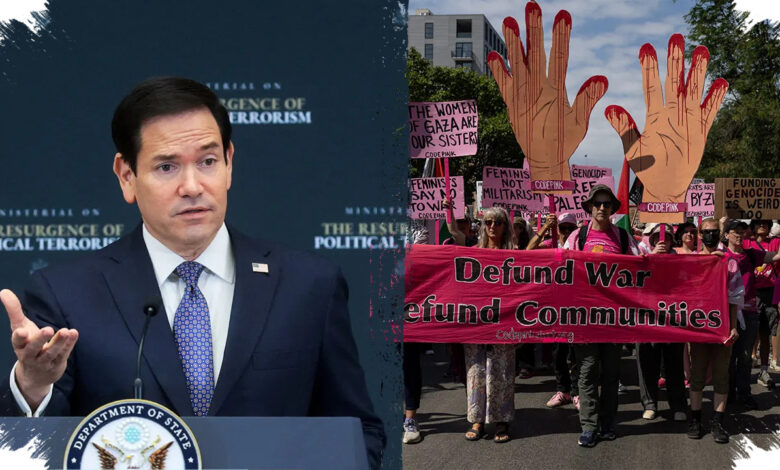
A State Department report says a U.S.-based coalition with ties to Cuba has published a plan to organize nationwide demonstrations within 24 hours of a U.S. military attack on the island, or an “imminent threat” of one. The document identifies federal buildings, military sites and immigration facilities as potential protest locations.
The report presents the plan as part of what it describes as a broader Cuban effort to build relationships with sympathetic American organizations. It does not announce sanctions or legal action against the U.S.-based groups discussed in the report.
A rapid-response timetable
The June “National Rapid Response Plan” was posted by the National Network on Cuba, a coalition representing more than 60 organizations. Its stated goal is to make it “politically and materially costly for the U.S. government to wage war on Cuba.”
According to the plan, the timing of a military action would determine when demonstrations begin. Organizers are told to mobilize supporters at 6 p.m. local time under the following schedule.
| Timing of U.S. military action | Planned demonstration time | Suggested locations |
|---|---|---|
| Before 3 p.m. Eastern time | 6 p.m. local time that day | Federal buildings, military sites, ICE facilities |
| After 3 p.m. Eastern time | 6 p.m. local time the following day | Federal buildings, military sites, ICE facilities |
The plan lists courthouses, post offices, military bases, recruiting offices, ICE detention centers and field offices as possible gathering points. It also names sports arenas during prominent events as optional sites for demonstrations.
Actions at immigration facilities are intended to “connect Cuba solidarity to anti-ICE/immigrant defense work happening nationwide,” according to the plan. It also directs activists to a Black Alliance for Peace database mapping 1,335 military and law-enforcement locations across the Western Hemisphere.
Groups named in the report
The State Department report focuses on the Cuban Institute of Friendship with the Peoples, known as ICAP, along with the National Network on Cuba, Code Pink, the People’s Forum, the Democratic Socialists of America and the National Lawyers Guild. It argues that overlapping delegations, campaigns and organizational relationships give Cuba access to a broad activist infrastructure in the United States.
ICAP is a Cuban government entity led by Fernando González Llort, who previously belonged to Cuba’s Wasp spy network and served 15 years in a U.S. prison before returning to Cuba. The report calls ICAP the central hub of Cuba’s international influence operation and says it coordinates more than 2,000 solidarity organizations in more than 150 countries.
The State Department links the National Network on Cuba to Havana through its relationship with ICAP. ICAP was sanctioned in June for allegedly supporting Cuban intelligence activities.
According to www.foxnews.com, the National Network on Cuba promotes the rapid-response plan as part of its “No War on Cuba” campaign. Its public materials also call for rallies, banner drops, caravans, teach-ins and other demonstrations.
Advocacy, travel and political ties
The report says the Democratic Socialists of America has sent multiple delegations to Cuba, including a 2023 trip in which members met privately with Cuban President Miguel Díaz-Canel and sought formal communication with Cuban ministries. It also says the organization was not created or controlled by Cuban intelligence, characterizing its support for Havana as primarily ideological.
The People’s Forum is described as an organizing hub that connects Cuba advocacy with anti-ICE and pro-Palestinian activism. The report says it has acted as fiscal sponsor for the Venceremos Brigade and helped organize delegations that met senior Cuban officials.
Code Pink and the National Lawyers Guild have also taken part in Cuba delegations and campaigns opposing the U.S. embargo, the report says. The National Lawyers Guild adopted a resolution in 2026 pledging to work with the National Network on Cuba and the wider Cuba solidarity movement.
Code Pink, the Democratic Socialists of America and the National Lawyers Guild’s Cuba Committee are listed among the coalition’s members, alongside the Communist Party USA and smaller organizations. The report says the specific role of each group in the rapid-response plan remains unclear.
Pressure on Havana and ongoing scrutiny
The report arrives as the Trump administration has intensified pressure on Cuba through tariffs and sanctions, alongside the long-standing U.S. trade embargo. Trump signed an executive order in January allowing tariffs on imports from countries supplying oil to Cuba, then followed with May sanctions aimed at foreign entities operating in or supporting key Cuban economic sectors.
Trump has discussed a “friendly takeover” of Cuba and said in May that “it looks like I’ll be the one that does it” when asked about intervention. Secretary of State Marco Rubio has said the administration prefers diplomacy while keeping military action on the table.
Code Pink has separately faced federal scrutiny connected to the financial network of Neville Roy Singham, the husband of co-founder Jodie Evans and a major benefactor of the group. A Manhattan federal grand jury is examining possible foreign-agent and tax violations involving Singham’s network, though Code Pink has not been publicly identified as a target and no charges have been filed.
The Treasury Department has also sought information from Code Pink co-founder Medea Benjamin about a March aid convoy to Cuba while reviewing potential sanctions violations. Code Pink has denied wrongdoing and said the delegation delivered humanitarian supplies during worsening shortages on the island.
The Cuban embassy in Washington could not immediately be reached for comment. Fox News Digital also sought comment from the National Network on Cuba, Code Pink, the Democratic Socialists of America and the National Lawyers Guild.