


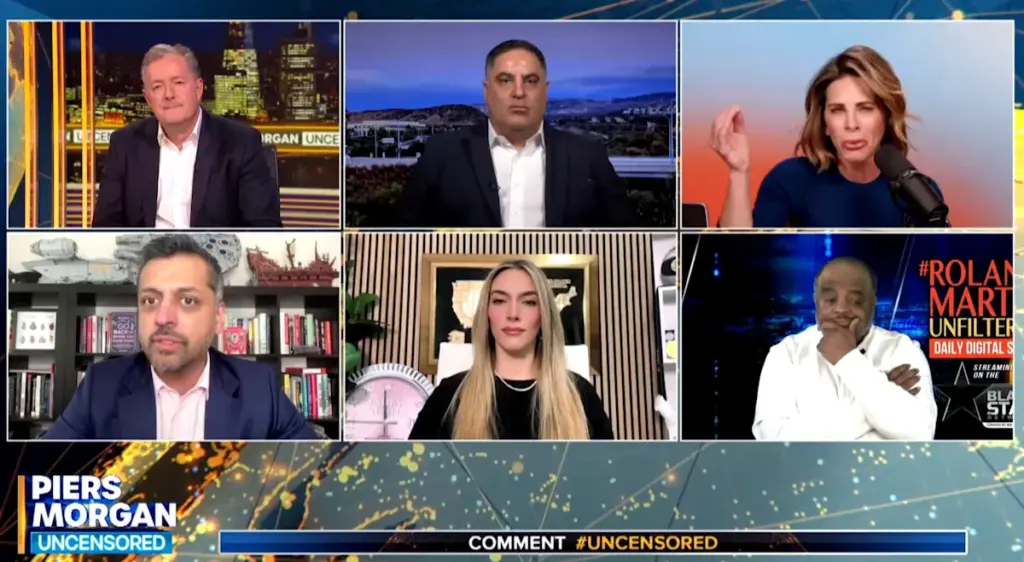
Fitness influencer Jillian Michaels disputed claims by New York Times opinion writer Wajahat Ali, who called her a “white nationalist” during a heated discussion on Piers Morgan Uncensored. The exchange followed Michaels’ comments on recent violent attacks by radical Muslims, including a massacre at a Hanukkah celebration in Australia.
Ali accused Michaels of making “hate-filled, stupid, reckless” statements about Muslims. He then insisted Michaels had previously admitted to being a white nationalist. Michaels expressed surprise and corrected him, saying, “You know I’m Arab, right? I’m Syrian and Lebanese and Turkish.” She asked Ali when she supposedly made such a claim.
When pressed, Ali could not produce any proof or clips to support his accusation. He admitted, “I’m under the mistaken impression you’re a white nationalist. I’m glad you’re not.” Michaels challenged Ali to “do a little homework” on the issue while laughing off the claim.
Earlier in the segment, Michaels defended concerns over Islamist terrorism. She noted the recent attacks in Australia and Syria and stressed that even if 1% of the world’s Muslim population sympathized with terrorism, that still represents 20 million people. Michaels said, “I think the alarm is about assimilation,” not migration, and argued these violent attackers do not represent the broader Muslim community of two billion people.
Ali responded by blaming former President George W. Bush’s War on Terror for “immense chaos” fueled by fear and mistrust similar to Michaels’ views. He further accused her of stoking Islamophobia and wanting to “get rid of all Muslim immigrants.” Michaels rejected these characterizations, stating, “We have to call out the people who want to destroy the West.”
This public confrontation highlights the intense debate surrounding Islam, terrorism, and identity politics. Michaels’ clarification about her heritage challenges the narrative Ali pushed publicly. The back-and-forth underscores the broader tension over how discussions on terrorism and Muslim communities are framed in media and public discourse.
Read more at: www.yahoo.com