


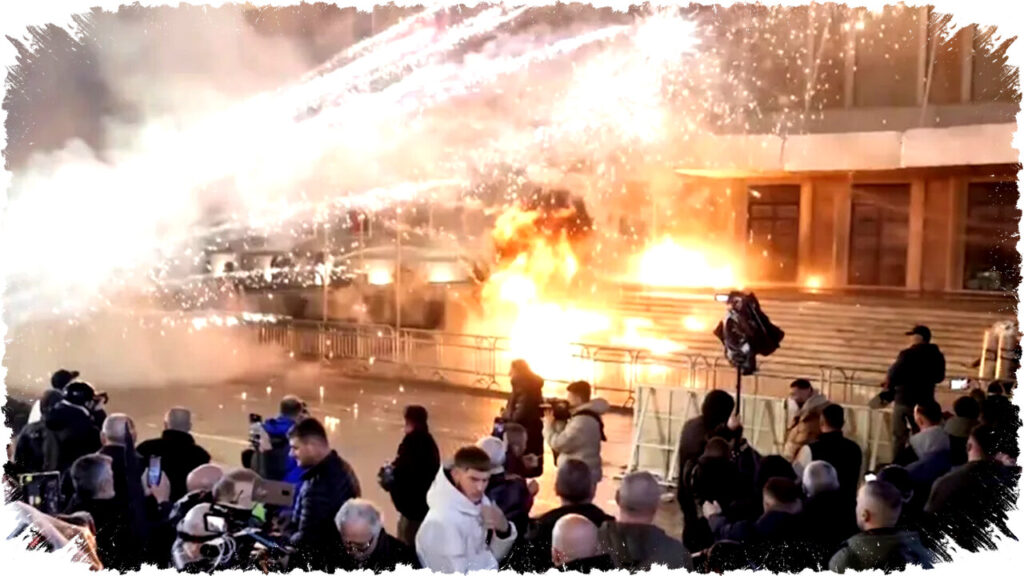
Thousands of protesters clashed violently with riot police outside government buildings in Tirana, Albania’s capital. This unrest followed a major corruption probe implicating top government officials.
The public outrage centers on Deputy Prime Minister Belinda Balluku, who was accused of manipulating a tunnel construction tender in southern Albania. A special prosecutor indicted Balluku for allegedly favoring a specific company, sparking immediate calls for her resignation from opposition parties.
Albania’s Special Court Against Corruption and Organized Crime suspended Balluku in November. However, Prime Minister Edi Rama challenged the suspension at the Constitutional Court, which reinstated Balluku in December despite the allegations.
Balluku denied all accusations, calling them “mudslinging, insinuations, half-truths and lies.” Despite protests, Prime Minister Rama has stood firm in keeping her in office, intensifying public dissatisfaction.
Political Backdrop of the Protests
According to Agim Nesho, a former Albanian ambassador, the protests underscore a growing backlash against Prime Minister Rama’s increasingly autocratic rule. Nesho explained Rama’s tenure is marked by centralizing power and allegations that public funds and institutions benefit politically connected networks.
The atmosphere is volatile, with protesters using rocks and Molotov cocktails against government offices. Security forces responded with water cannons and tear gas, escalating tensions.
Key Facts on the Protest and Corruption Allegations:
- Deputy Prime Minister Balluku is accused of corrupt interference in a public tender.
- Balluku was initially suspended by the anti-corruption court but reinstated by the Constitutional Court.
- Protests have included violent clashes and arrests, with over a dozen injured.
- The opposition Democratic Party claims the movement is peaceful and targets systemic corruption and autocratic governance.
- Albania ranks 91st out of 182 countries on Transparency International’s Corruption Perceptions Index.
These protests also highlight the weakening trust Albanians have in their institutions due to longstanding corruption scandals involving both government and opposition figures. This erosion of confidence affects judicial independence and the overall rule of law.
Impact on Albania’s European Union Aspirations
Albania has been an EU candidate country since 2014, aiming for closer integration with Europe. The 2025 European Commission report acknowledges some judicial reforms and progress against organized crime. However, controversies surrounding government corruption now complicate Albania’s EU membership prospects.
The United States has played a role in supporting Albania’s judicial reforms, including funding the Specialized Anti-Corruption Structure (SPAK). Despite this, experts warn that insufficient enforcement of legal reforms risks Albania sliding further toward authoritarianism.
Agim Nesho emphasized that both Brussels and Washington must take a firmer stance to uphold the rule of law in Albania. He cautioned that continued toleration of corrupt and autocratic practices could pull Albania towards Eastern-style autocracy instead of democratic integration.
Current Political Dynamics and Leadership Challenges
Sali Berisha, Albania’s former prime minister and leader of the opposition Democratic Party, has positioned himself as a key critic of Rama’s government. Although Berisha faces his own corruption charges and judicial supervision, he is pushing to unseat Rama and reclaim power.
Protesters supporting Berisha argue their actions are peaceful and focus on ending Rama’s authoritarian policies and restoring judicial independence. As reported by The Associated Press, around 16 protesters were treated for injuries with 13 arrests made during recent violent episodes.
This political turmoil comes amid prolonged struggles with government transparency and accountability. The Albanian public’s demand for democratic reforms and anti-corruption measures remains strong but faces significant institutional challenges.
The widespread demonstrations in Tirana illustrate mounting public frustration over entrenched corruption and governance issues. How the government addresses these accusations will likely influence Albania’s political stability and future trajectory toward European integration.
Read more at: www.yahoo.com