


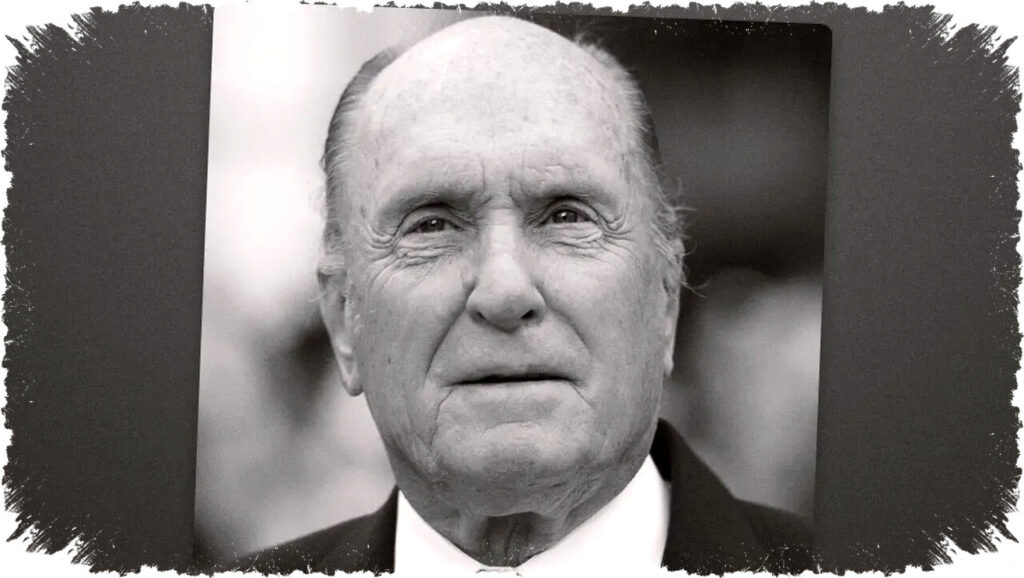
Robert Duvall, an iconic figure in American cinema, known for his unforgettable roles in The Godfather series and Apocalypse Now, has died at the age of 95. Duvall passed away at his home in Virginia, a place where he found peace away from the Hollywood spotlight, his wife Luciana confirmed.
Duvall’s career spanned decades, earning him seven Oscar nominations and one win for his portrayal of an alcoholic country singer in Tender Mercies (1983). His ability to embody complex characters with authenticity made him one of the most respected actors of his generation. Luciana described him as a passionate artist, deeply devoted to his craft and the human spirit his roles revealed.
Early Career and Breakthrough Roles
Duvall’s first major film role was the silent but enigmatic Boo Radley in To Kill a Mockingbird (1962), a part that sparked industry notice. Screenwriter Horton Foote, who greatly influenced Duvall’s career and penned several films featuring Duvall, personally recommended him for the role. This marked the beginning of a strong professional relationship with Foote.
Director Francis Ford Coppola played a pivotal role in catapulting Duvall to stardom. Coppola first cast him in The Rain People (1969) and later entrusted him with two iconic roles: Tom Hagen in The Godfather (1972) and The Godfather Part II (1974), and the fearless Lt. Col. Bill Kilgore in Apocalypse Now (1979). Duvall’s line from Apocalypse Now, “I love the smell of napalm in the morning,” has achieved legendary status in movie history. The intense scene was famously shot in a single take during a brief window of jet flybys in the Philippines.
Signature Roles and Critical Acclaim
Among his many roles, Duvall held a special affection for playing Augustus McCrae in the 1989 miniseries Lonesome Dove, based on Larry McMurtry’s Pulitzer Prize-winning novel. The role suited Duvall’s equestrian skills and resonated deeply with him. He once called it his Hamlet, underscoring the character’s importance in his career.
Duvall’s filmography is diverse, including roles in The Great Santini (1979), The Apostle (1997)—which he wrote, directed, and financed—and A Civil Action (1998). He portrayed a wide range of characters from a merciless Nazi in The Man Who Captured Eichmann (1996) to a small-town magistrate in The Judge (2015).
A Versatile and Dedicated Actor
Known for his intense preparation and ability to bring uniqueness to every role, Duvall avoided cliché performances. He famously described his approach as starting “from zero” to explore what happens naturally within a scene rather than forcing a predetermined outcome.
Alongside his film work, Duvall also contributed to the success of independent cinema, championing events like the Sundance Film Festival. His influence extended beyond acting into producing, directing, and writing.
Personal Background and Legacy
Born in San Diego in 1931, Robert Selden Duvall was raised on the East Coast due to his father’s military career. He studied drama at Principia College and further honed his craft at Sanford Meisner’s Neighborhood Playhouse in New York. Early friendships with aspiring actors Dustin Hoffman and Gene Hackman helped shape his career.
Despite his fame, Duvall remained a private figure who found joy in simple pleasures such as good food and music. His wife, Luciana, survived him. She acted alongside him in Assassination Tango (2002) and Wild Horses (2015).
Robert Duvall leaves behind a legacy of intense, transformative performances that have enriched American cinema. His contributions continue to inspire actors and filmmakers worldwide.
Read more at: www.hollywoodreporter.com