


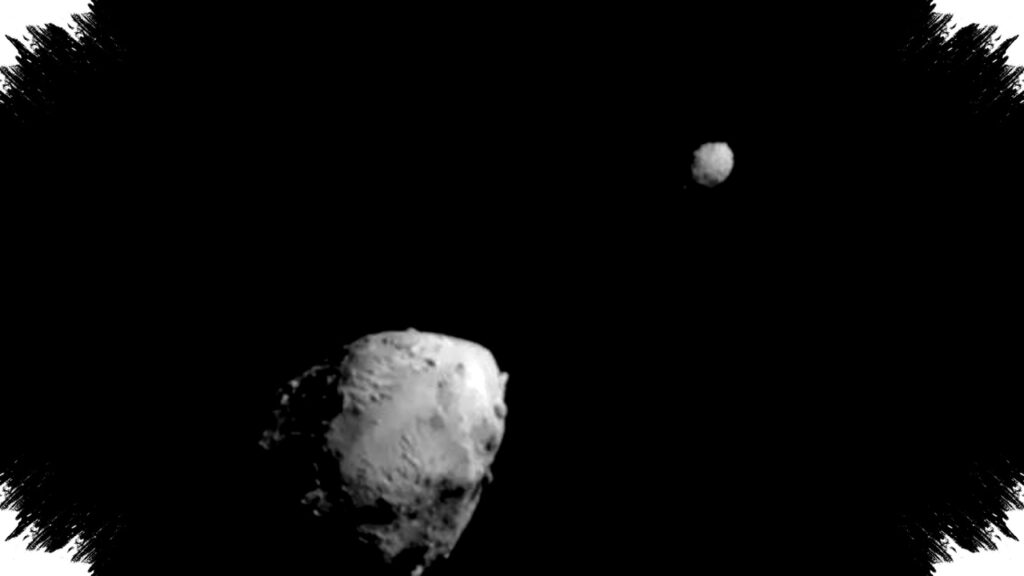
In 2022, NASA’s Double Asteroid Redirection Test (DART) spacecraft intentionally collided with the small asteroid Dimorphos, marking the first ever human-made alteration of a celestial body’s orbit around the sun. This planetary defense experiment aimed to determine whether humanity can effectively redirect potentially hazardous asteroids threatening Earth.
Dimorphos orbits a larger asteroid named Didymos, forming a binary system where both objects circle each other as well as the sun. Research published in Science Advances reveals that the DART impact not only changed Dimorphos’ orbit around Didymos but also slightly shortened the time it takes both asteroids to complete a single orbit around the sun.
Orbital Changes and Impact Dynamics
The binary system’s solar orbit period, which was approximately 770 days, decreased permanently by about 0.15 seconds after the impact. Dr. Rahil Makadia, a planetary defense scientist and lead author of the study, explained that the change in orbital speed was roughly 11.7 microns per second — a subtle shift that, over time, could determine whether such an object poses an impact risk to Earth.
The spacecraft’s collision caused a sizable release of debris weighing an estimated 16 million kilograms. Scientists observed that the momentum from this ejected rubble exerted a stronger influence on the asteroid system’s motion than the physical impact of DART itself. This phenomenon led to a faster orbit not only for Dimorphos but also for Didymos, altering the dynamics of the entire binary system.
Measuring Precise Orbital Adjustments
Researchers used a combination of ground-based telescopes and stellar occultation techniques to track the aftermath of the collision. Stellar occultations occur when an asteroid passes in front of a star, briefly blocking its light and enabling precise measurements of the asteroid’s position and velocity. Volunteer astronomers coordinated worldwide contributed to capturing 22 such events between October 2022 and March 2025.
Steve Chesley, co-lead author and senior scientist at NASA’s Jet Propulsion Laboratory, highlighted the challenges of these observations, emphasizing the importance of international cooperation and dedication among astronomy volunteers. Their meticulous work enabled the detection of minute changes in Didymos’ orbit around the sun with unprecedented accuracy.
Implications for Planetary Defense
While neither Didymos nor Dimorphos has ever posed a threat to Earth, this mission demonstrated that a kinetic impactor could successfully alter an asteroid’s trajectory — a critical capability for defending the planet if a hazardous object were detected early enough in the future. Thomas Statler, a senior scientist at NASA, praised the precision of the measurements, affirming that kinetic impact methods could be viable tools for planetary defense.
The European Space Agency’s Hera mission, launched in early 2024, is now en route to the Didymos-Dimorphos system to assess the impact crater and debris field created by DART. Hera will provide detailed observations and imaging expected later this year, offering further insights into the long-term consequences of the deflection experiment.
Meanwhile, NASA is developing the Near-Earth Object Surveyor mission, designed to detect and track dark asteroids that may be difficult to discover with Earth-based equipment. Improved detection coupled with deflection capabilities like those demonstrated by DART enhances global preparedness against future asteroid threats.
Key Data from the DART Impact on Didymos-Dimorphos System
- Orbit reduction time around the sun: ~0.15 seconds
- Momentum increase from debris: stronger than spacecraft impact alone
- Mass of debris released: approximately 16 million kilograms
- Previous orbit reduction of Dimorphos around Didymos: 33 minutes
- Number of stellar occultations used for measurements: 22 events across 2.5 years
This landmark experiment establishes a new era in planetary defense, illustrating how small but calculated changes in an asteroid’s orbit can yield significant protective benefits for Earth’s safety.