
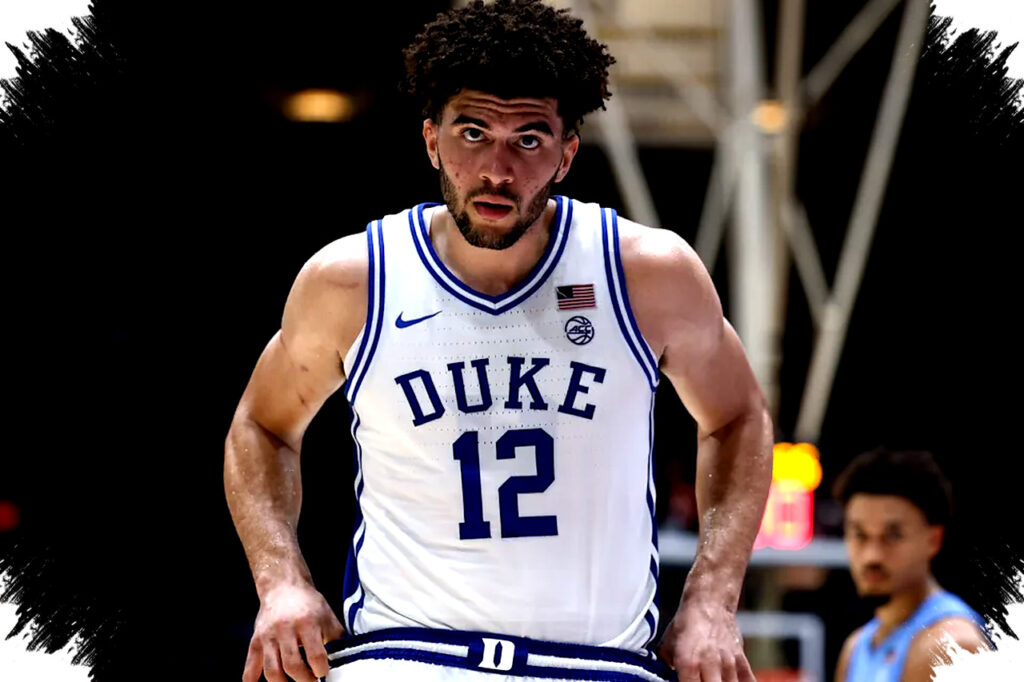
The 2026 NBA Draft class is attracting significant attention, particularly around the top three prospects: BYU’s AJ Dybantsa, Kansas’ Darryn Peterson, and Duke’s Cameron Boozer. Among these players, Boozer often ranks third, sparking debate about whether he should be in contention for the No. 1 pick. Despite his impressive stats, including 22.7 points, 10.2 rebounds, and 4.1 assists per game, several factors influence his draft positioning.
Boozer excels in scoring efficiency, sitting in the 94th percentile nationally, and ranks in the 100th percentile for Player Efficiency Rating (PER) and Wins Above Replacement Player (WARP). However, his limitations become clearer when analyzing his play style. Unlike the prototypical versatile stars sought after in the modern NBA, Boozer is mainly a power forward, lacking elite playmaking ability in transition and rim protection. His defensive impact is modest, having recorded only 17 blocks in 1,012 minutes.
Positional Constraints and Playing Style
At 6-foot-9 and 250 pounds, Boozer shares physical characteristics with established forwards like Paolo Banchero and Julius Randle. Yet, unlike these players, Boozer’s skill set is somewhat confined to one position without the multifaceted game that contemporary NBA stars often possess. His offense is strong near the rim, and he operates with high basketball IQ, especially in the pick-and-roll. He demonstrates an effective short roll game, where he can either make quick passes or attack the basket.
Moreover, Boozer displays efficient shot selection, shooting an impressive 40.7% from beyond the arc, which adds an important dimension to his offensive game. Nonetheless, his athleticism and ability to create plays off the dribble do not match the more dynamic wings in the draft, which impacts his potential as a primary offensive creator. Boozer is more suited to function as a secondary or tertiary playmaker rather than a franchise focal point.
Ideal Team Fit and Development Path
Boozer’s success at the professional level will likely depend on his fit alongside elite playmakers who can initiate offense. Playing off a star point guard, such as Tyrese Haliburton, would maximize Boozer’s impact as a frontcourt scorer and reliable secondary option. This role aligns well with his strengths as a physical, efficient finisher who excels with clear offensive roles and decision-making parameters.
While he is not projected to be a franchise-transforming centerpiece capable of leading a championship run independently, Boozer’s production and efficiency forecast a very solid NBA career. His ability to adapt within a defined role could accelerate his development, potentially positioning him as a Rookie of the Year contender. The context in which he generates his stats—balanced scoring, selective shot-taking, and solid playmaking—is critical to evaluating his true value.
Draft Position Considerations
Had Dybantsa and Peterson not been in the mix, Cameron Boozer would have been a strong candidate for the first overall pick. Nevertheless, given the presence of these other prospective superstars, Boozer being slotted third overall aligns with current assessments. He offers genuine All-Star upside and is anticipated to become a high-level NBA player, but his game does not yet exhibit the transcendent qualities that justify the No. 1 pick.
For franchises evaluating the 2026 draft lottery, it is essential to understand Boozer’s role clearly. He excels as a physical power forward capable of scoring and making plays within a structured offense but is not a dynamic, multi-positional creator. Teams seeking a foundational pillar for long-term championship aspirations may look elsewhere, whereas those aiming to build around complementary stars could find great value in Boozer’s skill set and approach.
Key Points to Consider About Cameron Boozer
- Stands out with efficient scoring near the rim and above-average three-point shooting (40.7%).
- Primarily a power forward with limited ability to defend multiple positions or protect the rim.
- Best suited as a secondary or tertiary playmaker within a team’s offense.
- Lacks elite transition creation but highly effective in the short roll and half-court sets.
- Physical playing style similar to Paolo Banchero and Julius Randle, marked by smart shot selection.
- Projected to be a productive NBA starter but not necessarily a franchise-leading superstar.
- Fits well alongside an established elite playmaker who can trigger the offense.
- Potential to contend for Rookie of the Year honors based on efficiency and immediate impact.
As the 2026 NBA Draft approaches, Cameron Boozer remains a compelling prospect with notable strengths and clearly defined limitations. While not the unanimous choice for the top pick, his combination of basketball IQ, scoring efficiency, and physicality make him an invaluable asset for teams prioritizing a complementary star player. Evaluators and front offices will need to balance Boozer’s high-level contributions against his narrower role when determining his place in the draft order.