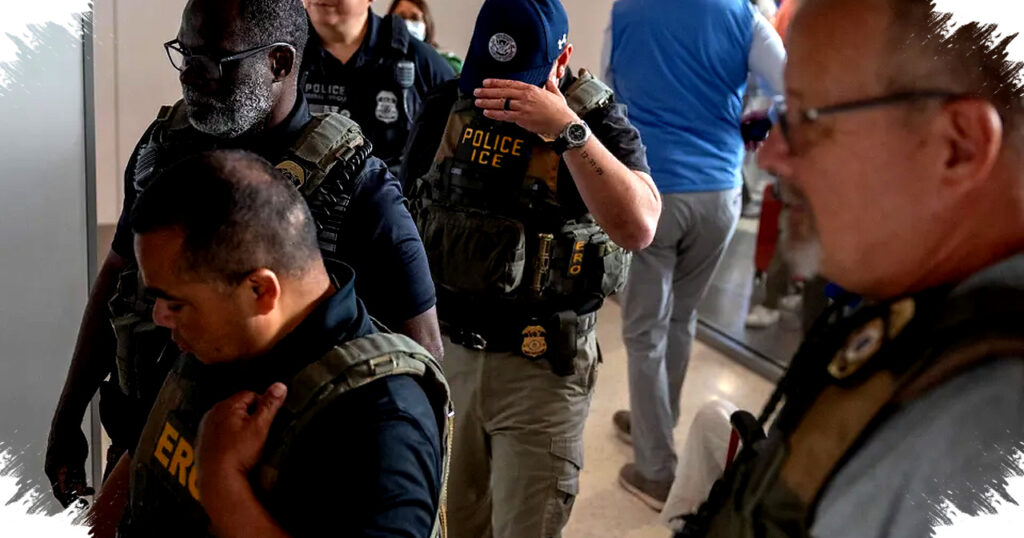
Former President Donald Trump recently instructed Immigration and Customs Enforcement (ICE) agents deployed at U.S. airports to remove their masks. This directive directly contradicted previous Republican claims that ICE agents needed masks to avoid being doxxed and targeted for their identities.
The deployment of ICE agents to 14 major airports came amid a Transportation Security Administration (TSA) staffing crisis caused by unpaid workers quitting or calling in sick. Despite this, Trump’s social media post urged agents to operate without masks, signaling a shift in the narrative around the need for facial concealment.
Questioning the Mask Justification
Republicans had argued that ICE officers wore masks to protect their anonymity from hostile elements who might photograph and harm them. However, Trump’s recent statement—the urging of "NO MASKS" at airports—called this justification into question. If the threat of doxxing were credible, agents would face the same risks inside the airports as elsewhere, making masks still necessary.
Most law enforcement officers in the country visibly show their faces along with name badges during their duties. The fact that many are publicly identified without issue has long indicated that ICE mask-wearing could be more of a political narrative than a security requirement.
ICE Agents’ Role Amidst TSA Shortages
Photos and videos from airports show ICE agents appearing with visible faces and engaging in minimal activity related to TSA functions. Their presence did little to alleviate long security lines, as ICE personnel lack the specialized training required to perform critical TSA screening tasks.
Everett Kelley, president of the American Federation of Government Employees (AFGE), emphasized that ICE officers are not trained in aviation security. TSA agents undergo extensive instruction and certification to detect explosives and weapons, skills that cannot be improvised or easily transferred. Kelley warned that deploying untrained personnel to security checkpoints might create more vulnerabilities rather than filling staffing gaps.
Political Implications of Mask Removal
The unmasking of ICE agents at airports undercuts a Republican argument that face coverings are indispensable for officer safety. Democrats have long called for ICE officers to reveal their identities, proposing reforms as part of broader homeland security discussions.
Democratic Representative James Walkinshaw noted the contradiction. If masks aren’t needed within airport environments, then the rationale for wearing them in community operations elsewhere weakens substantially. Walkinshaw stated, “We now know they don’t need the masks. That’s good news,” reinforcing calls for increased transparency.
Broader Impact and Context
The ongoing Department of Homeland Security shutdown has intensified operational challenges at airports. The presence of ICE agents at security checkpoints, despite their lack of specific expertise, has sparked criticism from labor unions and lawmakers. The move reveals tension between political messaging and practical realities facing federal agencies.
This episode illustrates how mask mandates for ICE officers have served political purposes beyond officer safety. Trump’s recent public position removes the guise of necessity and exposes inconsistencies in GOP statements about immigration enforcement tactics.
As airports continue to experience security staff shortages, reliance on untrained personnel raises concern over passenger safety and efficiency. The situation underscores the importance of addressing funding gaps and workforce stability within the Department of Homeland Security.
Ultimately, Trump’s directive for ICE agents to remove masks in visible roles at airports undermines previous GOP claims and intensifies scrutiny over the agency’s operational transparency and legitimacy.
Read more at: www.ms.now