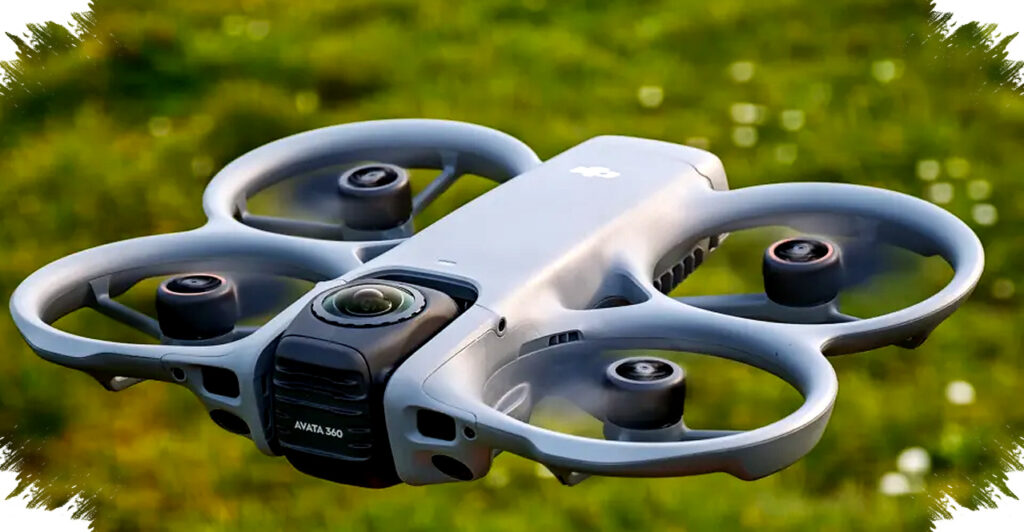
DJI’s Avata 360 drone arrives in a competitive and challenging market environment. It follows Antigravity’s A1, the first 360-degree drone released last December, thus positioning DJI as a late entrant in the 360 drone segment. Despite this, the Avata 360 offers distinct advantages that make it a compelling choice outside the US, where regulatory restrictions limit DJI’s drone sales.
Advanced Features and Design
The Avata 360 is a compact yet robust drone equipped with dual cameras capable of capturing 8K 360-degree photos and video. Unlike the A1’s fixed dual cameras, DJI’s dual lenses mount on a swiveling gimbal. This allows users to switch between full 360-degree recording and a traditional forward-facing first-person view (FPV) mode. This flexibility enables both immersive 360 capture and more conventional drone footage, broadening the drone’s use cases significantly. DJI’s drone supports recording at up to 8K resolution and 60 frames per second, surpassing the A1’s maximum 8K at 30fps, enhancing smoothness and clarity.
Control Options for Different Skill Levels
Control versatility is a hallmark of the Avata 360. Users can navigate the drone using several methods, including smartphone apps, a classic twin-stick remote controller, or the immersive goggle and motion controller setup. Beginners may prefer immersive 360 flying with motion controls that allow intuitive directional control with simple point-and-click commands. Meanwhile, more experienced pilots can use the twin-stick controller in single-lens mode for precise flight and camera control. In contrast, Antigravity’s A1 currently lacks twin-stick controller support.
Built-in Durability and Extended Flight Capability
The Avata weighs 455 grams, heavier than the A1’s sub-250-gram weight, which affects regulatory requirements globally. This additional weight contributes to a more durable build with fixed propeller guards integrated into the drone’s body, increasing its resilience during crashes or rough landings. The Avata also offers nearly double the A1’s maximum transmission range, reaching 20 kilometers under optimal conditions, plus a slightly faster top speed — 40 mph in sports mode. Both drones provide comparable battery life, with about 23 minutes for the Avata and 24 minutes for the A1.
User-Replaceable Lenses Enhance Longevity
A standout feature of DJI’s Avata 360 is its user-replaceable lenses. The outer glass on each main lens can be quickly removed and replaced using a simple kit provided by DJI, which includes essential tools and costs about $30. This design significantly improves the drone’s repairability and reduces downtime caused by minor lens damage, a practical upgrade that users appreciate, especially in rugged flying environments.
Pricing and Availability
Pricing for DJI’s Avata 360 is competitive. The drone alone starts at approximately $540, substantially less than Antigravity’s $1,599 bundle, which includes goggles and motion controllers. DJI’s Motion Fly More Combo, containing the RC Motion 3 controller, Goggles N3, and extra batteries, sells for about $1,100, still undercutting Antigravity’s pricing. However, adding DJI’s higher-end Goggles 3 would raise the total closer to Antigravity’s bundle price. While the Avata 360 is available now in China, shipments to other regions are expected to begin in April. DJI has no plans for an official US release, although the drone has FCC clearance, and users may purchase it through importers.
Software Experience and Editing Capabilities
DJI provides an app for editing 360 footage, allowing users to select specific angles and formats after flight. The interface is beginner-friendly for creating quick edits and highlights but may require practice to produce polished videos. However, the app currently lacks polish on Android devices, exhibiting stability issues and irregular screen orientation, which can impact the overall user experience. In comparison, Antigravity’s app is reportedly more refined despite being a newer offering.
Final Assessment
For drone enthusiasts outside the US, the DJI Avata 360 represents a valuable fusion of 360 filming capabilities and traditional FPV drone flexibility. It delivers higher video quality, improved flight performance, extensive control options, and better repairability at a more affordable price than the Antigravity A1. Although regulatory and market challenges limit DJI’s reach in the US, its Avata 360 stands as a significant, functional advancement in 360-degree drone technology for global users.
Read more at: www.theverge.com