


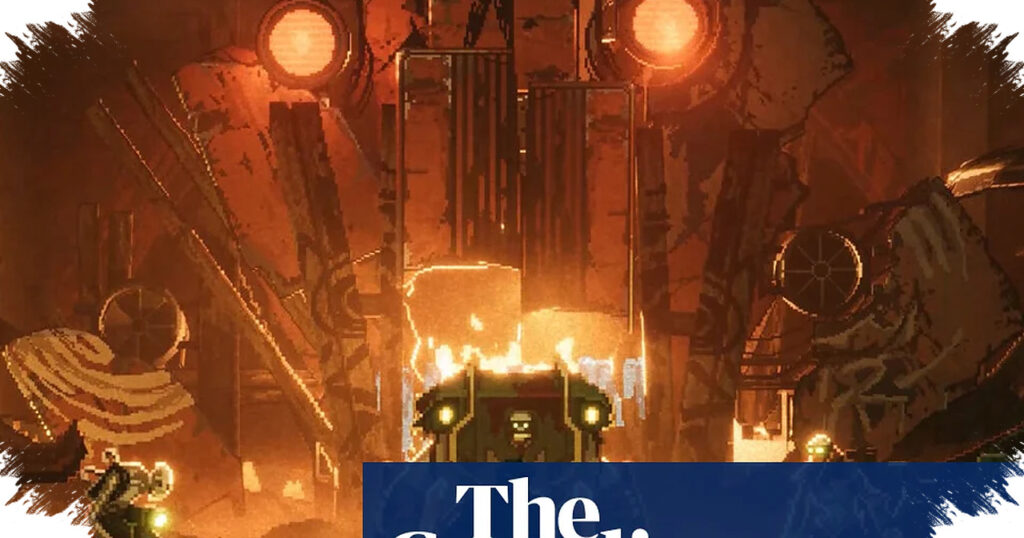
Replaced is a 2D action-platformer that wears its cyberpunk influences openly, from the mood of its ruined industrial spaces to the sleek hardware and corporate power at the center of its story. Yet its most striking trait is not its action or setting, but the soft, nostalgic look that turns a familiar dystopian genre into something warmer and stranger.
That visual choice gives the game a distinctive identity at first glance, even when many of its ideas feel borrowed. Alongside its pixel-art style, Replaced turns to sepia tones and gentle primary colours, especially in the crowded residential spaces, creating a mood that feels comforting rather than bleak.
A cyberpunk world with an unusual softness
Sad Cat Studios, the Belarus-based developer behind Replaced, uses the genre’s general language of steel, sprawl, and corporate control. But instead of leaning into the usual cold glare of cyberpunk, the game bathes its scenes in colour that feels almost nostalgic, as if a dystopian future had been framed through old illustrated postcards.
That contrast shapes the story from the beginning. Warren, a lanky scientist working on an AI for the Phoenix Corporation, becomes fused with the software after an accident in the lab, and the result is a panicked escape through a collapsing facility. The game quickly establishes movement as a core part of the experience, with Warren vaulting obstacles, climbing pipes, and dodging hostile forces in nearby woods.
The premise is straightforward, and the early hours follow a familiar action-platformer pattern. For a stretch, Replaced appears more interested in showing how well it can reproduce genre staples than in changing them.
Familiar combat and movement, with a few sharp touches
The game’s action sections place Warren in a trenchcoat, armed with a truncheon and handgun as he fights through dangerous spaces filled with goons and guards. The execution moves stand out most clearly, especially the close-range pistol finishers, which give the combat a harsh edge that fits the setting well.
Even so, much of the game’s structure feels broadly serviceable rather than inventive. Warren runs, shimmies, climbs, and slips through alleyways and industrial ruins in ways that will feel immediately recognizable to anyone familiar with the genre’s side-scrolling action formula.
The presentation can also become a practical problem. Some scenes are so densely detailed that interactive elements are harder to read, which weakens the flow of exploration. In a game that depends on movement and timing, that visual clutter sometimes works against it.
Where Replaced becomes more human
The strongest stretch comes when Warren reaches a refugee encampment built inside a disused train station. The pace slows, and the game lets the player move through a space that feels lived in, with displaced people trying to build ordinary lives in an abnormal world.
This section gives Replaced a wider emotional range than the early action stages. The camp is full of ordinary hardship, including poverty, shelter made from tents, and the uneasy protection offered by whatever light and warmth can be found beneath an unforgiving sky.
The game’s alternate 1980s United States setting becomes more persuasive here, especially in the details of weather and atmosphere. Acid rain, snowfall, and scattered lights in the camp combine to give the area a fragile, human scale that distinguishes it from the cleaner spectacle of the action scenes.
A striking wall that changes the meaning of the setting
One of Replaced’s most memorable moments comes when Warren returns to the heavily guarded facility at the center of the story. The route there moves through tall grass and boggy marshland while futuristic helicopters prowl overhead, ready to kill with a single shot.
Behind it all stands a massive wall, rendered as a dark and imposing shape. The game makes the image feel political as well as visual, and the barrier recalls real-world flashpoints such as the Mexico-US border wall and the West Bank barrier.
That moment matters because it pushes Replaced beyond simple genre imitation. For much of its roughly 10-hour run time, the game seems satisfied with remaking familiar cyberpunk imagery in polished pixel art, but this sequence gives the setting greater force and broader relevance.
It is here that the game’s prettiness gives way to something harsher. The image of a militarised wall, combined with the threat of instant death, makes the world feel less like an aesthetic exercise and more like a future that has already arrived.
Read more at: www.theguardian.com