


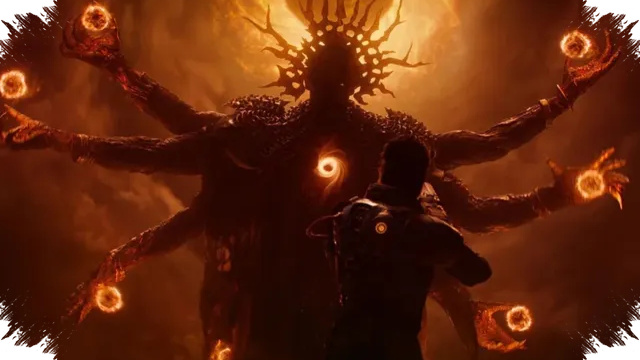
Saros stands out as a hostile, high-stakes sci-fi action game set on Carcosa, a planet that turns the familiar discovery-of-a-valuable-resource premise into something far more unsettling. The game follows Arjun, a soldier trying to survive relentless attacks, protect a lost love, and keep his sanity while a mysterious corporate mission pushes forward under AI control.
The result is a game that mixes dangerous combat with a bleak atmosphere and a story that stays intentionally opaque. It draws tonal inspiration from Robert W. Chambers’ The King in Yellow, but the core appeal comes from how Saros turns survival into a constant pressure test without losing momentum.
A planet built to feel wrong
Carcosa is not presented as a simple alien backdrop. It functions as an active threat, with monsters, lasers, and a creeping sense of madness shaping nearly every encounter.
Arjun is there with a scientific expedition, but the mission quickly becomes personal. The narrative suggests that saving one person matters as much as saving anyone else, although the game does not spell everything out clearly.
That ambiguity gives Saros a distinctive mystery, even if it can also make the cast feel distant. The recorded monologues found across Carcosa add to the unsettling tone, but they leave many questions unanswered on purpose.
Combat that demands attention
The strongest part of Saros is its action, which is described as precise, challenging, and consistently satisfying. Housemarque builds on the foundation of Returnal, but the systems here aim to feel more welcoming and more rewarding.
Movement is a major strength. Arjun jumps and dodges with sharp control, and the shooting feels powerful across the weapon set, with the Smart Rifle standing out as a likely favorite for many players.
A shield mechanic adds another layer to the combat loop. It can absorb certain enemy projectiles and convert that energy into stronger attacks, which creates more options during hectic battles and rewards quick decision-making.
Progression that softens the genre’s edge
Outside the firefights, Saros uses the Armor Matrix to make repeated runs feel meaningful. Between attempts, players can spend collected Lucenite and Halcyon on permanent upgrades, and the system gives clear benefits that support different playstyles.
The upgrade pace also feels noticeably fast. One strong run can unlock many improvements at once, which helps good attempts feel valuable and keeps failed runs from feeling wasted.
That design makes the game easier to approach than many rogue-style titles. For players who found Returnal intimidating, Saros appears built as a more forgiving entry point without giving up challenge.
Shorter sessions feel more practical
Saros also offers a structure that better supports shorter play sessions. Runs can be paused and returned to later, and players can use teleportation to reach specific locations at the cost of some power.
That choice reduces two common frustrations in the genre: repeating the same early areas and fighting the same bosses over and over. Bosses and starting-from-scratch runs are still available, but the option to skip some repeated content makes the experience feel more flexible.
This approach makes the game more accommodating for impatient or time-limited players. It also shows that Saros is trying to balance repetition with player convenience rather than forcing a rigid loop.
Story mystery versus emotional connection
The main narrative hook lies less in clear character development and more in atmosphere, tension, and unanswered questions. Team Echelon IV and the Soltari corporation frame the conflict, but the emotional payoff may not land equally for every player.
Even so, the world itself leaves a strong impression. The harshness of Carcosa and the coldness of the corporation create a setting that feels memorable, even when the characters remain somewhat underexplored.
That balance gives Saros a dual identity. Its story may not fully commit to emotional immediacy, but its gameplay, movement, and progression systems deliver a level of momentum that keeps the experience engaging from run to run.
Saros ultimately appears strongest when it embraces chaos, precision, and freedom inside a hostile alien world. The game’s blend of demanding combat, durable progression, and flexible run structure makes Carcosa feel like a place worth returning to, even when the story keeps its most important answers buried beneath the surface.