


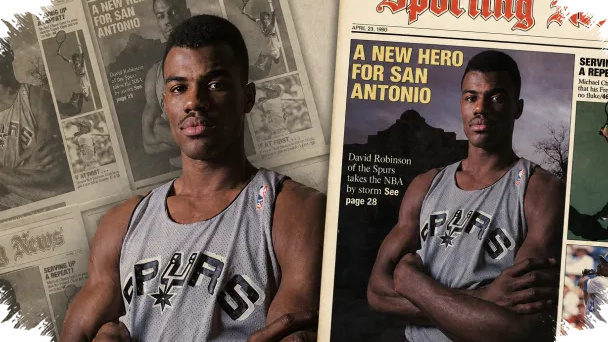
David Robinson’s rise gave the Spurs something the NBA had started to question: a true center who could still anchor a team from the middle. The long wait around his arrival looked worthwhile almost immediately, because he became San Antonio’s best player, one of the league’s top rookies, and a presence that changed how the franchise was viewed.
That change went beyond stats. Robinson helped revive a team that had been close to the bottom of the league, and he did it while the NBA was shifting toward perimeter stars and versatile forwards, which made his impact feel even more significant.
A center who arrived with doubts
Robinson entered the league with a complicated reputation. The Spurs had invested heavily in him after selecting the 1987 college player of the year from the Naval Academy, but they also had to wait through two years of military service before he could join the roster.
Those two seasons fed skepticism about whether he had been worth the gamble. Questions followed him from college, where critics wondered about his intensity and whether he had been overrated after Olympic and Pan American teams failed to win gold with him at center.
Robinson said he heard the doubts and could do little about them while he was still in uniform. Once he reached the NBA, he answered with production rather than argument.
Production that matched the hype
Through April 11, Robinson ranked 10th in scoring at 24.4 points per game, second in rebounding at 11.9, third in blocked shots at 3.9 and 13th in field-goal percentage at .533. Those numbers put him in the conversation with the league’s elite big men, including Houston’s Akeem Olajuwon and New York’s Pat Ewing.
His size did not define his game as much as his quickness did. Brown said Robinson still needed a reliable go-to move, but even as a rookie he already used speed to beat stronger centers down the floor and to create problems on both ends.
Robinson also accepted that the learning curve remained steep. Brown kept pushing him for more rebounds, more blocks and more intensity, while Robinson said he took the criticism as part of becoming better rather than as a burden.
The Spurs felt the effect immediately
Robinson’s value showed up far from the box score. Attendance at HemisFair climbed to a team-record average of 14,595, which was 92 percent of capacity, after falling to 8,462 the year he signed.
The Spurs also posted a 51-26 record through April 12 after going 21-61 the previous season. That put them in position to challenge for the Midwest Division lead and to threaten the franchise record of 53 wins.
The roster around him was still young, with two rookies and two second-year players in the starting lineup and only two holdovers from the previous season. Even so, the team looked transformed, and the turnaround made the Spurs one of the league’s most surprising stories.
Why Robinson fit the role so well
Robinson’s path to basketball was far from typical. He did not grow up chasing the sport, and as a youngster he preferred math, computers, and other activities that kept his mind busy.
He played several sports, including bowling, tennis and baseball, but he did not see himself as a future pro. Even at Navy, basketball initially felt like a distraction from his studies, and he stayed because he wanted a degree and valued the security that came with it.
That background seems to have shaped how he handled the NBA. Robinson described the two years away from competition as useful for maturity, and he said the experience helped him stay calm when coaches and opponents tried to unsettle him.
He also brought a personality that fit the league’s spotlight. Brown praised his ability to make people feel good, while Robinson handled media attention and autograph requests with ease.
A player still growing into his ceiling
Robinson’s own view of his season stayed measured. He said the team’s success mattered more than individual acclaim, and Brown agreed that the big center was still early in his basketball education.
That does not mean the potential was hidden. Robinson already understood that he could become a force in the middle, and his matchups with Ewing and Olajuwon reinforced that belief.
Brown continued to insist that Robinson needed a dependable scoring shot, whether it became a jump hook or a turnaround jumper. Even so, Robinson’s combination of length, speed and defensive presence gave the Spurs a foundation that few teams could match.
By the end of that rookie season, San Antonio had more than a promising player. It had a center whose arrival made the franchise relevant again, and one whose game suggested that the old idea of building around a dominant big man still had plenty of life left.