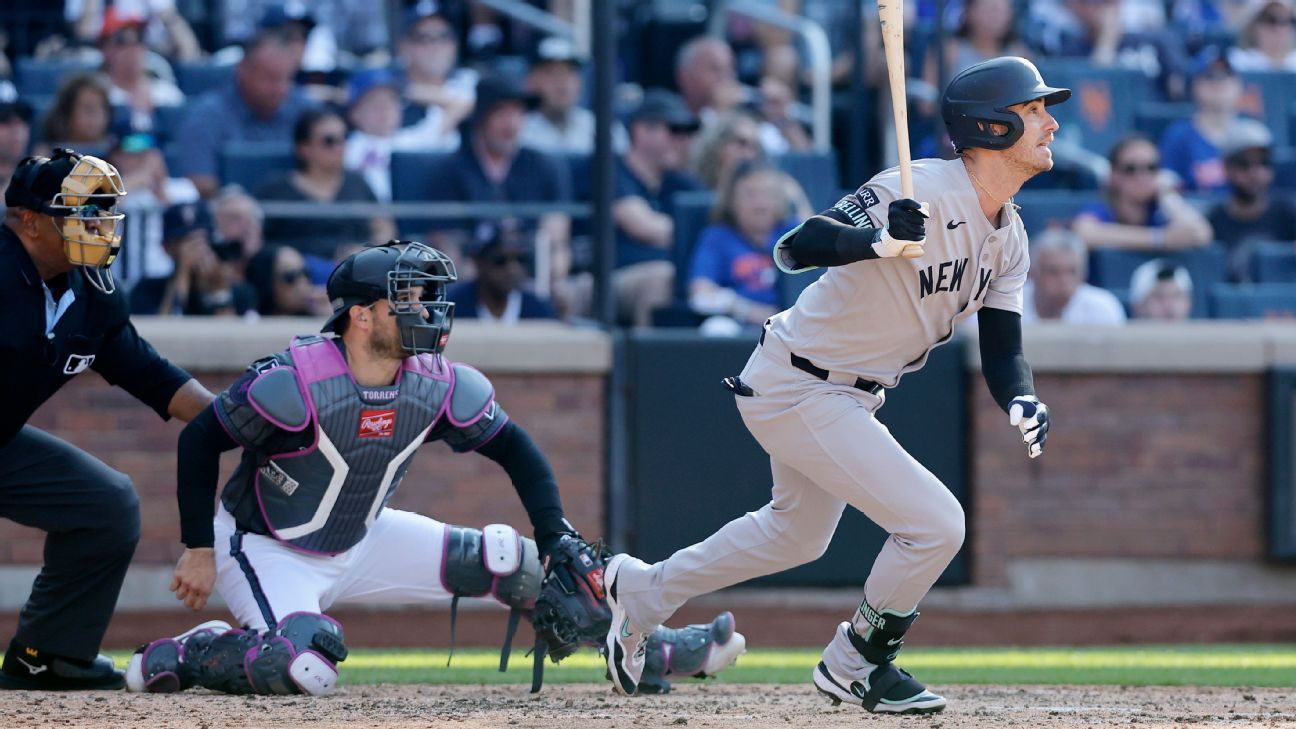
The first Subway Series of the season arrives with both New York clubs trending in opposite directions, and the numbers reflect that gap. The Yankees have leaned on elite starting pitching and a productive offense, while the Mets have been pushed down by injuries, underperformance and a roster reset that has yet to click.
That contrast has turned this weekend’s matchup in Queens into an early scorecard on two very different offseason plans. The Mets chose major change after last season’s collapse, while the Yankees kept most of their core intact after a 94-win campaign, and the early returns have been far kinder to the Bronx club.
The Mets’ makeover has been uneven
New York’s National League side entered the season with a new look built around a deeper overhaul of the coaching staff and roster. The idea was to replace last season’s breakdown with more balance, but the club has instead been dragged down by weak production in several key spots.
In FanGraphs’ projection through Wednesday, the Mets were seven games under .500 with a 28.6% chance of reaching the playoffs. They also sat last in the NL East, second to last in runs scored and near the bottom in wRC+ and OPS.
Some areas have improved
Center field has been one of the few encouraging spots, even though the path there has been unstable. Luis Robert Jr. was brought in as a high-upside answer at the position, but he went on the injured list April 30 with a herniated disk.
Even with that setback, Mets center fielders have produced a 98 wRC+, which ranks 12th in the majors. That is a sharp step up from last season, when six different players combined for a 71 wRC+ at the spot, and the team has already turned to 21-year-old A.J. Ewing for everyday duty after earlier patches from Tyrone Taylor and Carson Benge.
Starting pitching has also helped the Mets recover some value. Freddy Peralta, Clay Holmes and rookie Nolan McLean have formed a strong top trio, giving the club one of the better groups in the league despite weak support from the rest of the rotation.
Other changes have been costly
First base has been a major loss in value after the Mets moved on from Pete Alonso, who finished his run in Queens as the franchise home run leader. Jorge Polanco was signed to fill the position on a two-year, $40 million deal, but injury trouble quickly limited him to designated hitter duty and then sent him to the injured list with wrist issues on top of Achilles discomfort.
Second base has also slipped. Marcus Semien arrived in the Brandon Nimmo trade and was expected to help the defense, but his offense has stalled at a .224/.281/.306 line with two home runs and a 69 OPS+.
Third base has not brought relief either. Bo Bichette was signed to play the position, but injuries elsewhere pushed him to shortstop, leaving Brett Baty to carry much of the load at third. Mets third basemen have posted a 69 wRC+, which ranks 24th in the majors.
The Yankees have gotten what they wanted so far
The Yankees chose continuity after last season, and that approach has mostly worked. They entered this series with the second-best record in the American League, a 97.6% chance of making the postseason and a rotation that has been the best in baseball.
Their starting staff has been the biggest reason for the success. Cam Schlittler has emerged as one of the league’s best arms, Ryan Weathers has provided steady innings and Will Warren has added strikeout power. Max Fried and Carlos Rodón give the staff more upside once fully settled, and Gerrit Cole is expected to make his season debut later this month.
That group has offset some problems elsewhere and kept the Yankees in position for a strong June and beyond. Fried’s exit Wednesday with elbow soreness is a concern, but he said he is “not too worried,” and the Yankees still project as one of the deepest rotations in the majors if Cole returns as planned.
The Yankees’ offense has answered key questions
First base has turned into a clear success. Paul Goldschmidt and Ben Rice have split the role, and both have delivered strong production. Rice leads the majors with a .667 slugging percentage, a 1.079 OPS and a 197 OPS+, while Goldschmidt has hit .262 with four home runs and a .915 OPS in 70 plate appearances.
Shortstop has also improved. Jose Caballero exceeded expectations while filling in and posted a .305/.365/.495 line with four home runs and eight steals in 13 attempts across 29 games. He later broke his right middle finger, but manager Aaron Boone has said Caballero will return as the starter once he is ready. That is a strong sign for a position that had been a weakness with Anthony Volpe last season.
A few weak spots still remain
Second base has been quieter than hoped. Jazz Chisholm Jr. entered the year with big expectations after a 31-homer, 31-steal season, but he is batting .203 with four home runs and a .607 OPS in 171 plate appearances.
Catcher has also disappointed. Austin Wells has regressed offensively to a .180/.308/.280 line with three home runs, even though his framing remains elite. The Yankees may eventually need a right-handed hitting catcher if they want more balance there.
Designated hitter has been hit by injuries as well. Giancarlo Stanton went back on the injured list with a calf strain, and Jasson Dominguez later joined him with a shoulder injury after crashing into a wall in the outfield. Since then, Aaron Judge, Rice and Spencer Jones have rotated through the DH spot.
What the scorecard says before the Subway Series
The early verdict on these two offseason plans is clear enough for now. The Yankees kept their structure and have gotten elite pitching, top-end power and enough depth to remain a clear contender in a crowded American League race.
The Mets tried to fix multiple problems at once, but the turnover has exposed new issues and amplified old ones. Injuries have made the task harder, yet the broader problem has been production, with too many regulars failing to meet expectations and too few positions offering stability.
That makes this Subway Series more than a rivalry matchup in Queens. It is also a midseason snapshot of how two sharply different bets on roster building are working out, and the gap between the teams entering the weekend is as much about execution as it is about talent.
Read more at: www.espn.com