


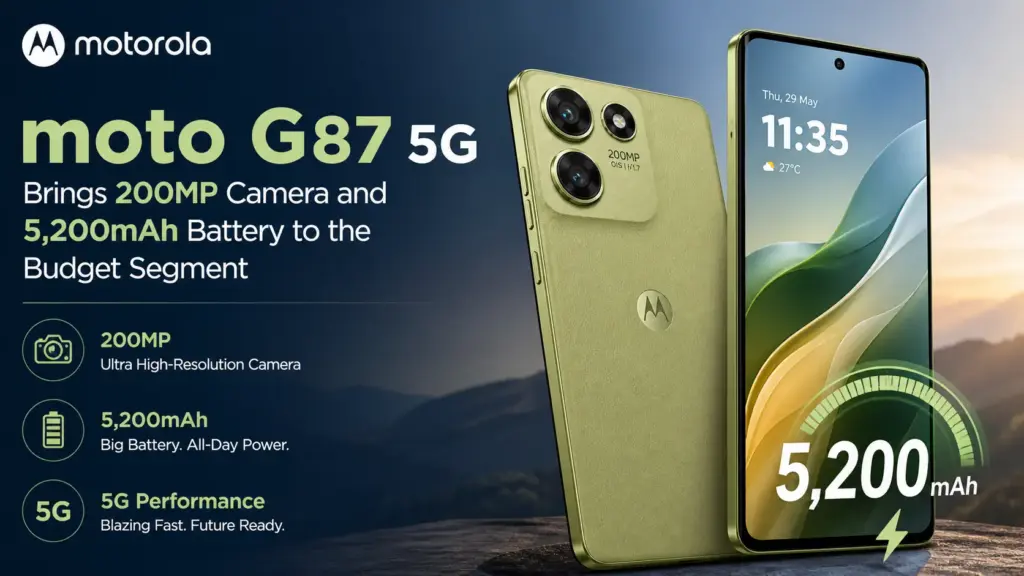
The smartphone race in 2026 is no longer defined by raw performance alone. Battery capacity, 200MP cameras, and AI features are spreading across more device classes, giving buyers far more choices than before.
That shift matters because flagship-level specifications are now showing up outside the premium tier. Users who care about photography, gaming, or everyday productivity can find more capable options across different price segments and usage needs.
Bigger batteries are becoming the new baseline
One of the clearest changes this year is the rise of large batteries in more phones, especially in the mid-range class. Several models already carry capacities between 6,000 mAh and 8,500 mAh.
That makes endurance a central selling point rather than a bonus feature. Manufacturers are also balancing these larger batteries with better power efficiency so long-term use remains comfortable.
AI is also becoming common across almost every product line. It is being used for camera optimization, smart power saving, and virtual assistants designed to respond more effectively to daily needs.
Samsung keeps the flagship pressure on
Samsung remains one of the companies pushing the high end forward through the Galaxy S26 Series. The lineup is said to use either the Exynos 2600 or Snapdragon 8 Elite Gen 5, depending on the market.
The phone uses a Dynamic AMOLED 2X panel with a 120Hz refresh rate. That combination is aimed at smooth performance for streaming, gaming, and other demanding tasks.
Samsung also highlights a main camera of up to 200MP with OIS. Generative AI support is included to help process photos and videos, showing how imaging on smartphones is increasingly tied to intelligent computation.
For endurance, the Galaxy S26 Series sits around 5,000 mAh. Samsung is also said to offer faster and more efficient charging than the previous generation.
Mid-range phones are getting premium camera hardware
Infinix is taking a more aggressive approach in the mid-range with the Note 60 Series. The lineup includes the Infinix Note 60, Note 60 Pro, and Note 60 Ultra.
The top variant is equipped with the MediaTek Dimensity 8400 Ultimate chipset. Its memory configuration is also large, with up to 12GB of RAM and 512GB of internal storage.
The camera setup follows the same ambitious direction. Infinix Note 60 Series brings a 200MP main sensor with AI photography support, reinforcing the idea that high-resolution imaging is no longer limited to premium devices.
Battery life is another strong point, with capacity ranging from 6,500 mAh to 7,000 mAh. That makes the series suitable for heavy use such as gaming, streaming, and long multitasking sessions.
Xiaomi, Oppo, and Realme take different paths
Xiaomi is sharpening competition through the Xiaomi 17 and Xiaomi 17 Ultra. The main focus is on visual efficiency and premium photography experiences.
Both devices are said to use LTPO AMOLED displays with adaptive refresh rates. This matters because the panel can adjust its refresh speed according to content, helping to balance smoothness and battery efficiency.
Xiaomi also keeps its Leica partnership in place. That collaboration remains an important selling point for users who want a stronger photographic character and a more serious imaging experience on a smartphone.
Oppo is following a different route with the Reno 15 Series. The lineup emphasizes a slim design while still aiming to improve low-light photography in a noticeable way.
Realme, meanwhile, is targeting users who care most about performance. Its latest GT series is aimed at gaming with a flagship-class chipset and a new cooling system.
That cooling system matters because high performance needs stable thermal control. With it, the chipset can maintain more consistent output during gaming or other heavy workloads.
Overall, the direction of 2026 smartphones looks more mature than before. Manufacturers are not only raising raw performance, but also refining the full user experience through AI, battery efficiency, smarter cameras, and more adaptive displays.
That is what makes the market more competitive and more useful for buyers. Options from Samsung, Infinix, Xiaomi, Oppo, and Realme now cover different priorities, from photography and gaming to daily productivity.