


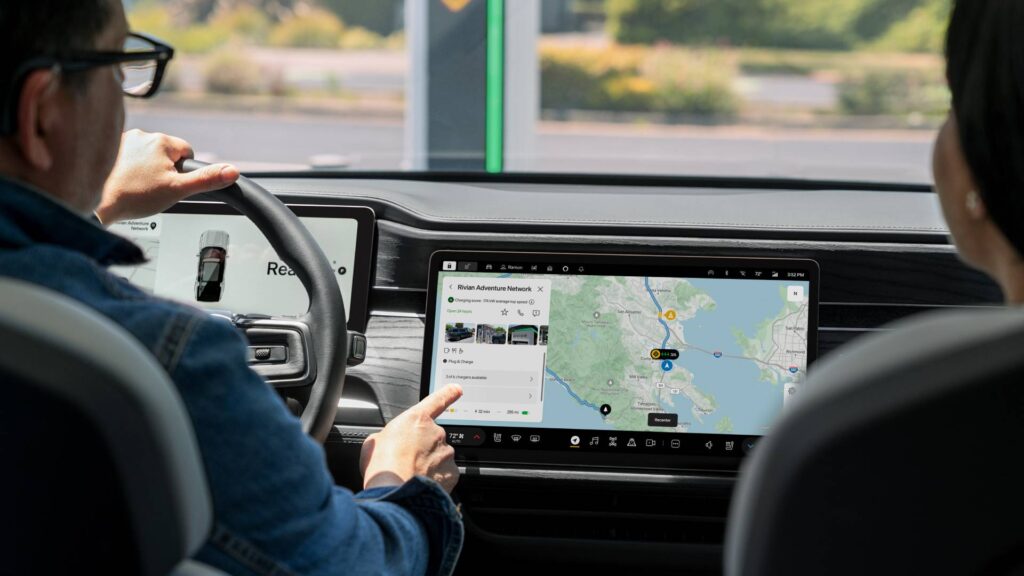
Rivian is sticking with its own software strategy, even as many drivers still expect Android Auto and Apple CarPlay to be standard features. The company continues to argue that a deeper in-car AI layer matters more than projecting phone interfaces onto the center display.
That position is especially notable as Rivian prepares for the launch of the R2 SUV on 9 June. Wassym Bensaid, Rivian’s head of software, said the company sees a future where more advanced AI inside the vehicle makes the debate over CarPlay far less important.
Rivian’s answer is its own assistant
At the center of that plan is Rivian Assistant, the company’s in-house digital co-pilot. Bensaid described it as a subscription service that is built directly into the vehicle rather than appearing as a mirrored phone interface on the main screen.
The system is designed to do more than answer basic commands. Rivian says it can adjust vehicle settings, summarize text messages from a paired phone, and handle troubleshooting questions that are specific to the owner’s vehicle.
Why Rivian is not chasing phone mirroring
For many car buyers, Android Auto and CarPlay remain attractive because they bring familiar apps into the cabin with little effort. Rivian is taking a different route by keeping full control of the software experience inside the car.
That approach gives the company more room to build features that are tailored to the vehicle itself. Rivian’s view is that this makes the cabin experience more cohesive and more capable than relying on a phone-first interface.
Bensaid also acknowledged that demand for CarPlay has been strong in the past among Rivian owners. He said an earlier survey showed more than 70 percent of customers wanted CarPlay, but a newer survey showed that figure falling to below 25 percent as Rivian’s own software improved.
AI still leaves room for outside services
Rivian is not closing the door on other AI systems entirely. Bensaid said Rivian Assistant may eventually work with another AI assistant such as Gemini to carry out certain actions on a user’s phone through voice commands.
That is a different model from Android Auto or CarPlay, which mainly move the phone experience into the vehicle. Rivian instead wants AI to sit between the driver, the car, and the broader app ecosystem.
When asked about the value of access to phone apps, Bensaid did not dismiss that need. He said the combination of Rivian Assistant and Gemini could still allow drivers to control certain apps with voice input.
A broader bet on in-car software
Rivian has long stood out in the U.S. market for holding back on Android Auto and CarPlay. The latest remarks from Bensaid make clear that the company has no immediate change of direction.
That stance sets Rivian apart from many automakers that treat the two platforms as close to mandatory. For those brands, the appeal is simple: drivers can move from phone to car without learning a new system.
Rivian is betting that a tightly controlled software stack will matter more in the long run. The company also appears to see internal technology as a key differentiator, including through its joint venture with Volkswagen, RV Tech.
In Rivian’s view, a more context-aware AI assistant could gradually reduce the need for Android Auto and CarPlay. The company is placing that bet just as it prepares to bring the R2 SUV into the market.
Source: www.androidauthority.com