
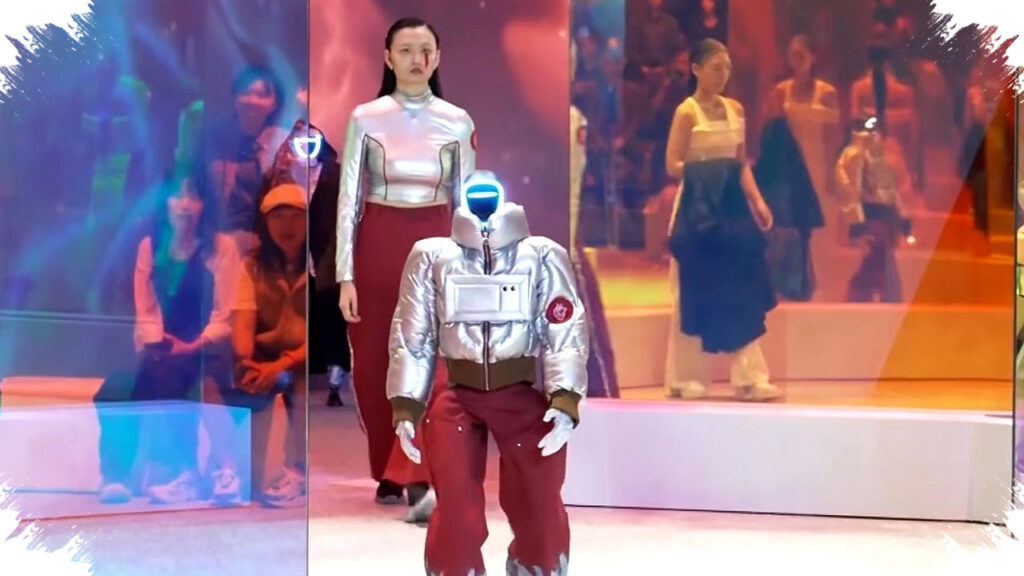
A fashion show in Seoul is asking a question that once sounded futuristic: if robots are becoming part of everyday life, should they also have their own style language? Galaxy Corporation used its latest runway presentation to explore that idea, placing humanoid machines beside human models in coordinated looks rather than treating them as background props.
The result was a presentation that shifted robots away from the usual image of productivity and automation. On the catwalk, the machines became part of a visual argument about identity, personality, and coexistence in public spaces that are cultural as well as practical.
Robots dressed as part of the concept
The show was built around matching outfits for humans and robots, with the aim of showing how biological bodies and mechanical bodies might exist side by side. One robot appeared in a blue cowboy-style outfit with a hat, while the human model walking with it wore a similar set.
That visual pairing made the concept easy to read from a distance. The robots were not placed on stage as decorative extras, but were integrated into the choreography alongside the human models with synchronized movement.
Designing for a mechanical frame
Galaxy Corporation said the clothing was not simply scaled down from human fashion. The collection was created specifically for the skeletal structure of robots, which meant the cuts and proportions had to suit mechanical forms rather than human anatomy.
Other looks in the show included a shiny silver jacket, a loose flowing dress, and oversized futuristic trousers. The overall styling leaned into dramatic silhouettes and an outer-space mood, turning the runway into an experiment in what fashion might look like when the wearer is no longer only human.
Fashion as identity for machines
Chief executive Choi Yong-ho said the company believes robots, like humans, need identity and personality. In that view, clothing becomes more than an accessory, because it helps distinguish one entity from another.
Choi also said robots need to wear clothes and that, just as each person is unique, each robot should also appear different. Galaxy Corporation used that idea as the conceptual base for the Seoul presentation, treating fashion as a way to define machines in public life.
Reuters reported that the company sees the direction of style moving both ways. In that future, humans could take inspiration from looks worn by robots, while robots could also adopt styles originally made for people.
From runway experiment to product plan
The collection is also intended to move beyond a one-night spectacle. Galaxy Corporation hopes to launch it later under the MACH33 brand, suggesting that the runway test is being developed into something with a commercial identity.
The humanoid robots on stage were made by the Chinese robotics company Unitree. Although their movement still depended heavily on preprogrammed actions, they remained convincing as part of a carefully timed performance with human models.
A wider push into public life
The fashion show fits into Galaxy Corporation’s broader effort to bring robots into mainstream entertainment. The company previously opened Galaxy Robot Park in Seoul, which it describes as the world’s first robot-themed amusement park.
Visitors there can watch robot performances, interact with robot dogs, and take part in robot boxing matches. That approach shows a clear attempt to place robots not only in workplaces, but also in leisure spaces and social experiences.
South Korea has increasingly become a stage for humanoid robots in public settings. Earlier this month, a humanoid robot named Gabi took part in a Buddhist ordination ceremony in Seoul and greeted visitors during the event.
Taken together, these appearances show a consistent shift in how robots are being presented. They are moving from technical tools to symbols with cultural presence, appearing in places as different as temples and fashion runways while entering conversations about expression, style, and identity.